
What Food Choices Are a Matter of Life and Death?
by Bill Misner, PhD1
Few dare to dream methods for resolving the health-care issues facing America. One best-selling author, T. Colin Campbell, after he completed the most comprehensive scientific study of nutrition ever conducted, argues that most health issues can be resolved by simply changing from animal-derived foods to plant foods.2,3 Is then our food choice either culprit or solution? Several esteemed clinicians, rather than dispute Campbell’s findings, assigned patients suffering with heart disease, cancers, diabetes, and autoimmune diseases, a strict plant food menu. Nearly all subjects progressed so well that they were taken off their previously prescribed medications. Each clinician observed that patient compliance application of the plant food protocol is required for attaining results. Of those patients whose health returned from consuming plant foods, once they “cheated” by adding a small portion from animal-derived food, their original complaint returned. If a plant food intervention improves health, longevity, and resolves the health issues afflicting our modern industrialized society, examination to determine efficacy is rational.
Animal-derived foods have been identified as the active agents responsible for initiating disease in The China Study.2,4 Here Campbell presents remarkable evidence for resolving the health-care issues that plague our modern society. Five statements merit review:
-
Dietary animal-protein volume is associated with increased cancer risk.
-
Dietary animal-derived protein volume % effects cancer risks.
-
Dietary animal-derived protein volume % effects heart disease and diabetes risks.
-
Plant food diet prevents and reverses diabetic death.
-
Plant food diet prevents and reverses heart disease death.
-
Plant food diet increases metabolism [BMR] & decreases BMI, while animal foods decrease BMR and increase BMI.
#1 – Dietary animal-protein volume is associated with increased cancer risk.
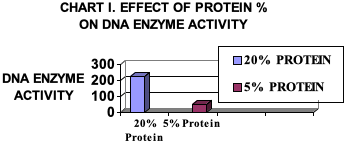
Researchers gave rats a high dose of a known, potent carcinogen, aflatoxin, and fed them differing amounts (% total calories) animal-derived milk protein (Chart I).5–7
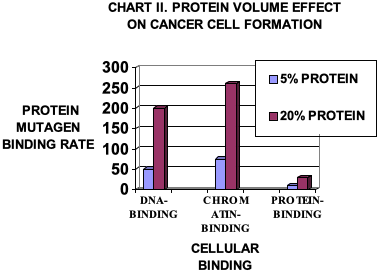
When rats consumed 5% of total calories from animal-derived milk-protein, only 1/5th DNA-enzyme activity resulted, compared to that from consuming 20% milk protein.8 The higher 20% milk protein total calories increased DNA-enzyme activity, which in turn increased DNA-binding, increased chromatin binding, increased protein binding, increased mutagen activity, resulting in cancer cell formation. Cancer cell formation, therefore, is more closely associated with the amount of animal-derived milk protein consumed than the known cancer-cell precursor carcinogen aflatoxin (Chart II):
#2 – Dietary animal-derived protein volume % effects cancer risks.
Campbell (1982) confirmed that low 5% milk-protein diet as compared to a high 20% protein diet decreases mutagenic effects and reduces the rate of precursor cancer cells formed9:
-
-72% in DNA-binding
-
-68% in chromatin-binding
-
-66% in protein-binding
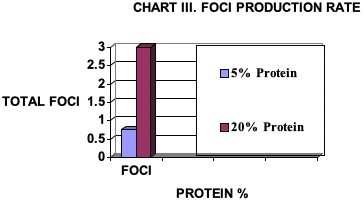
They observed that the amount of milk protein calories consumed increases the amount of aflatoxin entering the cell, resulting in an increase in cell mitosis [cell reproduction] and mixed function oxidase enzyme activity (enzyme growth factor). A higher intake of animal-derived milk protein calories combined with exposure to aflatoxin, a potent carcinogen, increases the rate of cancer cell precursors, called foci. Foci production increases proportionately with each percent of milk protein calories consumed (Chart III)
10
:
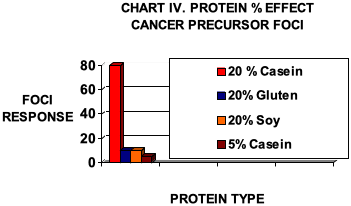
Similarly, Madhavin and Gopalan discovered that after rats were given Aflatoxin, with a 20% milk protein calorie diet, 100% of them died from liver cancer within their 100-week lifespan, while those consuming Aflatoxin with a 5% milk protein calorie diet survived, not one contracted liver cancer during their 100-week lifespan.11 From review of the Madhavin & Gopalan research, Campbell et al. (1989) identified which and how much dietary protein calorie amounts were associated with an increased carcinogenic effect.12 Animal-derived dairy milk is 87% casein, a protein that supports growth in a newborn calf, not rats. When 20% of protein calories originate from cow’s milk, the resultant cancer growth in rats was determined by measuring foci response. Interestingly, no cancer growth occurs when 20% of the protein calories originate from plant proteins (wheat or soy), or, if the animal-derived dairy milk protein content is restricted 5% of the total calories consumed (Chart IV). One interpretation is that one dietary protein formula known to support infant growth in one species may increase the risk of toxic consequences when chronically consumed by another species.
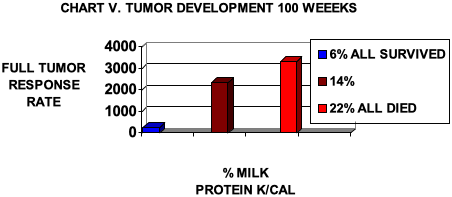
When researchers feed high- and low-protein diets with aflatoxin to rats over an expected 100-week life span, full tumor development occurred in the high-casein protein diet, but not the low-casein protein diet. Rats consuming a low 6% milk-protein diet all survived after 100 weeks, while rats consuming a milk-protein diet after 100 weeks all died (Chart V).
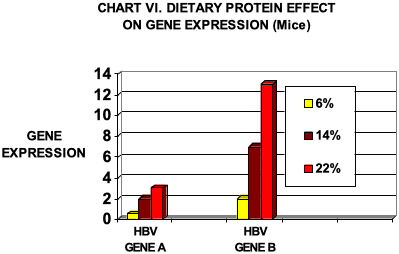
Aflatoxin’s carcinogenic effect appears to be activated by a “growth” property from casein, an animal-derived protein produced by a cow for the calf’s growth during infancy. The amount of and type of protein consumed determines whether or not a carcinogenic effect occurs. Hu et al. (1997) also identified another mechanism that relates to a strikingly similar effect related to dietary protein volume % on cancer cells associated with hepatitis B virus (HBV) infection. A piece of HBV virus inserts itself into a genetic piece in liver cells, resulting in liver cancer. Mice (not cows) infected by HBV, those consuming a higher volume of animal-derived protein increased proportionately elevated expression of HBVGENE-A & GENE-B (Chart VI)13:
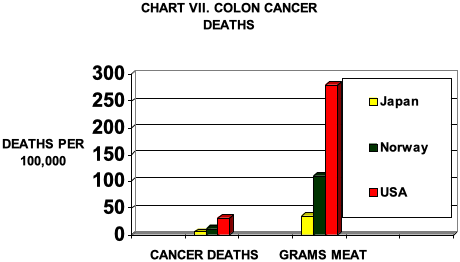
The amount of “animal” meats consumed has been associated with human-female colorectal cancer deaths (Chart VII)14:
#3 – Dietary animal-derived protein volume % effects heart disease and diabetes risks.
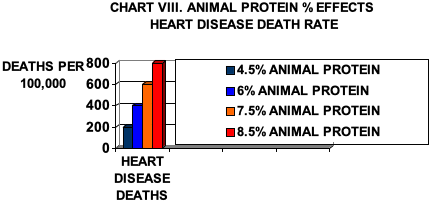
Protein (animal-source) has been associated with heart disease death rate. Joliffe & Arthur (1959) reported significant statistical associations between coronary heart disease death and animal protein intake.15 As animal protein consumption increases, the rate of heart disease deaths per 100,000 increases (Chart VIII):
The Question
: If disease and death were associated from eating too much animal-foods, what would be the preventative effects in those whose diets consist only of plant-foods with no animal-derived foods?
#4 – Plant food diet prevents and reverses diabetic death.
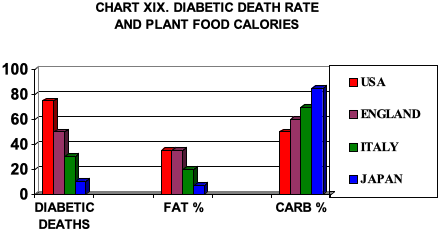
Hinsworth reported (1935) that in countries where plant-foods are consumed most (Japan), death from diabetes occurs less as compared to countries (US) where animal-foods are consumed most (Chart XIX).16
#5 – Plant food diet prevents and reverses heart disease death.
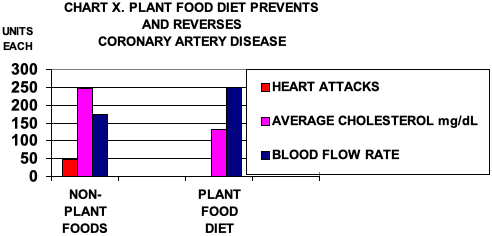
Esselstyn and colleagues reported similar but highly remarkable associations between the effects of a long-term plant-food diet reversing progressive coronary artery disease in human subjects (Chart X)17:
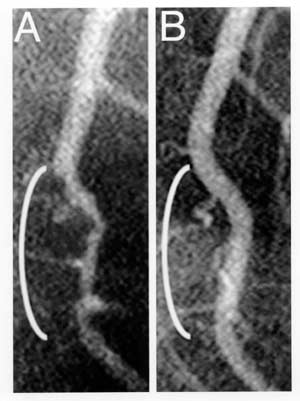
When a plant food diet is strictly adhered to, coronary artery disease is reversed; Esselstyn demonstrated this by a before-and-after angiogram of a subject after only 32 months on a plant food diet (below)18:
Figure 1: Coronary angiograms of the distal left anterior descending artery before (A) and after (B) 32 months of a plant-based diet without cholesterol-lowering medication prove profound improvement:
Plant Food Diet Decreases Atherosclerosis Deaths
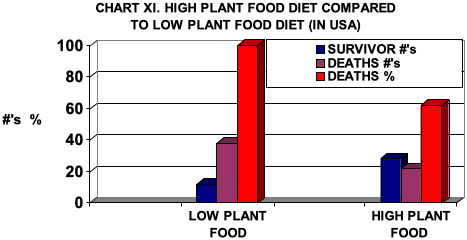
The plant food diet has been associated with increased survival rate. In a country where a plant food menu is not practiced (US), death rate increases and number of survivors decreases. Morrison compared the death rate numbers related to consuming the typical American diet or eating a plant-food diet (reduced cholesterol and fat) for 8 years. He concluded that survival rate was remarkably higher due to consuming plant foods (Chart XI)19:
#6 – PLANT FOOD DIET INCREASES METABOLISM [BMR] & DECREASES BMI, WHILE ANIMAL FOODS DECREASE BMR AND INCREASE BMI.
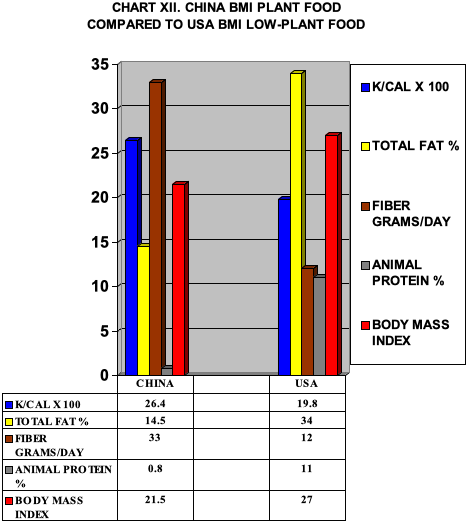
We are what we eat and to a large extent; food choices make calories contribute to either positive or negative effects on body mass. Campbell compared how diet effects body mass index eating either a plant-food diet (China) or not eating a plant food diet (USA). 20 (Chart XII.)
PLANT FOOD MENU INCREASES BASAL METABOLIC RATE [BMR]
The comparison of Chinese calorie intake of 2640 k/cal from largely plant-foods create a body mass index of 21.5 as compared to Americans’ calorie intake of 1980 k/cal per day that results in a body mass index of 27, which demonstrates that vegetarians have a higher basal metabolic rate than people who live on primarily animal-source calories. Campbell discovered that rats fed vegetarian diets or a low 5% protein exercised 200% more on training wheels than those rats whose diets were from high protein from animal sources. 21 Poehlman (1988) also reported that vegetarians record much higher metabolic rates than non-vegetarians. 22 Further evidence of higher basal metabolism is observed as weight loss in subjects changing from animal source to a plant-food menu (Chart XIII.) 23
CONCLUSIONS
The conclusions from T. Colin Campbell’s book, The China Study 24 are:
-
DIETARY PROTEIN VOLUME IS ASSOCIATED WITH INCREASED CANCER RISK 25.
-
ANIMAL-DERIVED PROTEIN VOLUME % EFFECTS CANCER RISKS.
-
ANIMAL-DERIVED PROTEIN RATE IMPACTS HEART DISEASE AND DIABETES DEATH RATE.
-
PLANT FOOD DIET PREVENTS AND REVERSES DIABETIC DEATH.
-
PLANT FOOD DIET PREVENTS AND REVERSES HEART DISEASE DEATH.
-
PLANT FOOD DIET INCREASES METABOLISM [BMR] & DECREASES BMI, WHILE ANIMAL FOODS DECREASE BMR AND INCREASE BMI.
These statements illustrate the importance of plant foods choice for vigorous health and quality of life. Humans at birth up to 2-years age require no more than 5% protein-calories from mother’s breast milk for growth, questions the need for foods derived from animal-sources. If the caloric excess proteins and fats derived from animal-foods enhance the onset of heart disease, cancers, diabetes, and autoimmune diseases, then the lower protein plant-food diet producing health with no provocative consequences deserves serious consideration. Individual compliance is the largest obstacle to be overcome, but once achieved, a plant-food lifestyle is a well-advised intervention that may resolve a majority of the health-care issues in the USA.
Notes
1.
AAMA board-certified alternative medicine practitioner discloses no competing interests.
2.
Campbell TC. Campbell TM. The China Study. Benbella Books. Dallas, Texas.
3.
Animal-derived foods are identified as calories originating from any living creatures (cattle, dairy milks, poultry, livestock, and fish).
4.
Campbell TC. Campbell TM. The China Study. (2006) Benbella Books. Dallas, Texas.
5.
Campbell TC. “Influence of nutrition on metabolism of carcinogens {Martha Maso Honor’s Thesis).” Adv. Nutr. Res. (1979): 29-55.
6.
Appleton BS. Campbell TC. “Inhibition of Aflatoxin-initiated preneoplastic liver lesions by low dietary protein.” Nutr. Cancer 3 (1982) 200-206.
7.
Dunatf GE. Campbell TC. “Relative contribution of dietary protein level and Aflatoxin B1 dose in generation of presumptive preneoplastic foci in rat liver.” J. Natl. Cancer Inst. (78) (1987): 365-369.
8.
Preston RS. Hayes JR. Campbell TC. “The effect of protein deficiency on the in vivo binding of aflatoxin B1 to rat liver macromolecules.” Life Sci. 19 (1976):1191-1198.
9.
Appleton BS. Campbell TC. “Inhibition of Aflatoxin-initiated preneoplastic liver lesions by low dietary protein.” Nutr. Cancer 3 (1982) 200-206.
10.
Dunaif GE. Campbell TC. Relative Ccontribution of dietary protein level and Aflatoxin B1 dose in generation of presumptive preneoplastic foci in rat liver. J. Natl. Cancer Inst. (78) (1987): 365-369.
11.
Madhavin TV. Gopalan C. “The effect of dietary protein on carcinogenesis of Aflatoxin.” Arch. Path. 85 (1968): 133-137.
12.
Schulsinger DA. Root MM, Campbell TC. “Effect of dietary protein on development of Aflatoxin B1-induced hepatic preneoplastic lesions.” J. Natl. Cancer Inst. 81 (1989) 1241-1245.
13.
Hu J. Cheng Z. Chisari FV, et al. “Repression of hepatitis B virus (HBV) transgene and HBV-induced liver injury by low protein diet.” Oncogene 15 (1997): 2795-2801.
14.
Armstrong D. Doll R. “Environmental factors and cancer incidence and mortality in different countries with special references to dietary practices.” Int. J. Cancer 15 (1975): 617-631.
15.
Joliffe N. Arthur M. “Statistical associations between international coronary heart disease death rates and certain environmental factors. J. Chronic Dis. 9 (1959): 636-652.”
16.
Hinsworth HP. “Diet and the incidence of Diabetes Mellitus. Clin Sci 2 (1935): 117-148.”
17.
Esselstyn CB. Ellis SB. Medendorps SV. et al. “A strategy to arrest and reverse coronary artery disease: a 5-year longitudinal study of a single physician’s practice. ” J Family Practice 41 (1995): 560-568.
18.
Ibid.
19.
Morrison LM. “Diet in atherosclerosis.” JAMA (1960): 884-888.
20.
Campbell TC. Campbell TM. The China Study. Benbella Books. Dallas, Texas. pp74.
21.
Kreiger E., Youngman LD., Campbell TC., “The modulation of Aflatoxin (AFB1) –induced preneoplastic lesions by dietary protein and voluntary exercise in fischer rates. FASEB J. 2 (1988): 3304 abs.
22.
Poehlman ET., Arciero PJ., Melby CL. et al. “Resting metabolic rate and postprandial thermogensis in vegetarians and nonvegetrarians.” Am J. Clin. Nutr. 48 (1988): 209-213.
23.
Campbell TC. Campbell TM. The China Study. Dallas, TX: Benbella Books:139.
24.
Ibid.
25.
High intake 20% milk protein calories [but not 5%] increased DNA-enzyme activity, DNA-binding, Chromatin-binding, protein-binding, and mutagen activity in cells, which increased the risk of cancers.







0 Comments