
There Is
a
Treatment
for
Ebola
by Walton Ferris
83walton@gmail.com
There is a treatment for Ebola, and other viruses. Try it.
It is safe, inexpensive, available, nonspecific, and unlikely to breed resistance.
It is the inducing of a high enough level of the ascorbate ion in one’s plasma, often enough, and for long enough.1–5
Normal levels of ascorbate in the well-fed are 34 to 114 umol/L but are quickly used up by an infection.30 Normal levels in the poorly fed are likely under 40 umol/L. The kidneys flush ascorbate levels above 80 umol/L in a few hours.
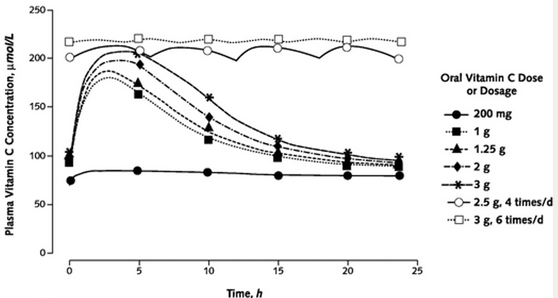
Maximum levels with repeated oral intake are 220 umol/L, and may provide some resistance to infection.7 Achieved by 2 or 3 grams of ascorbic acid or sodium ascorbate every four hours – or 12 grams in a water bottle drunk through the day. Repeated oral intake of liposomal ascorbate may achieve continuous levels above that.
Treatment of symptoms needs thousands of umol/L, and maintaining that level until resolution, achieved regularly by IV of sodium ascorbate in doses of 20 to 100 grams. Possibly oral liposomal ascorbate in doses above 5 grams could help.
Note that humans, primates, and fruit bats are considered the vectors for Ebola – and they are also the only animals (besides guinea pigs) that don’t make endogenous ascorbate, in gram amounts.
Some reasons for considering ascorbate to be antiviral are:
Robert F. Cathcart, MD, said: “My experience with giving massive doses of ascorbic acid orally to over 30,000 patients and with giving intravenous sodium ascorbate to over 2,000 patients would indicate that with Ebola and other viral hemorrhagic fever diseases that intravenous sodium ascorbate should be used in doses beginning with at least 180 grams per 24 hours. If the fever is not controlled or the symptoms are not reduced, the dosage and the rate of administration should be increased until they are controlled. ” When administered in a hospital, the administration should be constant, around the clock at the rate and amount to eliminate the symptoms. If the fever does not abate in the first 3 or 4 hours, the rate should be increased to whatever necessary to break the fever. However, when the fever and other symptoms abate then the rate of administration can be reduced.2
“Interestingly, the symptoms of avian flu include hemorrhages under the skin, and bleeding from the nose and gums. These are also classical symptoms of clinical scurvy, which means a critical vitamin C deficiency is present. This means that vitamin C (ascorbate) is needed to treat it. Severe cases may require 200,000 to 300,000 milligrams of vitamin C or more, given intravenously by a physician. This is similar to ebola.”3
W. M. Wassell, MD, said: “To prevent Ebola and other plague like diseases you need to up your vitamin C levels to match those animals that produce their own vitamin C by taking orally at least 10g vitamin C daily in spaced out doses throughout the day. To cure Ebola, 50g IVC daily for 3 days should do for most. Rule of thumb is to give enough vitamin C to keep the fever away for 72 hrs.”8
Belfield and Stone (1975) reported enormous success in the treatment of a variety of viral infections in animals: “The intravenous use of ascorbate is especially valuable in the therapy of viral diseases as it appears to be an effective, non-specific, non-toxic virucidal agent. We have not seen any viral disease that did not respond to this treatment. Successful therapy appears to depend on using it in sufficiently large doses.”4
As far back as 1948, Fredrick R. Klenner, MD, cured 17 out of 17 cases of viral pneumonia and 60 out of 60 cases of polio using the unheard-of IV doses of 350 to 700 mg/kg, and went on to find a wide range of results for such high, frequent doses.5,32,33 His 25 years of successes are a great proof of this approach.
Steve Hickey, PhD, has a good article.12
A dramatic case of cure with sodium ascorbate (SA) in 2009 was Alan Smith, who was at death’s door from swine flu. See video: https://www.youtube.com/watch?v=vTXSTGGRvKY.
A great lecture by Levy is available at https://www.youtube.com/watch?v=GpptUsJFCEY; he mentions Ebola at 11 minutes. He has cured two cases of West Nile virus and one of dengue fever.18
There are at least three methods of application:
1. infusion of SA, most proven (IVC);
2. oral application of liposomal ascorbic acid, (LA) easiest to use in the field;
3: oral application of ascorbic acid (AA) and/or its salts, useful as a preventative.
1. The infusion method is most effective, raising levels up to peaks of 15,000 to 25,000 umol/L (= 441 mg/dl).6 It is rapidly excreted in the urine, returning to baseline in 4 to – hours, and will also be used up reducing the virus, so reapplication must be done in hours, keeping the minimum level above, say, 1000 umol/L. These high levels produce a high redox action, attack the virus, replace ascorbate body stores, strengthen the tissues that were hemorrhaging, and rejuvenate other antioxidants. One prediction7showed the following graph of level vs. time when there is no active oxidative factor and no lowered body store of ascorbate7:
Figure 1
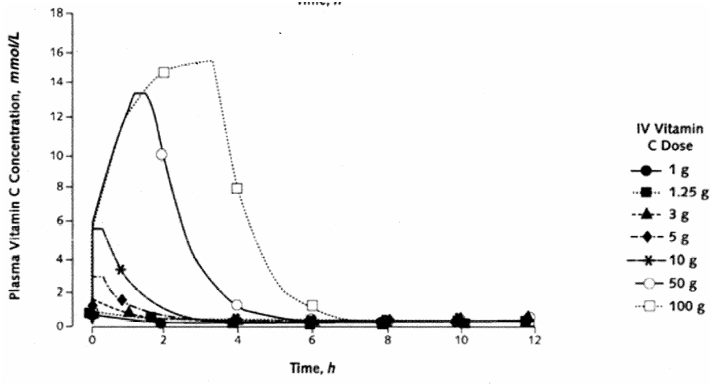
From Figure 1, one can see that a 10 gram dose might have to be repeated in 2 hours to keep the level high, where a 50 gram dose would last for 4 hours.7 Klenner said to repeat every 2 to 6 hours until the patient recovers.8 He kept their temperature going downwards. (See also Figure 4 of note 6.)
The infusion rate should preferably be 0.5 gram/minute (no more than 1 gram/minute).9 The dilution can be 18 ml/g normally (no less than 10 ml/g for large doses).11 The dose/infusion should be between 350 mg/kg and 1200 mg/kg.11 For the first IV for acute infection, Levy suggests a dose between 1000 and 1500 mg/kg. Adding some oral divided doses, around 180 mg/kg, would help. One study found a synergistic effect in adding oral alpha-lipoic acid.10
These large doses are contraindicated if the patient has reduced renal function or urinary output. Use caution with G6PD deficiency, sickle-cell anemia, or high levels of unbound iron or copper, although large doses of vitamin E may help against hemolysis.13
Do provide much hydration. And, since Ebola breaks down ground substance and collagen, provide whey or some other nutrient that contains glycine, lysine, and proline, if possible.14 Selenium deficiency increases susceptibility, as does vitamin D deficiency.28
Read the details and precautions from the Riordan Clinic, which has done over 40,000 infusions, up to 1000 mg/kg, on pages 13–18 of their protocol at http://www.doctoryourself.com/RiordanIVC.pdf. Pages 11–12 tell of the Phase I clinical trials. Note that they are not treating a raging infection, so do not follow their schedule of 2 or 3 infusions per week; it might require closer to every 6 or 8 hours.
Note also, “Due to the chelating effect of IVC, some patients may complain of shakiness due to low calcium or magnesium. An additional 1.0 mL of MgCl added to the IVC solution will usually resolve this. If severe, it can be treated with an IV push of 10 mL’s of calcium gluconate, 1.0 mL per minute.”6
In the field you could prepare stock solution of sodium ascorbate by the following method: http://www.vitamincfoundation.org/pdfs/civprep.pdf.
Note: USP sodium ascorbate sells for under $4.00/100 grams. Cathcart talks about this at http://www.youtube.com/watch?v=Zgi-7xPrCAg.
2. Levy finds that liposomal ascorbate taken orally is effective and does not cause bowel or kidney problems.17 He cured one case of hemorrhagic dengue fever with 10 grams.18 One might start with 2 to 5 grams, and repeat until the desired response is achieved, at 4 to 8 hour intervals. Higher cost but very easy. Try it.
It might have shorter shelf life at high temperatures.
A very good US source is LivOn Labs (www.livonlabs.com), and Swanson (http://www.swansonvitamins.com) just added a liposomal vitamin C as SWU904. There are probably some vendors that are less competent.
3. Oral dosage of ascorbic acid or sodium ascorbate may raise one’s resistance to disease, but for someone already seriously ill, it would take massive doses to do any good, and for Ebola it’s unlikely to be enough. See www.doctoryourself.com/titration.html.20
The digestive system does not accept large doses (over 3 grams) well; thus many 1 or 2 gram doses, taken often, are better absorbed. Each person will find some limit, usually over 20 grams/day, that will cause some diarrhea. Cathcart said that being near that limit was necessary for effectiveness in treating acute conditions and that the limit rises as one feels sicker. One man took 4 grams every 20 minutes!
Under normal circumstances, 3 grams every 4 hours would produce the maximum (220 umol/L) blood level, but toxins such as Ebola can use up ascorbate quickly. See Figure 2 for oral dosing results.7
Figure 2
Such a dose rate may help as protection, and if one checked urinary AA levels daily and they remained high, it should be an indication that one is still healthy.29
If the level drops, immediately increase dosage or go back to steps 1, 2, or 4.
In fact, a field test for presymptom Ebola (or other serious conditions) might be to take 1 gram of AA orally then test urinary AA 4 hours later, when it should peak. A low level suggests that something is amiss.29
4. Levy also suggests that in difficult cases the best treatment results can come from a combination of IVC sodium ascorbate 25 to 150 grams, liposomal 1 to 5 grams, oral ascorbate to tolerance, and ascorbyl palmitate 1 to 3 grams.21
5. It has not been determined what would be an adequate preventative dosage for a health worker. A 20 gram IV every 8 hours? 3 grams of liposomal every x hours? 2 grams of oral AA every hour? Perhaps the 3 grams every 4 hours would be sufficient.
Background
Ascorbic acid is remarkably safe.22 The LD50 is 11,900 mg/kg (oral, rat) according to the Wikipedia entry on ascorbic acid. The Riordan clinic did over 40,000 infusions of sodium ascorbate, up to 1000 mg/kg with only a few minor reactions. (Don’t use other mineral salts; you might get too much mineral.) Cathcart did 20,000 infusions. Follow the contraindications and provide sufficient hydration.9
Ascorbate has been used for thousands of years. Most mammals have an intact enzyme system that converts glucose into ascorbic acid in daily amounts up to 185 mg/kg/day when healthy, and many times that when under oxidative stress.23–25 (A 154 lb animal, when well, might produce 13 grams a day; when sick, on the order of 50 grams a day – in the bloodstream.)
This action is endogenous for most mammals, but fruit bats, guinea pigs, primates, and humans lack an enzyme, thus lack the endogenous ascorbate, and thus are ripe for virus infection and to act as a vector of the virus.26 An easy test would be to compare the response of a guinea pig vs. a mouse or rat to an Ebola sample.
It has been used clinically, curing viral diseases since 1948 in published reports.5
There are two present-day experts in ascorbate use:
Thomas E. Levy, MD, JD, has spent over 20 years using ascorbate and has written several books on the subject, including Curing the Incurable (2002) and Primal Panacea (2011). Each has 1200 references and shows the wide range of benefits, including cardiovascular. His 2013 book, Death by Calcium, is about both AA and the body’s difficulties dealing with calcium.
His website is www.peakenergy.com; e-mail televymd@yahoo.com. He has made many YouTube videos, including https://www.youtube.com/watch?v=GpptUsJFCEY and https://www.youtube.com/watch?v=YTW9x91RWnY.
Ron Hunninghake, MD, is chief medical officer at the Riordan Clinic in Wichita, which has done 40,000 IVCs and research. Its website is www.riordanclinic.org.
Notes
All accessed October 1, 2015.
1. Vitamin C as an antiviral: it’s all about dose [online article]. Orthomolecular Medicine News Service. Dec. 3, 2009. http://orthomolecular.org/resources/omns/v05n09.shtml.
2. Ebola and Marburg virus [Web page]. Vitamin C Foundation. vitamincfoundation.org/www.orthomed.com/ebola.htm.
3. Vitamin C beats bird flu and other viruses, too [online article]. Orthomolecular News Service. Oct. 26, 2005. http://orthomolecular.org/resources/omns/v01n12.shtml.
4. Belfield W, Stone I. Megascorbic prophylaxis and megascorbic therapy: a new orthomolecular modality in veterinary medicine. J Int Acad Prev Med. 1975;2:10–26. Available at http://www.seanet.com/~alexs/ascorbate/197x/belfield-w-j_int_assn_prev_med-1978-v2-n3-p10.htm.
5. The real pioneer was Fred R. Klenner, MD (1907–1984). He found that sufficient, frequent, and continued doses IVC resolved all the viral diseases he found. See http://www.whale.to/m/klenner.html and http://www.seanet.com/~alexs/ascorbate/198x/smith-lh-clinical_guide_1988.htm. For a history, see also Ahttp://www.doctoryourself.com/klennerbio.html and a hometown newspaper article about him 25 years after he discovered this antiviral action: https://www.dropbox.com/s/b00rtxgels2n14g/klenner2yellowed.tif?dl=034.
6. See Figs. 3, 4 (p. 3). The Riordan IVC protocol for adjunctive cancer care intravenous ascorbate as a chemotherapeutic and biological response modifying age [online document]. Riordan Clinic Research Institute. February 2013. www.doctoryourself.com/RiordanIVC.pdf.
7. Fig. 2 in Padayatty SJ, Sun H, Wang Y, et al. Vitamin C pharmacokinetics: implications for oral and intravenous use. Ann Intern Med. 2004;140(7):533
–
537. http://annals.org/article.aspx?articleid=717329. Also Figs. 2, 5, and 6 in Riordan NH, Riordan HD, Casciari JP. ebastian J. Clinical and experimental experiences with intravenous vitamin C. J Orthomol Med. 2000;15(4). Available at http://www.orthomolecular.org/library/jom/2000/pdf/2000-v15n04-p201.pdf.
8. Wassell WM. Ebola [online article]. Sept. 22, 2014. http://www.vitamincfoundation.org/pdfs/Wassell-Ebola-Article.pdf.
9. Riordan Clinic Research Institute. Op cit., 12–18.
10. Casciari JJ , Riordan NH , Schmidt TL , Meng XL, Jackson JA
,
Riordan HD
.
Cytotoxicity of ascorbate, lipoic acid, and other antioxidants in hollow fibre in vitro tumours. Br J Cancer. 2001;84(11):1544–1550. Available at www.ncbi.nlm.nih.gov/pmc/articles/PMC2363673/pdf/84-6691814a.pdf.
11. Klenner FR. Observations on the dose and administration of ascorbic acid when employed beyond the range of a vitamin in human pathology. J Appl Nutr. 1971;23(3–4):61–88. Available at http://www.seanet.com/~alexs/ascorbate/197x/klenner-fr-j_appl_nutr-1971-v23-n3&4-p61.htm. See “Intravenous Application.”
12. Hickey S, Roberts H, Downing D. Can vitamin C cure Ebola? [online article]. Orthomolecular Medicine News Service. http://orthomolecular.org/resources/omns/v10n13.shtml.
13. Cathcart RF. Vitamin C: the nontoxic, nonrate-limited, antioxidant free radical scavenger. Med Hypotheses. 1985;18:61–77. Available at www.vitamincfoundation.org/www.orthomed.com/nonrate.htm.
14. Collagen synthesis [Web page]. Wikipedia. Last modified Oct. 8, 2015. http://en.wikipedia.org/wiki/Collagen#Synthesis.
17. Levy TE. Primal Panacea. Medfox Publishing; 2011:130–133.
18. Ibid.,16.
20. Cathcart RF. Vitamin C, titrating to bowel tolerance, anascorbemia, and acute induced scurvy. Med Hypotheses. 1981;7:1359
–
1376. Available at www.doctoryourself.com/titration.html.
21. Levy TE. Reversing disease with the ‘multi-C’ protocol [online article]. March 11, 2014. http://www.naturalhealth365.com/vitamin_c/0929_multi_c_protocol.html.
22. Levy TE. Curing the Incurable: Vitamin C, Infectious Diseases, and Toxins. Medfox Publishing; 2011:371–408.
23. Belfield WO, Stone I. Megascorbic prophylaxis and megascorbic therapy:
a new orthomolecular modality in veterinary medicine. J Int Acad Prev Med
.
1975;2(3):10–26. Available at http://www.seanet.com/~alexs/ascorbate/197x/belfield-w-j_int_assn_prev_med-1978-v2-n3-p10.htm.
24. Stone I. Homo sapiens ascorbicus, a biochemically corrected robust human mutant.Med Hypothesis. 1979 5(6):711–721. (13,000 mg/70 Kg).
25. Conney A et al. Metabolic interactions between L-ascorbic acid and drugs. Ann N Y Acad Sci. 1961;92:115–127.
26. Stone I. The natural history of ascorbic acid in the evolution of the mammals and primates and its significance for present day man. Orthomol Psychiatr. 1972;1(2–3)82–89. Available at http://www.seanet.com/~alexs/ascorbate/197x/stone-i-orthomol_psych-1972-v1-n2-3-p82.htm.
27. Jungeblut C. Inactivation of poliomyelitis virus in vitro by crystalline vitamin C (ascorbic acid). J Exper Med. October 1, 1935;62 (4):517–521. Available at http://jem.rupress.org/content/62/4/517.
-
Taylor EW, Ramanathan CS. Theoretical evidence that the Ebola virus Zaire strain may be selenium-dependent: a factorin pathogenesis and viral outbreaks? J Orthomol Med. 1995;10(2). Available at http://orthomolecular.org/library/jom/1995/articles/1995-v10n0304-p131.shtml.
-
Two brands of appropriate AA test strips are VitaChek-C and Quantofix. Vita-chek is available at http://store.riordanclinic.org/product/VPLCStrips.html. For large quantities, get URS-1A-50 from Teco Diagnostics at 714-463-1118.
-
Hickey S, Roberts HJ, Miller NJ. Pharmacokinetics of oral vitamin C [online document]. Survive Cancer. http://www.canceraction.org.gg/system/files/Hickey-Liposomal vit C.pdf.
-
Hickey S, Roberts HJ, Miller NJ. Pharmacokinetics of oral vitamin C. J Nutr Environ Med. 2008. Available at http://www.livonlabs.com/proof/Dr_Hickey_Clinical_Study_Published.pdf/
A background reference:
The Healing Factor: Vitamin C Against Disease. Available at http://www.vitamincfoundation.org/stone. (A full book by a pioneer of ascorbate, Irwin Stone, a chemist who really studied it – and benefited from it.)
Another good papers on ascorbate use is:
Ely JTA. Ascorbic acid and other modern analogs of the germ theory. J Orthomol Med. 3rd Quarter 1999;14. Available at orthomolecular.org/library/jom/1999/articles/1999-v14n03-p143.shtml.
Notice
This article is not in any way offered as prescription, diagnosis nor treatment for any disease, illness, infirmity or physical condition. This is just publicly available information gathered from many sources and a few common-sense guesses. Persons needing medical care should obtain it from a physician. That said, I do report that several sources suggest that 2 or 3 grams of vitamin C, 4 times a day may be near optimum for healthy adults, normally. Irwin Stone and Linus Pauling, both of whom had really investigated this, took 18 grams/day, just to add a safety factor.
© 2015 Walton Ferris








0 Comments