
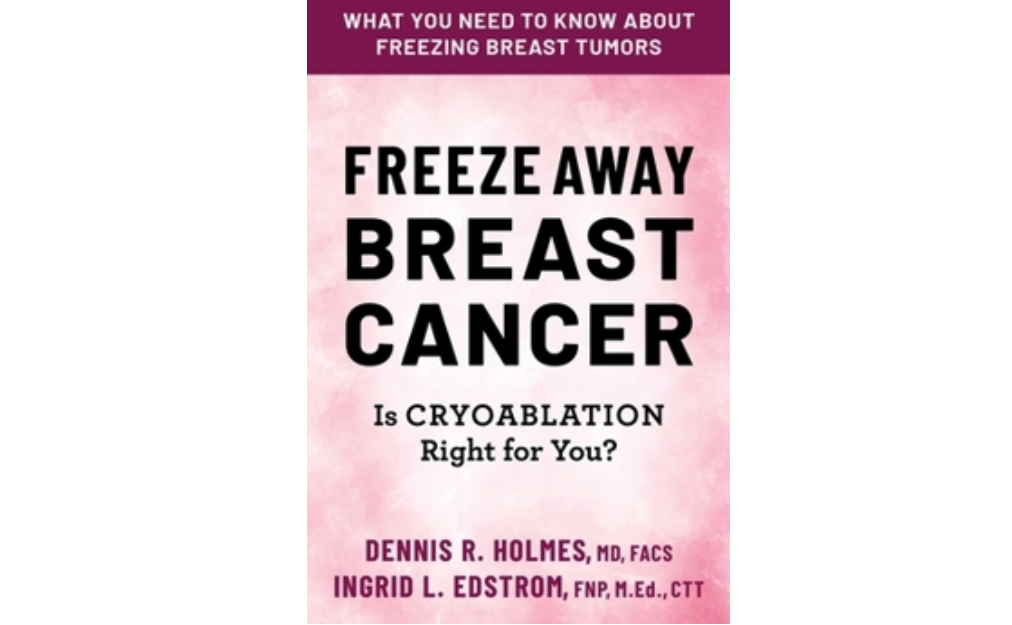
Book by Dennis R. Holmes, MD, FACS, and Ingrid L. Edstrom, FNP, MEd, CTT
$18.95, 6- X 9-inch Paperback, 176 pages, ISBN 979-07570-0542-8
For most women, a diagnosis of breast cancer brings with it a frightening array of questions, concerns, and difficult decisions. What treatment will be necessary? Will surgery be required? How much of the breast can be preserved? And perhaps most importantly, are there alternatives to traditional breast cancer surgery that are both effective and less physically demanding? In Freeze Away Breast Cancer, Dr. Dennis Holmes and Ingrid Edstrom introduce readers to an innovative treatment that may offer new hope to women facing this diagnosis.
The treatment is called cryoablation, a procedure that uses extremely cold temperatures to freeze and destroy cancerous tissue without the need to surgically remove the tumor. Although cryoablation has been used for many years to treat certain cancers of the liver, skin, and cervix, as well as benign breast tumors, its application to breast cancer is a relatively recent development. Today, advances in medical technology and clinical research have made it a potential treatment option for carefully selected patients with certain forms of breast cancer.
What makes cryoablation particularly appealing is its minimally invasive approach. Rather than removing a tumor through conventional surgery, a physician inserts a specialized probe into the affected area, where controlled freezing destroys the targeted tissue. The procedure can often be performed using local anesthesia, with less discomfort, minimal scarring, and a shorter recovery period than traditional surgery. For women concerned about preserving the natural appearance of their breasts, these advantages can be especially meaningful.
The authors bring considerable professional experience to the subject. Dr. Dennis Holmes is a breast cancer surgeon who has been closely involved in advancing the use of cryoablation in breast cancer treatment. His coauthor, Ingrid Edstrom, is a nurse practitioner specializing in women’s breast health, with particular expertise in educating patients about their treatment options and ways to reduce the risk of cancer recurrence. Together, they offer a perspective that combines medical knowledge with an understanding of the emotional and practical challenges women face following a cancer diagnosis.
One of the book’s greatest strengths is its accessibility. Rather than overwhelming readers with complicated medical terminology, the authors explain breast cancer, the principles behind cryoablation, and the circumstances under which this treatment may be appropriate. They also make clear that cryoablation is not suitable for every patient. Factors such as the size, type, and location of a tumor, along with other medical considerations, play an important role in determining eligibility.
Equally valuable is the book’s guidance on finding qualified medical professionals. Because cryoablation remains a developing option in breast cancer care, choosing a physician with appropriate training and experience is essential. The authors help readers understand what questions to ask, what information to obtain, and how to participate more confidently in decisions about their treatment.
Breast cancer remains the most commonly diagnosed cancer among women worldwide, making access to reliable information about emerging treatments especially important. Freeze Away Breast Cancer does not suggest that one procedure is the answer for everyone. Instead, it introduces a promising alternative that deserves consideration by patients who may qualify.
For women newly diagnosed with breast cancer, as well as those seeking to better understand the latest developments in breast cancer treatment, this book offers something particularly valuable: knowledge, reassurance, and the opportunity to make more informed choices about their care.
About the Authors:
Dennis R. Holmes, MD, FACS, received his medical degree from Tulane University School of Medicine. Dr. Holmes then attended the General Surgery Residency Program at the University California of San Francisco and the Breast Surgery Fellowship Program at the University of Southern California. With more than 20 years of experience, he is recognized as an expert, pioneer, and educator in breast cryoablation. Dr. Holmes is a strong advocate for individualized cancer therapy that adapts the extent of care to the patient’s values, avoiding unnecessary side effects. Dr. Holmes currently serves in the leadership of several national surgical societies and is a frequent lecturer at conferences worldwide. His practice is located in Glendale, California.
Ingrid L. Edstrom, FNP, MEd, CTT, received her BS in nursing from the University of Rhode Island, graduating as a family nurse practitioner, and her master’s in health education from Boston University. As a nurse practitioner, she has done extensive patient teaching in regard to medical issues, disease, and prevention. Lifestyle and nutritional counseling has been a focus of her practice. Currently, Edstrom is the founder and president of Infrared Breast Health, LLC and the creator of the Proactive Breast Wellness program teaching module. She resides in Eugene, Oregon.
Preface
My calling as a breast cancer surgeon and researcher has never been simply to follow the standard of care—it has been to raise the standard of care. This drive has shaped my life’s work and forged deep trust with colleagues and patients who share this unwavering commitment to progress.
The true heroes of this journey, however, are the women who refused to accept limitations—those who wouldn’t settle for the conventional wisdom that lumpectomy or mastectomy were their only choices. Their courage and determination ignited my pioneering work in breast cancer cryoablation. Every breakthrough, every refined technique, every leap forward exists because of their willingness to venture into uncharted territory alongside me.
Cryoablation: From Vision to Revolution
In 2002, when I began performing cryoablation on fibroadenomas, I wasn’t just treating benign tumors—I was laying the groundwork for a future of less invasive cancer care. I imagined a world where women could be spared the physical and emotional trauma of surgery while still receiving safe, effective treatment. To advance my skills and help train others, I established a minimally invasive breast biopsy and cryoablation clinic at Los Angeles County +USC Medical Center in 2004. This clinic served as a training ground for other breast surgeons and a springboard for further innovation.
While the groundwork was being laid for the first US-based study of breast cancer cryoablation, in 2009 I traveled across the Pacific to Japan to study alongside a visionary surgeon already treating breast cancers with cryoablation. Upon returning, I joined the American College of Surgeons Oncology Group’s Z1072 cryoablation trial, which validated cryoablation’s ability to eliminate small breast cancers. That trial required lumpectomy or mastectomy after cryoablation, but it opened the door to the next step: cryoablation without surgery.
To reach that goal, I launched the FROST Trial (Freezing without Resection of Small Tumors)—the first national study to offer women with invasive breast cancer cryoablation without subsequent surgery. Together with my collaborators and the brave women who participated, we proved that cryoablation is a safe, effective alternative to lumpectomy or mastectomy for selected small cancers.
I also focused my attention on ductal carcinoma in situ (DCIS; stage 0 breast cancer) in response to women with DCIS who also wanted an alternative to lumpectomy or mastectomy. With crowdfunding from patients—a testament to their belief in this mission—I was able to launch the DCIS Cryoablation study, which is still ongoing but has already demonstrated the effectiveness of cryoablation in the treatment of DCIS.
Along with these clinical innovations came a host of technical breakthroughs, including cryoablation-assisted biopsy and techniques to treat more advanced-stage breast cancers. Each advancement was driven by patients who were unwilling to accept traditional needle biopsies or existing size limitations of cryoablation. This journey is proof of what’s possible when doctors and patients refuse to accept the status quo. Cryoablation is not just a technique—it’s a movement. It’s changing the future of breast cancer care by offering a gentler, yet equally rigorous, path to healing.
This is more than medical progress—it’s a promise fulfilled. A promise to innovate, to elevate care, and to honor the courage of every woman who dared to demand better. It represents the power of partnership between dedicated physicians and courageous patients who dare to envision a better way forward.
A chance encounter with a new patient in early 2010 opened a vista of new possibilities utilizing cryoablation in my holistic clinical practice. A woman appeared for a thermography scan before she went to have her cancer cryoablated in Detroit, Michigan, by Peter Littrup, MD. He is the grandfather of breast cryoablation in the United States. She then came back several times after her cryoablation procedure for repeat thermo-graphy scans to follow her progress along with other structural imaging.
This woman started my professional journey to learn as much as possible about cryoablation and help promote this technology wherever I could. For me, the experience was the genesis for this book and the work that I do now on telemedicine visits with women who want to know if they may be a cryoablation candidate. Then I try to get them to a clinic that can provide the cryoablation care that they seek.
I realized that more women needed to hear about this technology. Cryoablation needed to be embraced by medical providers, women, and insurance companies as the future of breast cancer care. My solution to getting the word out about cryoablation was to try to educate surgeons and radiologists about adding this technology to their clinics and hospitals. Over the next couple years, I became a sales representative for both Sanarus and IceCure, the leading manufacturers of the cryoablation equipment at that time. In this way, I would be able to have more access to the research and hoped to get more physicians to start using the cryoablation equipment so women would have better access across the United States.
What is there not to like about breast cryoablation? The women can have early treatment and keep their breasts; additionally, the procedure can be done in an office and should be cost effective. Socialized medicine countries that must pay for the medical care of their citizens are embracing cryoablation enthusiastically! If US insurance companies would utilize cryoablation, they would be saving billions of dollars on cancer care. Hopefully this book will start to open more doors. Freezing a woman’s cervix is now “standard of care” and has been since the mid-1960s. Cervical cryoablation was considered a new technology once also.
This book also provides guidance for women with breast cancer on how to power up the immune system and make lifestyle changes, improve diet, avoid environmental toxins, improve sleep, and reduce stress. All these things are critically important during this tumultuous time, after just receiving a breast cancer diagnosis. Reducing the risk of breast cancer recurrence is on every woman’s mind. If your breast cancer journey leads you down the path for doing cryoablation, or if you take the surgical path, you will still need to start making changes to improve your immune system, lifestyle, and diet. This is key for renewed health and healing!
My hope is that this book will be a guide and an explanation of what breast cryoablation is all about and if you are a candidate. The goal is to educate women who are struggling with a breast mass and work-up for breast cancer and who need another potential option for dealing with their diagnosis and to help reduce recurrence.
– Dennis R. Holmes, MD
Editor’s Note: See also








0 Comments