
Psychocardiology:
Experience with Psychosomatic Energetics
by Dr. Birgitt Holschuh-Lorang
At the university level, psychocardiology has hitherto received scant attention, even though it is a very promising branch of medicine. As little as 10 years ago, the idea that the “travails of the soul” could influence the heart was still considered hocus-pocus. When you consider that, from a case-history standpoint, only 50% of patients with cardiac complaints exhibit risk factors such as hypertonia, diabetes, overweight, hyperlipidemia, sedentary lifestyle etc., it seems obvious that we should be considering other possible causes. Connections between psychological stress and heart disease have been known since ancient times. Common parlance is rich with phrases relating to this: “I really took it to heart,” “I was so scared my heart stopped beating,” “It broke my heart.”
Psychocardiology investigates the influence of psychological and psychosocial factors on the development of cardiac diseases. There are currently 22 studies worldwide involving well over 50,000 test subjects, which have revealed the significance that negative affect has on the prognosis of general mortality and coronary heart disease. The following negative affects play a particularly significant role in this connection:
-
depression
-
sorrow
-
anger
-
hostility
-
fear
-
stress
-
mobbing
-
burnout
It is no accident that depression, sorrow, anger, and hostility are listed first, since they all apply to the so-called type D personality, who seems particularly at risk with respect to cardiac disease. These are people with demanding jobs and limited scope for decision-making, who tend towards depression, distress, unhappiness and sorrow, who lack self-confidence, who put up with a lot that then eats them up inside – in short, the type of the introverted loser. By contrast, type A personalities are constantly energized, always pressed for time and – as so-called extroverted combative types –characterized by ambition, a hectic pace, and rivalry.
Studies have shown that the negative effect of chronic stress triggers a steady release of adrenaline, noradrenaline, and cortisol, and also negatively influences dopamine and serotonin levels. Some theories say that this can lead to paralysis of cardiac muscle cells or to coronary artery spasms. As a result, patients complain about thoracic pressure, cardiac arrhythmia, or else CHD or a previous myocardial infarct are detectable.
The usual psychocardiological or cardiopsychosomatic treatment consists of psychotherapeutic conversations, behavioral therapy, social-medicine measures, promotion of compliance and, if necessary, crisis intervention, in order to get the affected patients to rethink their position and change their behavior, to become more relaxed. This approach does not always have the desired result. For this reason, I have, for a number of years, been using a complementary-medicine method called Psychosomatic Energetics (PSE).
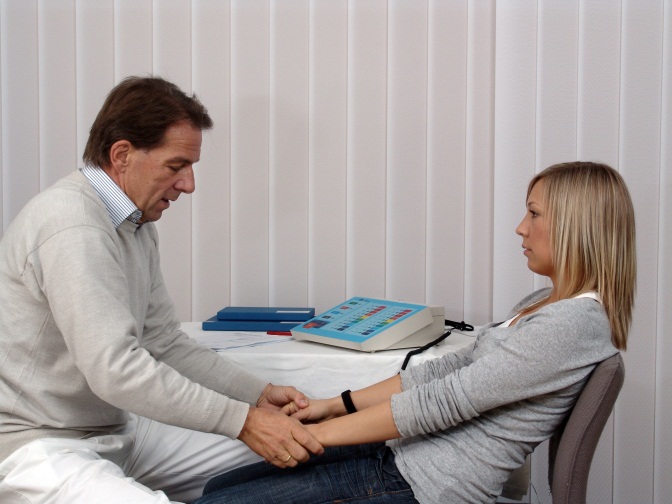 psyche and soma. PSE theory says that an adequate input of life energy on the one hand regulates the autonomic nervous system (and thus also cellular function) and on the other is responsible for satisfactory psychic stability. The methods of PSE – developed by my general-practitioner colleague Reimar Banis – enable one to ascertain a patient’s energetic state as a percentage figure with the aid of a test device (REBA) with which one stresses the various energy levels with stepwise rising intensity. For energy testing, I use the kinesiological arm-length test (see Figure 1). With the energy readings thus obtained, one learns about the patient’s physical vitality and psychological resilience. Generally, the ratings not only reflect the patient’s own perceived sensitivities, but also agree with the clinical findings. Figure 1: Kinesiological arm-length test
with the aid of the REBA test device .
Ailing patients normally have lower readings. Experience has shown that the cause of this is repressed emotional conflicts whose contents can be related to specific themes through testing. These conflicts, which have been repressed into the subconscious, not only stockpile life energy, they also block energy uptake. They can be dissolved by means of special homeopathic compound remedies. During the course of this treatment, patients generally experience an increase in energy which in turn is a positive influence on the vegetative regulatory system, while at the same time strengthening emotional resilience. The result is that the symptoms abate or disappear entirely.
The mode of action of the method is described in the following three patient case studies.
Case Study 1: Peter, 52
Anamnesis
: The patient has had anginose symptoms for years. CHD is not detectable. There is hypertonia. He feels quite exhausted and tends to depression. A number of stays in psychosomatic clinics yielded no results. He complains of trouble sleeping and “stress dreams.” His current treatment consists of the antidepressant Saroten, which has not brought any noticeable improvement.
At the first session, PSE diagnostics showed noticeably restricted readings for vitality at 25% (nominal 100%) and for emotional resilience at 20% (nominal 100%). In addition, there is an external energy block in the form of geopathic stress, which usually indicates a geo-radiation contaminated bed location. Over the course of four therapy sessions, four different subconscious conflict themes were identified. These were repressed anxiety, internal tension, frustration and dissatisfaction, and the feeling of being a victim of circumstances. Gradually, these conflict themes were eliminated using the homeopathic compound remedies Chavita 4/Emvita 15, Chavita 6/Emvita 23, Chavita 3/Emvita 11, and Chavita 5/Emvita 18. At the last session the readings for vital energy and emotional resilience have both risen to 95%. The patient feels noticeably more stable, and in general things are going well for him. He has no more anginose symptoms. He has moved his bed and is sleeping well. He no longer needs Saroten.
Case Study 2: Christa, 49
Anamnesis
: The patient had complained for months about retrosternal pressure: she constantly feels a lump in her chest. No basis exists for CHD. She lives in a difficult family conflict constellation, which makes her feel constantly exhausted and overburdened. At the first testing session, the readings were markedly low, with vital at 25% (nominal 100%) and emotional energy at 20% (nominal 100%). The tested conflict themes panic, rage, and life as a struggle were energetically dissolved with the compound remedies Chavita 4/Emvita 16, Chavita 3/Emvita 9, and Chavita 7/Emvita 26. After three therapy sessions, the energy readings had risen to 75% vital strength and 70% emotional energy. She is doing much better, the retrosternal lung feeling has disappeared, her inner stability is improved, and she feels that she can cope much better now with her family and work situations.
Case Study 3: Wolfgang, 54
Anamnesis
: The patient frequently complains of cardiac symptoms such as a feeling of pressure and palpitations. There is atrial fibrillation and a condition following mitral valve replacement. A cardioversion has been done. He is not taking the medications prescribed by the clinic – digitoxin, furosemide, enalapril, and Concor – because his body cannot tolerate them. He feels tired and lacking in drive; as a teacher, he is under constant job stress. The initial examination reveals a vital reading of 45% and an emotional of 30% – values which match up with his physical and psychological condition. The conflict themes to be resolved (life as a struggle, panic, tension, and rage) are treated with Chavita 7/Emvita 26, Chavita 4/Emvita 16, Chavita 6/Emvita 23, and Chavita 3/Emvita 9. After four therapy sessions, he experienced a noticeable increase in energy with a final reading of 90% for vital energy and 85% for mental resilience. He feels good. Fatigue and lack of drive are much improved. His heart is no longer a problem, and he is far better able to do justice to his daily demands.
These case histories illustrate to what extent repressed conflicts – which drain away life energy vampire-style, so to speak – can cause problems for the heart. Conflict themes can be tested and treated with the aid of the test procedures of Psychosomatic Energetics, and in numerous cases have improved patients’ cardiac problems, or even sometimes eliminated them entirely, while at the same time stabilizing the psychological situation. PSE is thus, in its truly holistic approach, a proven reliable testing and therapy procedure that has become an indispensable part of everyday medicine for me.
Bibliography
Banis R. A manual of psychosomatic energetics. Explore! for the Professional. Chrystyne Jackson; 2004.
———. New Life through Energy Healing. Gateways; 2009.
———. Durch Energieheilung zu neuem Leben [New life through energy healing]. Verlag Via Nova; 2002
———. Psychosomatische Energetik: Lehrbuch für Therapeuten [Psychosomatic Energetics (A Manual for Therapists)].VAK Verlag.
———. Lesebuch der Psychosomatischen Energetik [Psychosomatic Energetics Reader] Vol. 1. Comed Verlag Hochheim; 2004.
———. Lesebuch der Psychosomatische Energetik [Psychosomatic Energetics Reader] Vol. 2. Comed Verlag Hochheim; 2006.
———. Lesebuch der Psychosomatische Energetik [Psychosomatic Energetics Reader] Vol. 3. Comed Verlag Hochheim; 2007.
———. Lesebuch der Psychosomatischen Energetik [Psychosomatic Energetics Reader] Vol. 4. Comed Verlag Hochheim; 2008.
Fischer J. Heart and Mind: the Practice of Cardiac Psychology. American Psychological Association; 2011.
Holschuh-Lorang B. Psychosomatische Energetik in der Allgemeinmedizin – Ergebnisse einer Praxisstudie. Schweiz Z Ganzheitsmed. 2004;3:173–178.
Jordan J, Bardé B, Zeiher AM, eds. Contributions Toward Evidence-Based Psychocardiology: A Systematic Review of the Literature. American Psychological Association; 2007.
Dr.med. Birgitt Holschuh-Lorang MD
Fachärztin für Allgemeinmedizin-NHV
Zum Scheidberg 9
66798 Wallerfangen-Gisingen
GERMANY









0 Comments