
Different Kinds of Pharmacological Curves
In our last article we explored some basic reasons why low dose combination therapy is a sensible approach to formulation, providing efficacy while minimizing safety concerns. Integral to that conversation was a typical sigmoidal dose response curve that allows for estimation of an effective dose 50 (ED50), commonly used as a model of drug-dose response in today’s view of pharmacology. We demonstrated that ascension up such a curve results in increased probability of toxicity as advancement in efficacy slows. In this article we explore a different dimension of dose response, the biphasic or hormetic response, and suggest that given the understanding this model provides, low-dose therapy again asserts itself as a preferable approach to formulation.
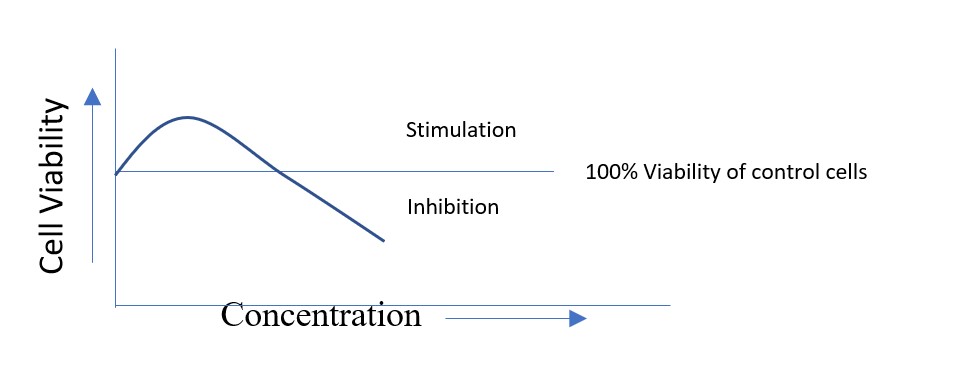
In an hormetic dose-response, low doses of an intervention have a stimulatory effect at a low dose and an inhibitory effect at a higher dose. An example of this is an agent that stimulates cell growth at lower concentrations but at higher concentrations becomes cytotoxic.
History of the Scientific Community’s Relationship with Hormetic Dose-Response
An excellent review of the scientific community’s rocky relationship with the hormetic dose response is published by Calabrese.1 The pioneer in describing this pattern of dose response was Hugo Schultz, a contemporary of Koch, who did his microbiological research at Greifswald University in Germany and began publishing his findings in the 1880s. In working with disinfectants that at higher doses had an inhibitory effect on yeast fermentation, he found that if he exposed the yeast instead to smaller doses below the yeast’s “indifference point,” stimulatory effects were repeatedly produced. His own description of this work states:2
“Sometimes, when working with substances that needed to be examined for their effectiveness in comparison to the inducers of yeast fermentation, initially working together with my assistant, Gottfried Hoffmann, I found in formic acid and also in other substances the marvelous occurrence that if I got below their indifference point, i.e., if, for example, I worked with less formic acid than was required in order to halt the appearance of its anti-fermentive property, that all at once the carbon dioxide production became distinctly higher than in the controls processed without the formic acid addition. I first thought, as is obvious, that there had been some kind of experimental or observation error. But the appearance of the overproduction continually repeated itself under the same conditions. First I did not know how to deal with it, and in any event at that time still did not realize that I had experimentally proved the first theorem of Arndt’s fundamental law of biology.”
Because Schultz and his colleague, Rudolph Ardnt, would go on to assert that their observations of a hormetic response pattern explained the effectiveness of homeopathy (strictly to the extent that substances in remedies were not diluted past Avogadro’s number) Schultz and Ardnt were highly criticized by the proponents of other dose-response models and their work was largely rejected.3 This was a tragedy, especially in light of the fact that their research was corroborated4 and the principle of a bi-phasic response became reported in other biological models.5,6 Eventually, however, as examples of hormetic response continued to accumulate, and owing much to Calabrese’s team of researchers, the hormetic dose response is becoming recognized as a generalizable principle of the biological sciences7 and one that incorporates the concepts of additivity and synergy.8
An example of a hormetic response can be illustrated with reseveratrol. At low concentrations (0.625 and 1.25 mcg/ml), resveratrol has a stimulatory effect on gamma-interferon and Interleukin-2 production of Peripheral Blood Mononuclear Cells (PBMCs), while doses above this amount inhibit secretion of these cytokines. Likewise, multiple levels of resveratrol below 2.5 mcg/ml consistently increase Interleukin-4 production, while concentrations above this amount are increasingly inhibitory. Again, a hormetic response is also seen in terms of PBMC viability and replication, with a low concentration of resveratrol being stimulatory and larger concentrations inhibitory.9
An additional example of hormetic response is seen when PC12 cells are exposed to varying concentrations of saponins from one of the most well-known adaptogenic herbs, Panax notoginseng.10 Lower concentrations increase cell proliferation, with a peak increase of 30.3%, at 0.12 mg/ml. This effect gradually declines with increasing doses until an inhibitory effect is seen at 4 mg/ml.
It is important to remember that not every hormetic response may be something that is desirable. For instance, berberine has been shown in vitro to have stimulatory effects on cancer cell lines at concentrations between 1.25-5 mM and inhibitory effects at higher concentrations between 10-80 mM.11 This highlights the need for better understanding the effects of low dose therapies, in vivo, including the cumulative effects of low dose combination therapies. While of course great insight into this issue will come from the combination of basic science research and longer-term clinical trials, we would argue that there is also value in learning from empirical methods of formulation, used for centuries.
For example, the TCM approach to formulation includes not only a “Monarch” herb of main effect and a “Minister” herb to enhance the effects of the Monarch, but importantly there is a recognized need for an “Assistant” herb, included specifically to help offset toxicity of the Monarch/Minister herbs.12 Learnings accumulated over centuries with this approach help lead to the overall most favorable balance in outcome from the sum of hormetic responses in action.
At this point it may be helpful to consider several conceptual questions: If many herbs combined in low doses present the body with multiple opportunities for hormetic responses, and low-potency homeopathics also induce a hormetic response, is the line drawn in many a mind between mixed low-dose botanical treatments and at least low potency homeopathic remedies a bit of an artificial one? Moreover, if both approaches are really different means to achieving an overall favorable hormetic response or balance of hormetic responses, could we not intellectually connect and combine both approaches under a larger umbrella of hormetic-response inducers?
Indeed, if the therapeutic benefit of low dose combination therapy is a sum of hormetic responses, could not overall healing progress in some, in fact many, circumstances without any single ingredient being present at a level that reaches an ED50 on a more typical dose-response curve? The effects of hormetic response seem a very plausible avenue for explaining the long-observed benefits of Traditional Chinese Medicines,13 and the formulas of other healing systems, such as Ayruveda, that commonly mix many whole herbal and other medicinal ingredients together in low amounts. Indeed, a hormetic dose response is of particular interest to naturopathic physicians and may even be seen as a unifying model of dose-response across multiple naturopathic modalities.
One of our more interesting observations, perhaps, is that whether one chooses to reside more mentally attached to a typical, sigmoidal dose-response curve, or whether one finds joy and utility in seeking to become a respectable hormetic response specialist, strong reasons arise after considering both models of dose response to pursue low dose and low dose combination therapy.
References
1. Calabrese EJ. The Emergence of the Dose-Response Concept in Biology and Medicine. Int J Mol Sci. 2016 Dec 5;17(12):2034. doi: 10.3390/ijms17122034. PMID: 27929392; PMCID: PMC5187834.
2. Schulz H, Crump T. NIH-98-134: Contemporary Medicine as Presented by its Practitioners Themselves, Leipzig, 1923:217-250. Nonlinearity Biol Toxicol Med. 2003 Jul;1(3):295-318. doi: 10.1080/15401420390249880. PMID: 19330137; PMCID: PMC2656124.
3. Calabrese EJ. The Emergence of the Dose-Response Concept in Biology and Medicine. Int J Mol Sci. 2016 Dec 5;17(12):2034. doi: 10.3390/ijms17122034. PMID: 27929392; PMCID: PMC5187834
4. Branham SE. The Effects of Certain Chemical Compounds Upon the Course of Gas Production by Baker’s Yeast. J Bacteriol. 1929 Oct;18(4):247-64. doi: 10.1128/jb.18.4.247-264.1929. PMID: 16559396; PMCID: PMC375082.
5. Hotchkiss M. Studies on Salt Action: VI. The Stimulating and Inhibitive Effect of Certain Cations upon Bacterial Growth. J Bacteriol. 1923 Mar;8(2):141-62. doi: 10.1128/jb.8.2.141-162.1923. PMID: 16558991; PMCID: PMC379008.
6. Smith EC. Effects of ultra-violet radiation and temperature on fusarium. II. Stimulation. Bulletin of the Torrey Botanical Club. 1935; 62(3):151-164.
7. Calabrese EJ, Blain RB. The hormesis database: the occurrence of hormetic dose responses in the toxicological literature. Regul Toxicol Pharmacol. 2011 Oct;61(1):73-81. doi: 10.1016/j.yrtph.2011.06.003. Epub 2011 Jun 15. PMID: 21699952.
8. Calabrese EJ. Hormesis: why it is important to toxicology and toxicologists. Environ Toxicol Chem. 2008 Jul;27(7):1451-74. doi: 10.1897/07-541. PMID: 18275256.
9. Falchetti R, Fuggetta MP, Lanzilli G, Tricarico M, Ravagnan G. Effects of resveratrol on human immune cell function. Life Sci. 2001 Nov 21;70(1):81-96. doi: 10.1016/s0024-3205(01)01367-4. PMID: 11764009.
10. Zhang C, Li C, Chen S, Li Z, Ma L, Jia X, Wang K, Bao J, Liang Y, Chen M, Li P, Su H, Lee SM, Liu K, Wan JB, He C. Hormetic effect of panaxatriol saponins confers neuroprotection in PC12 cells and zebrafish through PI3K/AKT/mTOR and AMPK/SIRT1/FOXO3 pathways. Sci Rep. 2017 Jan 23;7:41082. doi: 10.1038/srep41082. PMID: 28112228; PMCID: PMC5253660.
11. Bao J, Huang B, Zou L, Chen S, Zhang C, Zhang Y, Chen M, Wan JB, Su H, Wang Y, He C. Hormetic Effect of Berberine Attenuates the Anticancer Activity of Chemotherapeutic Agents. PLoS One. 2015 Sep 30;10(9):e0139298. doi: 10.1371/journal.pone.0139298. PMID: 26421434; PMCID: PMC4589364.
12. Wang D, Calabrese EJ, Lian B, Lin Z, Calabrese V. Hormesis as a mechanistic approach to understanding herbal treatments in traditional Chinese medicine. Pharmacol Ther. 2018 Apr;184:42-50. doi: 10.1016/j.pharmthera.2017.10.013. Epub 2017 Nov 8. PMID: 29080703.
13. Wang D, Calabrese EJ, Lian B, Lin Z, Calabrese V. Hormesis as a mechanistic approach to understanding herbal treatments in traditional Chinese medicine. Pharmacol Ther. 2018 Apr;184:42-50. doi: 10.1016/j.pharmthera.2017.10.013. Epub 2017 Nov 8. PMID: 29080703.
Published July 15, 2023








0 Comments