
Salicinium: A Powerful Biological Response Modifier in Cancer
by Carol M. Brown, DO, PhD, FAARFM
My introduction to Salicinium was an abrupt episode, but the beginning of a dramatic change in my practice. A few years earlier I had provided high-dose vitamin C to one of my patients with a 6-year history of ovarian cancer. She had been treated at the Issels Clinic in California, and the cancer had been stable for over 2 years. She and her husband had also experimented with various other alternative treatments since her diagnosis and the discovery of her intolerance to the routine conventional regimen. It was about a 90-minute drive from their home in Chicago to our clinic in Milwaukee, so she came for IVs rather sporadically. Two years later, as her cancer was progressing, I received a call from her husband stating there would be a new IV regimen coming by FedEx to my office in the morning, and asking if I would give it to her. I scrambled for information; and, after studying the data and determining it was safe, I administered it to her a few days later. She felt better and was ambulatory by the end of the 3-week IV regimen but again her treatment schedule was inconsistent and she was lost to follow-up after about 6 months.
At that time, my practice consisted primarily of patients with difficult conditions who were not adequately improving or worsening and who sought “another way.” I did not specialize in treating people with cancer, though I had taken a fellowship in integrative cancer therapies to learn to support those trying to overcome cancer without medical intervention. I was intrigued with the patient’s response and the ease of administration of the Salicinium. She had no adverse effect except for the day that her immune system “woke up” and she had 2 to 3 hours of chills and achiness. It seemed so clean – using a natural product with the potential to stop cancer. During the next few months I researched cancer and Salicinium as a way to help my other patients.
As physicians, we always seem to be looking for ways to “kill” something, but forget that we are already endowed with the greatest killing mechanism ever created – our own immune system. In fact, we have spent the last hundred years trying to determine how to help (or cause) our killer cells to attack invaders for which the immune system appears not to be programmed. Some of the latest studies are directed entirely toward programming an individual’s immune globulins to recognize their own particular cancer.
Could the immune system already be programmed to handle this problem? Are there other diseases or pathologies that we can look to and find answers to this dilemma? Is cancer really the problem or is it a victim, just as we are when it resides within us? Can we look to the past to find answers which will change the future?
As a PhD I was taught to study a subject, take it apart, and study it again and again. While beginning my studies on cancer I ran across the term trophoblastic thesis of cancer. In looking up literature on the subject I found a document titled “An Inquiry into the Trophoblastic Nature of Cancer,” by Peter W. Stacpoole, 1971. While reading this document, I was stunned to find the forerunner of one of today’s answers to the nature of cancer. On pages 15/16 I quote in full:
The distinct invasiveness of the trophoblast and the intimacy of the junctional zone are associated with a characteristic fibrinoid material, probably of trophoblastic origin (Kirby et al. 1964; Bradbury et al. 1965; Currie and Bagshawe 1967; Curie et al. 1968; Bradbury et al. 1969) which exists as a sort of acellular barrier between maternal and trophoblastic tissue and which may act to limit the invasiveness of the trophoblast (Wynn 1964, 1965, 1967). The fibrinoid may be mucopolysaccharide in nature, since normal pregnancy trophoblast (as well as “malignant” trophoblast) is known to exhibit a pericellular coat, rich in sialic acid (Currie and Bagshawe 1967; Currie et al. 1968; Billington et al. 1969; Bradbury et al. 1969). It is thought that this sialomucin coat protects the genetically foreign trophoblast and fetus against maternal lymphocytic attack by electrostatic repulsion of the lymphocytes, by physically masking the trophoblast’s antigens or by some other mechanism (Simmons and Russell 1962; Currie and Bagshawe 1967). (emphasis mine)
It doesn’t take an inquiring mind long to realize that this “fibrinoid material” is the beginning of the search which has led us to alpha-N-acetylgalactosaminidase, or nagalase for short. This enzyme is not only the primary protective agent for cancer cells but also the single item that allows life as we know it to keep going on this earth. It is the protection for the trophoblast (cytotrophoblast) of the placenta. It is also the very enzyme that our muscle cells instantly excrete upon the inability of the mitochondria to manufacture ATP due to a lack of respiration. Without this function, our muscle cells would be recognized as diseased or foreign cells and be phagocytized by our own immune reactions. There would be no mammalian life if it were not for Nagalase.
Since the beginning of inquiry into the nature of cancer, another unexpected factor has baffled the best of scientists: why, when returning respirating cells – which had been made to ferment in vitro by lowering oxygen pressure by 35% (anaerobiasis) – back to a normal oxygen pressure, did they return to respiration and not remain in fermentation? This type of cell is referred to as a facultative aerobe, a cell able to live with or without oxygen, because it can metabolize energy either way. It prefers aerobiasis over anaerobiasis, but can continue to live for a period of time until oxygen can be restored, thus respiration. This is why our muscles remain sore for a period of time after being overused. The production of lactate accumulates lactic acid in the tissue until oxygen is returned and normal cellular respiration is resumed.
The problem here is this: if oxygen is not returned in time (and no study has been done to find out how long that may be) the mitochondria is harmed and cannot return to full respiratory function, so the facultative cell remains at some level of fermentation. The facultative anaerobic cell can still produce nagalase for protection from the immune system. It still maintains the function of division, but it cannot reproduce something for which it no longer has functioning chromosomes. This cell can now only reproduce cytoplasmic functioning cells. The further these cytoplasmic cells divide, the more purely anaerobic they become. It has always been said that these cells become obligate anaerobes, a cell that can be poisoned by oxygen. This terminology is incorrect. These cells become aerotolerantcells, as they make energy without oxygen, and unlike obligate anaerobes, they are not poisoned by oxygen. Because of this single difference, they can go anywhere that they are carried and not be bothered by the immune system or even greatly raised (hyperbaric chamber and other) oxygen levels (Hogg S. Essential Microbiology. 1st ed. Wiley; 2005:99–100.)
On this note, if one disbelieves this factor, one must ask oneself, how can cancer stem cells and cancer tumor cells metastasize all through any part of mammalian tissue, away from the acidic milieu of the cancerous process and survive in a much higher oxygen atmosphere? It is because these cells are manufacturing their own microcosmic atmosphere (nagalase) and are aerotolerant. These two factors (the returning of cells to normalcy and aerotolerance) have misled science for all these years as humankind has tried to understand and devise control over the cancer scourge.
Consider the following: the nagalase coating (which is actually alpha-N-acetylgalactosaminidase) is an enzyme containing the glycome N-galactosaminidase. When a phagocyte carrying N-galactosamine comes close to a fermenting cell, it is repelled as like repels like because the phagocytealso carries N-galactosaminidase (Currie and Bagshawe 1967). Phagocyte repelling has been known for years, but what wasn’t known is the composition of the vitamin D3-binding protein containing three sugars: one galactose, another sialic acid, and N-acetylgalactosamine, which is deglycosylated by nagalase, effectively stopping the production of GcMAF from vitamin D. Thus, as the old phagocytes die, new ones are prevented and immune suppression begins. This happens very slowly at first, but becomes rapid as the process gains ascendancy. When studying GcMAF, I was interested to discover that other entities also producing nagalase for their protection; for example, HIV, HSV-1/2, influenza, hepatitis C, and oddly enough, if certain cells are infected by a virus, cells themselves. This demonstrates that cancer and fermenting cells do not have exclusivity.1
So once again we ask ourselves the question, is the immune system already programmed to handle this problem? The answer is of course, no. If it were, there could be no life as we know it. It also means if, in the natural course of things, the immune system were not supposed to have an effect on these things, then something very unnatural such as cancer cells has happened. In other words, we should not look to the immune system for fault, but elsewhere. What can we find in nature to change the course so that phagocytes can operate as they were intended?
It is not the purpose of this article to dwell on prevention – which of course has proved to have failed miserably – but to identify a way of allowing the immune system to do what it was intended to do best: keep the mammalian body functioning disease free. The cells that fail to return to respiration gradually become victims to permanent fermentation and eventuate into the process which ultimately victimizes us: cancer.
The truth is that the immune system is working as intended. However, we are still compelled to find something to interfere with the debranching enzyme nagalase. If nagalase can be disrupted, then the phagocytes of the immune system would be able to proceed with lysing of the fermenting cell. At the same time, more phagocytes would be signaled to the area and begin deconstructing the now vulnerable naked cells.
Upon entering the world of Salicinium, I wanted to understand its effects. I learned from certain scientific publications that a fermenting cell, due to the greatly increased requirement for an almost all-glycome diet, will transfer some of its large GLUT-4 insulin receptors from the inside lining of the cell to the outside lining to allow vastly increased amounts of sugar to enter. The external location and the larger size of the GLUT-4 transporters allow larger, complexed molecules of sugars to enter the needy fermenting cell. These complexed molecules pass the debranching enzyme as they are delivered through the inside lining of the cell and sugars are separated from their associated complexes. Are you beginning to see the requirement for a lot of sugar in the cancer/immune process? Once passing the debranching enzyme, the glycome is picked up by hexokinase and phosphorylated by ATP to become glucose-6-phosphate. 2,3
The First Immune System Biological Modification by Salicinium
Salicinium is a glycobenzaldehyde.
In the food chain, there are many things that contain aldehydes. Aldehydes are protective to many foods, and nature has allowed our metabolic system ways to detoxify them, mostly through the liver. However, benzaldehydes are different and very toxic. Benzaldehyde never gets inside normal cells and is slowly detoxifiable by the liver. Complexed with glucose, it is harmless to healthy aerobic cells. However – in the case of a fermenting cell – a benzaldehyde glycome will be drawn in through the GLUT- 4 receptor and be intercepted by the debranching enzyme to separate the glycome for use and the benzaldehyde is set free.It must be detoxified. Remember this is not aldehyde. It is benzaldehyde!
Glucose-6-phosphate is active in the cytosol pathway as it is in any cell, normal or fermenting. But in a fermenting cell, the out-of-the-ordinary benzaldehyde is attracted to the next step of the energy pathway: NADP+. NADP+ is the detoxifier for aldehyde as well as an intermediate step to 6-phosphoglucono-lactone. Normally NADP+ picks up a hydrogen atom from glucose-6-phosphate and becomes NADPH. However, when it attaches to a hydrogen from benzaldehyde it becomes NADP-benzaldehyde, an intolerable situation.4,5
This can best be best explained by quoting from Salway’s book Metabolism at a Glance, Chapter 12, page 32: The pentose phosphate pathway:
The pathway can be considered in two phases: the irreversible oxidative phasecomprising the reactions catalyzed by glucose 6-phosphate dehydrogenase, lactonase and 6-phosphogluconate dehydrogenase; and the reversible, non-oxidative phaseinvolving the rest of the pathway, then: Regulation of the pentose phosphate pathway: The flow of metabolites through the pathway is regulated at the glucose 6-phosphate dehydrogenase reaction and the 6-phosphogluconate dehydrogenase by the availability of NADP+. Therefore, in red blood cells for example, the flow is linked to the ability of NADP+ provided by glutathione reductase;the latter is needed to produce reduced glutathione, which protects cells from oxidative damage. In liver it is regulated by the availability of NADP+ supplied by fatty acid synthesis.” (emphasis mine)
This same principle is identical for any fermenting cell.
This is an irreversible act in the metabolic pathway.The process of making four ATP from one glucose and two ATP has now faltered. When this happens, the fermenting cell is not dead, but it is beginning to starve for energy. While in this precarious position, the amino acid protein necessary for the production of nagalase cannot be produced and the protective nagalase coating is lost. Now exposed and ready for recognition, the cancerous cell is doomed.
The Second Immune System Biological Response Modification by Salicinium
Salicinium was tested by the German laboratory BioFocus and compared to the best-known immune-stimulating product – Lektinol. Salicinium increased the NK cell activity attained by Lektinol by nearly double in all cases. Also included were test samples from two persons without cancer and these two controls also increased the activity of NK cell activity. One would expect an increase in the numberof natural-killer cells if nagalase levels were lowered as well, but that would be a much slower process.
This proves the second biological response modification attained with Salicinium.
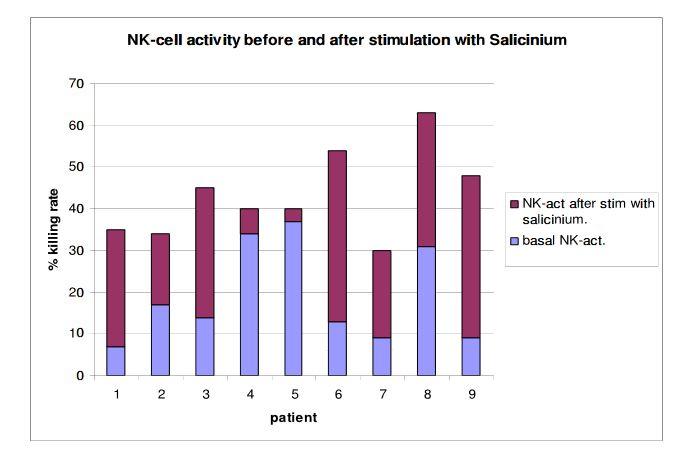
*Patients 4 & 5 were control patients with no cancer.
On March 25 of this year, I presented at The Best Answer for Cancer Conference in Reno, Nevada. While there I had the privilege of meeting several other physicians who also use Salicinium and shared findings. I was also able to meet with Ioannis Papasotiriou MD, PhD, head of the molecular biology department of Research Genetic Cancer Centre LTD (RGCC). Their lab has tested Salicinium on blood from more than 5000 cancer patients, and Salicinium has maintained an incredible kill rate against cancer stem cells (CSCs) and circulating tumor cells (CTCs), with more than 80% of patient samples’ being sensitive and no form of cancer not being affected. A single dose provides a 48-hour kill rate of about 26%. That’s one dose!
Papasotiriou believes that there is more to be learned about Salicinium and is excited about the reproducibility and response to it.
My experience has been very good as well. I have nearly a 70% survival rate. I will share a few patient experiences:
Ken, 48-Year-Old Male
2010: Adenomcarcinoma of protocaval region/unknown origin. Initial treatment at Mayo for possible pancreatic cancer with surgical resection and chemotherapy.
January 2014: Presented to our clinic with recurrence. Afraid to be retreated conventionally due to lack of specific diagnosis and concern for further inadequate treatment. Wife looking for alternatives. General health OK. IV Salicinium protocol completed 3 weeks later. He is well, back at work since February 2014, hunting, enjoying life with his wife, and following recommendations carefully. Initial nagalase test result was 2.00. Present nagalase test result is 0.87.
Slobodan, 67-Year-Old Male
2013: Cirrhosis/stage 4 liver cancer w/mets to chest wall and spine. Tx Nexavar palliative care advised – unable to tolerate Nexavar. “Inoperable.” Wife – breast cancer survivor – treated in Mexico 12 years ago, now alive and well. Sought nontoxic treatment for husband but currently unable to afford foreign (US) health care.
Began Salicinium December 2013. Completed protocol August 2014. PET scans normal in June 2014. Bone scan unremarkable June 2014. Initial nagalase – 1.40. Present nagalase – 0.67. Alive, active, and well.
Jamilla, 48-Year-Old Female
2012: Stage IIB moderately differentiated invasive ductal carcinoma ER/PR 100% positive HER-2/neu negative left breast cancer. Husband naturopath – treating alternatively – unable to resolve – condition progressing. Surgical resection in New York (to avoid pretreatment with chemotherapy). Positive sentinel node.
Began Salicinium July 2013. Completed protocol September 2014. Thermograms negative. Mammograms negative. Initial nagalase – 2.60. Present nagalase – 0.72. Alive, well, full-time work at Southwest Airlines. Husband happy.
Note : If you don’t quite grasp how Salicinium works or are somewhat a visual person (as I am) and would like to see precisely what happens after Salicinium has modified the immune reaction, unblocking the immune reaction, please go to http://www.youtube.com and type “ntk8XsVIDe0” exactly as shown here (last character is a zero) in the search bar.
This recent video created by the University of Cambridge (UK) shows exactly what happens first to the cancer stem cells, then to the circulating tumor cells, and finally the primary cancer (in that order) when they are attacked by a body’s cytotoxic T cells.
Notes
1. Yamamoto N, Urade M. Pathogenic significance of alpha-N-acetylgalactosamine activity found in the hemagglutinin of influenza virus. Microbes Infect. 2005;7:674–681; Yamamoto N. Pathogenic significance of alpha-N-acetylgalactosamine activity found in the envelope glycoprotein gp160 of human immunodeficiency virus type 1. AIDS Res Hum Retroviruses, 2006;22:262–271.
2. Calvo MB, Figueroa A, Pulido EG, Campelo RG, Aparicio LA. Potential role of sugar transporters in cancer and their relationship with anticancer therapy. Int J Endocrinol. 2010. Article ID 205357; Salway JG. Medical Biochemistry at a Glance. 3rd ed. Wiley; 2012:42,60,61,72. Salway JG. Metabolism at a Glance. 3rd ed. Blackwell; 2004.
3. Korbelik M, Naraparaju VR, Yamamoto N. The value of serum alpha-N-acetylgalactosaminidase for the assessment of tumour response to radio and photodynamic therapy. Br J Cancer. 1998;77:1009–1014; Yamamoto N et al. Deglycosylation of serum vitamin D3-binding protein leads to immunosuppression in cancer patients. Cancer Res. 1996;56:2827–2831.
4. Chieco P, Normanni P, Treinen MM. Localization of high benzaldehyde dehydrogenase activity in rat upper gastrointestinal tract mucosa: a quantitative histochemical study. J Histochem Cytochem. 1988;36(3):245–252.
5. Chieco P, Normanni P, Molsen MT, Maltoni C. Quantitative histochemistry of benzaldehyde in carcinomas of vinyl chloride-treated rats. PMID: 3003181.





0 Comments