
KEYWORDS: Oncology, Integrative medicine, German clinic; CAM therapies, Cancer; Open mind
A Cancer Story
By Serge Jurasunas
I would like to share with my readers a letter from one of my patients about her recent struggle with stage 4 cancer because it is really emotionally disturbing since in our practice we deal with patients fighting for their lives. This case, in particular, is one where the medical doctors told her that nothing more could be done. When she asked me to help her to live at least few more years for the sake of her children, here is what she wrote me:
Dear Dr. Jurasunas,
Here is a summary of my story, which I want to share with you, my family, and friends. I hope my experience can be used to help and inspire other people in their struggle with cancer.
In February 2008, I was diagnosed with an advanced stage IV nasopharyngeal carcinoma and metastases to my ganglions. My doctors told me this was very serious and had a grave prognosis.
When I first met you, I had just undergone chemotherapy and radiation, suffered many adverse side effects and I felt despair. Dr. Jurasunas, your advice has been an invaluable help. You prescribed for me a personalized complementary treatment together with a special diet. I started immediately, feeling confident and hopeful.
I felt better, especially since my nasopharyngeal tumor was totally eliminated in a short time. I still had cancer in my right cervical ganglion (although much reduced) as well as liver metastases. I knew my journey was only beginning and you encouraged me gave me hope and much needed support.
I underwent more chemotherapy which seemed positive at first, but this was followed by a recurrence. At the beginning, it was necessary to have blood transfusions because I developed a serious anemia. Fortunately, this was resolved by receiving your special injectable stem-cell injections.
I then developed a strong toxic reaction to chemotherapy. One oncologist told me to take a break. This was in 2011, I was still working full time, fighting against my cancer, and experienced tremendous stress.
From that day forward, I stopped chemotherapy and conventional medical treatment after being told hospital checkups no longer necessary. My oncologist did not like the idea, but obviously respected my decision.
In July 2012, I became very swollen. I told my oncologist about this and repeatedly asked him to perform puncture to drain the excess liquid that had seriously reduced my mobility and autonomy. I felt very uncomfortable with this painful condition, but my doctor still refused.
As a result, it became harder for me to breathe, talk, eat, and even relieve myself. I was totally dependent on my husband and my two sons to simply get up from bed, to dress, and even perform my daily hygiene. I felt helpless and distraught.
In the meantime, Dr. Jurasunas, you told me about going to Germany to take hyperthermia, vitamin C perfusion, and vaccine to stimulate dendritic cells, among other treatments which seemed successful. You had just returned from the Complementary Oncology Congress set up by the St. George Hospital in Munich, where you had been invited to lecture, visiting the hospital where patients received integrative cancer care. You were very enthusiastic in recommending these treatments to me, insisting that I should go since I was fighting for my life.
This was a very hard decision for us to make, since the hospital stay and treatments were very expensive. We felt obliged to make a sacrifice. I contacted the Hospital in mid-August; they recommended Klinik Marinus am Stein. After deciding that I would take the treatment in Germany, I hoped it would be soon as possible, but the clinic’s first possible available opening was October 1st. It was very difficult for me to wait, as each day I would feel worse. Due to financial problems, I was unable to take the full suggested treatment program. In fact, in September 2012, the oncologist told my family that I would not be expected to live past Christmas time.
The clinic informed me before traveling, it was better to have a puncture to drain the liquid from my abdomen with a hypodermic syringe, but my oncologist refused to perform the procedure. This was unfortunate.
The day before the trip to Germany, I went to the ER to find another doctor who would perform the puncture procedure to remove the excess liquid. The on-duty ER doctor evaluated my case, and was completely terrified by the severity of the situation, asking me if I could breathe, eat, and evacuate. I answered that everything I did it was difficult. She ordered an RX (that is the only service available on weekends) but she was not very comfortable draining my excess fluid. I waited many hours until the doctors changed. The new doctor was younger and very sensitive to my situation. We spoke and he told me if I was willing to risk it, he would perform the puncture. We spoke about the German clinic and my planned treatments. He encouraged me by affirming his belief in alternative treatments. The procedure extracted nearly ½ quart (400 ml) of liquid.
I had three hours before departure and went home to rest. I woke up after a few minutes and saw my dressing was completely soaked, dripping more fluid. After taking a shower I made a new dressing with all the compresses that I had at home, and went to the airport. The trip was very unpleasant because the liquid kept running out, but in fact this was beneficial.
Arriving at Munich airport, I was greeted by the clinic’s driver who held up a poster with my name. He helped me climb into the van. The driver, Stephan, even caught me in his arms when I felt weak. It was only an hour ride to Klinic Marius.
As soon as we arrived, Dr. Weber was there to receive me. He’s a fantastic and very encouraging gentleman. Here they offer both alternative medicine treatments along with traditional medicine when needed. I was taking oral chemotherapy. I then quickly I was the patient in the poorest condition, my tumor having already spread throughout my cervical lymph node, liver, and bones. Despite everything I had gone through, I still had a lot of faith and hope. Instinctively felt I was in the right place.
I realized then that my situation with a failing body was so bad that I couldn’t possibly take all my planned treatments. It became necessary to change treatment strategy to first activate my immune system.
After three weeks, I returned to Portugal with a return trip to Germany in six weeks. In Portugal, I continued taking needed oxygen to help me breathe and continued having punctures to drain my abdominal liquid.
The oncologist, who was following my case, was against the idea of taking further treatment in Germany. This was her stance, even from the first time I spoke with her about my plans. When I informed her I would go back in six weeks, she disagreed again, telling my husband and daughter that traveling again to Germany was really nonsensical waste of money. She felt there was nothing further to be done and even told my daughter, who was a pharmacist that she should know better, since she believed I was finished.
Up until now, I have been to Germany three times. My blood analysis confirmed my body was improving in a positive way. The oncologist recognized some beneficial improvement but refused to believe the obvious, still being against alternative treatments. Fortunately, I had been to two other doctors from the same oncology practice, who believed traditional and alternative medicine complement each other, who were encouraging.
First, I am grateful to God, who has planned my life in an extraordinary way, who has placed along my road dedicated and wonderful people like my dear Dr. Jurasunas, Dr. Weber, and all his amazing team.
I requested my retirement pension, and at the same time I have been taking care of my mother, who has been bedridden since December 2012. Both Dr. Weber and Dr. Jurasunas were worried because I should be more relaxed and peaceful, but I felt compelled to take care of my mother who is ill. I tried to do my best, yet I felt relatively well. The doctor from the medical board, who decided on my retirement application, looked at me and at my exam reports with a confused expression, commenting that my reports did not match my appearance because I had a very healthy air.
I returned to Germany on June 24th for the fourth time. I hope that my treatment will continue to succeed. I recommend these treatments to all people who do not wish to give up, who are willing to look for help and fight for their health. PRAISE GOD!
Comments:
My patient’s nasopharyngeal carcinoma diagnosis came with a death sentence by Christmas 2012. She wrote her story and signed it in May 2013, and is still alive as we enter the beginning of 2015. I saw her again for consultation last October, on her way back from Germany where she took hyperthermia, ozone therapy, and high dosage IV vitamin C treatments. She then asked me to help her with some of my treatments that included injectable stem-cells; Tegaran, a new anticancer treatment from fermented soya; and fresh thymus extract, i.m. While her condition is still bad, as shown by this letter, her oncologist and doctor had told both her and her family, that there was nothing more to be done. I believe this was a very poor attitude for medical doctors to convey to their patient, since there is always something positive to do, some hope. The patient herself needed to believe that at least she could live little bit longer. Diet is something very important when you know what food is best, especially plenty of organic vegetable juices and liquid foods.
This case, in particular, demonstrates the total lack of interest by oncologists for alternative or complementary therapy, even in the face of chemotherapy failure. This simply showed a lack of compassion and support for a patient desperately fighting for her life by any means, left alone with absolutely no help from the local socialized medical system.
Cancer patients are also human beings that suffer, fight, and need better understanding and help. You cannot practice medicine like a computer without feelings. This requires a more open mind and compassionate heart in order to practice oncology. Even today’s voices from progressive oncologists suggest that cancer disease needs a more global, integrative approach.
One of my colleagues, and a good friend, is Dr. Joseph Brenner, medical oncologist and head of the Oncological Institute at the Wolfson Medical Center in Israel. Dr. Brenner also directs a private alternative medicine clinic. CAM, he stated, must be included together with conventional therapy since he believes chemotherapy in addition to its many toxic effects has not contributed any significant improvement over the past 30 years. He is even not afraid to speak about the failure of the conventional system. An open mind in oncology is a rare quality but sometimes a personal experience with disease, even in the family, may drive you to begin to think about if what you are doing is partially wrong or not enough. Then you decide to forget about what you have learned at university and start to learn from other systems, which was the case with Dr. Joseph Brenner. He said, “I also fought for my life just like any other cancer patient.” He was trained at Memorial Sloan Kettering Medical Center in New York City.
My case serves as an example for both misinformed oncologists and patients who, only too often, believe in toxic therapy because this is what they have incorrectly been taught, that only chemotherapy can cure cancer.
If this patient was supposed to only have lived up until Christmas 2012, last we heard, she lived past Christmas and New Year’s, into the Fall of 2015. We have, in fact, a small victory, accomplishing what modern medicine could not accomplish, even in the face of a fatal proclamation that nothing further could be done. During the year 2014 and in early 2015, my patient returned twice to the Klinic Marinus, while I supported her the best I could, because they could offer more specialized hyperthermia treatment, ozone therapy, and high dose IV vitamin C. In between trips to Germany, she came to my own clinic for checkups, took the important Live Blood Analysis, and received some nutritional support and injectable treatment of frozen embryo umbilical cord extract, thymus, and spleen that really strengthened her immune system and body.
Today medical oncology agrees that preventing the progression of a cancerous tumor even without a decrease in size is considered a success because it prolongs the patient’s life.1 We have just proven that something more can and has been done. Despite both her medical doctor and hospital oncologist having shown a total disregard for this case, denying the value of CAM and turning their back on this poor patient, at least in such a situation they could have been giving some hope and offering to try something new, why not! This is one thing that oncologists should learn to go outside of their rigid protocol. Recently a new type of congress was set up in Sweden called the, “Open Mind Congress.” This is where doubting oncologists and skeptical doctors should go to listen and learn about successful new theories to open their minds.
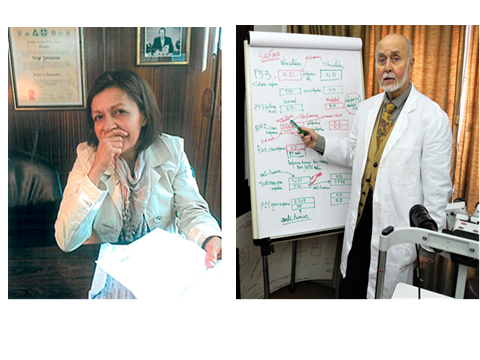
Dr. Jurasunas’ Patient (Left), Dr. Serge Jursunas ( Right)
-
Brenner J, Living Without Cancer. 2012; p. 50.








0 Comments