
Healing with Homeopathy
by Judyth Reichenberg-Ullman, ND, MSW, and Robert Ullman, ND
Galápagos: A Wealth of Homeopathic Medicines and a Remarkable Opportunity for New Provings
Part
1
Getting to Galápagos
Avid travelers and nature lovers that we are, we have been attracted by the Galápagos Islands for decades. But the cruise-ship style of exploring the islands seemed unaffordable, and four to seven days too short and regimented for independent adventurers like us. We were quite drawn to a kayak tour, but that turned out to be even more prohibitively expensive. So, we filed away the Galápagos, along with an African safari, as one of those dream trips we might do someday. We came close a couple of years ago when we stopped in the Quito airport on the way to visit the Huaorani Indians, and sighed regretfully when seemingly all of the other passengers embarked on to Galápagos.
This Christmas we began to plan a 20-day road trip down the Carretera Austral to Southern Patagonia while our Chile house was rented to tourists. As we went online to book the return car ferry, we noticed a red alert due to a threatened eruption of the Hudson volcano, very close to where we would be travelling. Upon further investigation, we discovered that the previous eruption lasted nine months, so we quickly switched gears, assessed our frequent-flier-miles situation, and booked flights to the Galápagos. “Island hopping,” traveling from island to island by plane or, much more commonly, by boat, a much more affordable alternative to cruises, which is growing rapidly in popularity, opening up the possibility for travel to backpackers and other low-budget travelers. We were fortunate enough to have acquaintances, in both places where we live, who have extensive Galápagos experience. We had days free, but were told that we were traveling during the two busiest and most expensive weeks of the year. We did make use of a travel agent highly praised online, only to learn, the last day on the islands, from a savvy, retired French couple who have traveled the world on a shoestring, that we, like they, could have traveled happily, at a fraction of what we paid, by booking hotels and tours upon arrival to each island. Live and learn!
Up Close and Natural
Unquestionably, the most phenomenal feature of Galápagos is the accessibility of the exotic wildlife. Although licensed guides were required in some areas, as a collaborative effort to preserve the fragile ecosystem, we had many other opportunities to venture off by ourselves, by land and sea, in the immediate proximity of lounging sea lions, prehistoric-looking iguanas cross crawling on the beach. We refrained from touching any of the animals, even though we were within a foot of baby, even newborn, sea lions; immense and ancient giant tortoises; and iguanas, though harmless to humans, posturing threateningly with a peculiar ratcheting-motion head nod. We became so quickly and naturally accustomed to “hanging out with the locals” that we experienced withdrawal symptoms upon reaching the cement jungle of Guayaquil!
Thanks to its significant distance from other land masses, and the fact that humans arrived only a few hundred years ago, there is abundant flora and fauna that is endemic – found only in Galápagos. It was in 1831 that the young, enthusiastic Charles Darwin boarded the HMS Beagle, destined to change the worldview of much of humanity and to bring international fame to the islands. It was the subtle, though unmistakable differences in the shapes of the finches that convinced Darwin of the theory of evolution. Despite the plundering of giant tortoises and other island treasures, and visits by over 180,000 tourists by plane and over 60 seafaring vessels, the Galápagos Islands remain surprisingly intact. The biodiversity is by far the most remarkable of any place we have traveled.
Galápagos Seen Through the Eyes of Two Homeopaths
Everywhere we wandered, we found ourselves surrounded by members of the plant, animal, and mineral kingdom that either already existed as a homeopathic medicine or would be an ideal candidate for a proving. The substances already available as homeopathic medicines were not prepared in the Galápagos, but come from other parts of the world. The following are just a few examples of natural substances that exist in the Galápagos that are used as homeopathic medicine.
Plant Kingdom
Mancinella hippomane (Poison apple)
Again and again we came across Manzanilla, known by homeopaths as Hippomane mancinella, or poison apple. It is a species of flowering plant belonging to the Euphorbiaceae, or spurge, family. Native to Florida, the Bahamas, Caribbean, Central American, and northern South America, the name in Spanish (Manzanilla) means “little apple,” from the superficial resemblance of its fruit and leaves to those of an apple tree. Known as manzanilla de la muerte, “little apple of death,” it is one of the most poisonous trees in the world. Homeopaths simply call it Mancinella. All parts of the tree, including the fruit, contain strong toxins. During rainfall, the plant secretes a white, milky, latexlike substance. It has been reported that even standing under the tree during rain can cause blistering of the skin. The smoke resulting from burning the tree can cause blindness, and the fruit, if eaten, can prove fatal. In the Caribbean, the sap of the tree was used to poison blowgun darts, and the leaves introduced into the water supply to poison enemies. As a form of torture, it is said that people would tie victims to the tree and leave them there to be exposed to the elements!
Homeopathically, Mancinella is used frequent for complaints of the mucous membranes, throat, and skin. The general characteristic of the Euphorbiaceae family is a feeling of tightness as if the skin is bound. Mancinella has a very striking keynote on the mental level, particularly given its potential lethal toxicity. Those needing the homeopathic substance exhibit a tremendous fear of being taken or possessed by the devil or evil spirits. They are unable to rid themselves of these dark thoughts, leading to a fear of being evil and of insanity. We had a patient diagnosed with bipolar disorder who described this very symptom, as well as constricting pain of her back and joints, and who responded beautifully, both physically and mentally, to the medicine.
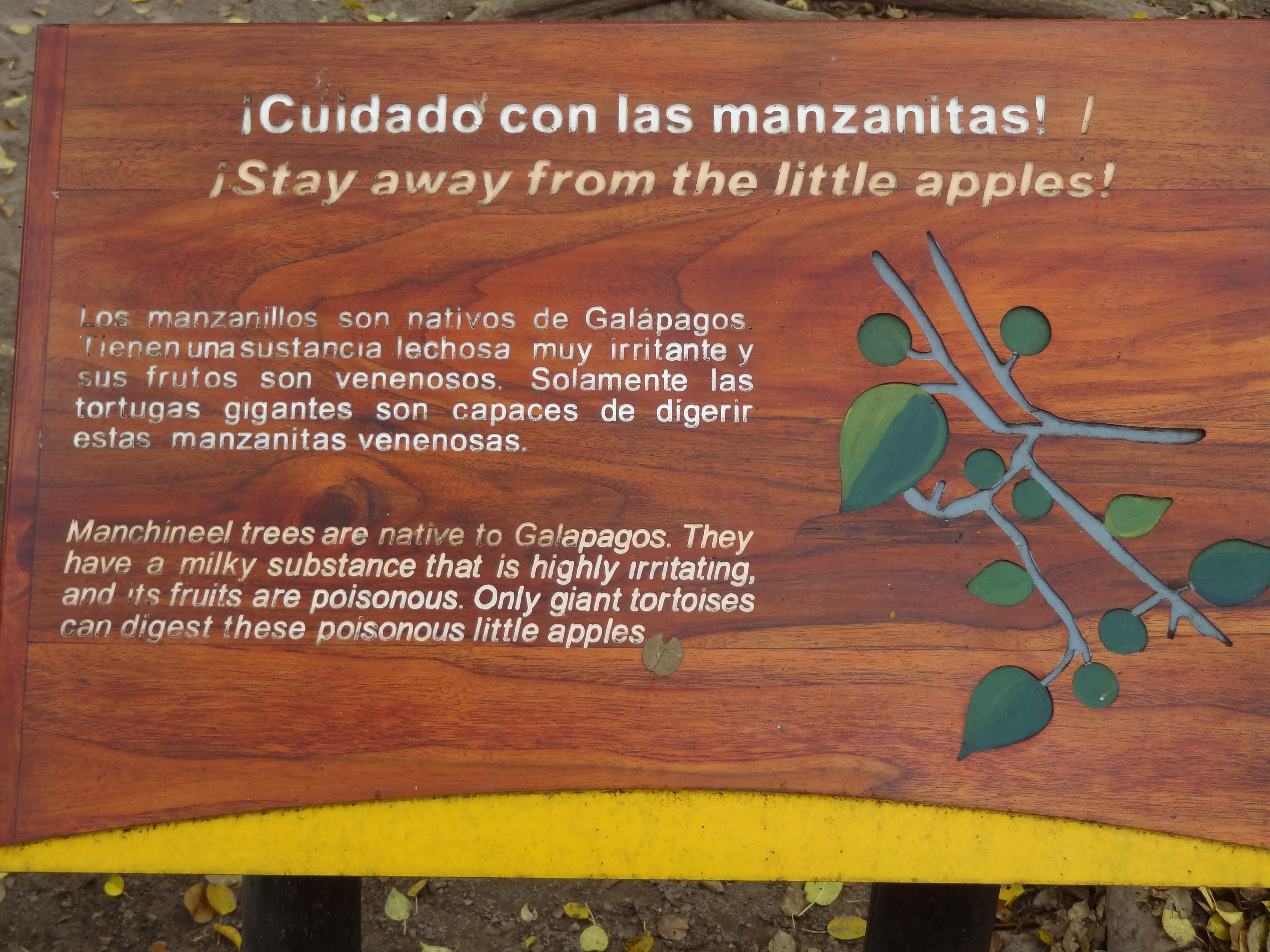
What was especially striking about the presence of this tree in Galápagos was how prevalent it was, and how easy it would have been to succumb to its temptation. In fact, we heard stories of Galapágueños who did die from ingesting the leaves. You can see the photo that we took of a Manzanilla in the middle of a location commonly frequented by tourists. Notice the warning sign!
Opuntia (Prickly pear)
Opuntia, prickly pear or nopal, is a member of the Cactaceae (cactus) family. Included in this genus are about 200 species, distributed throughout most of the Americas, including six different species in Galápagos. They are divided into 14 different varieties, most confined to one or a few islands. Basically, on islands where tall, trunked varieties are found, there are also giant tortoises with longer necks adapted to reach the plants. Islands without tortoises have low forms of Opuntia. We observed the beautiful, yellow-flowering cactus throughout the dry areas of the island, quite colorful and attractive.
In homeopathy, the sensation associated with the cactus family is expansion and contraction. Patients describe their chief complaint as having a balloon-like, bursting, fullness. The contraction may be experienced as tightness, constriction, or a feeling of being encaged in wire. The most common Opuntia in homeopathy is Opuntia vulgaris. We are successfully treating a patient for depression with this medicine. Using the case taking technique where the patient connects with and describes, from a subconscious state, exactly which medicine is needed, she used the words “short-tempered, like if you push a pin cushion … I think I will burst … so I have to be like a prickly pear.” She has responded well to the medicine.
Animal Kingdom
Diomeda exulans (Albatross)
An albatross aloft is a breathtaking sight. The largest of the sea birds, its wings are long and narrow, and its beak large. Its wingspan is up to 11 feet, it lives an average of 50 years, and it mates for life and breeds every two years. It spends the majority of its life airborne, glides for hours without resting, and can fly hundreds of kilometers a day. One bird, tracked through banding, was recorded traveling over 3700 miles in 12 days. These birds land only to nest, exclusively on islands. Mating pairs produce just one egg and take turns caring for it. Galápagos albatrosses are huge, with a wingspan of 240 cm, and have long yellow beaks, white heads, and a gray body. Galápagos albatross reproduces on the islands, spending the rest of the year along the Peruvian coastline.
Wandering albatross was proven by Jonathan Shore, MD. The core theme was searching for an impossible destination. Other key aspects of the proving were a sense of isolation; feeling of freedom, even in a group; and vulnerability, and homesickness. Wandering from place to place was a common feature. It is to be considered for repetitive stress/strain injury, for those who cannot settle down, and those who always feel away from home.
Dutch homeopath Pieter Kuiper found albatross to be an effective medicine for a 36-year-old woman with headaches and profuse menstrual periods. She complained of “flying behavior,” being carried along with the wind, and the desire to be free.
Urolophus halleri (Stingray)
Stingrays are graceful sea animals, often submerged in sand, detectable following a sudden swirl of and then a rapid motion with a gentle flapping or gliding motion. There are two different types generally, those that live on the bottom of the body of water in which they dwell, and the swimmers. The venom apparatus or “sting” is a modified scale. We observed a number of manta rays while snorkeling and kayaking in the Galápagos. The manta ray (Manta hamiltoni or Mantaraya) can have up to a 9-foot wingspan. They are quite beautiful and gentle. They feed on plankton near the surface of the water, and they can be commonly sighted from ships or dinghies.
Todd Rowe, MD, conducted a proving of stingray. The principal themes were confusion/poor memory, a feeling of betrayal or injustice, a feeling of disconnection, aloneness, confusion between dream and reality, and issues with water. Physical symptoms which were addressed included insomnia, fatigue, poor concentration, hot flashes, hay fever, and chronic nightmares.
We were unable to find any cases of Ray in the homeopathic literature, but it is just a matter of time until this will occur.
Mineral Kingdom
Hecla lava (volcanic rock from Iceland)
The Galápagos Islands are one of the world’s most active volcanic areas. Española, the oldest of the islands, was formed 3 to 5 million years ago from a volcanic hot spot located on the sea floor. As a hot spot discharges materials, they accumulate, spread, and rise, reaching a level of 6000 to 10,000 feet from the ocean floor. As the tectonic plates move at a rate of 3 inches a year, the volcano breaks free of the stationary hot spot, and forms an independent island. Six of the island’s volcanoes are still active, one on Fernandina and five on Isabela. We participated in a day hike to Sierra Negra volcano on Isabela, and visited the impressive, massive black lava crater – the largest caldera of all of the Galápagos volcanoes, 4.3 by 5.6 miles.
Homeopathic Hecla lava is made from the lava of the volcanic eruption of Mt. Hecla, which is located nearly 5000 feet above sea level. The craters are usually filled with snow, and there is usually a cloud floating above the volcano. The lava is a silicate of calcium, magnesium, and aluminum, as well as containing iron oxide. The preparation was introduced by a homeopathic doctor who happened to observe massive bony growth of the jaw in sheep grazing in the region. Hecla lava has been given successfully for a variety of bone diseases and glandular swellings.
Our most successful case of Hecla lava was a number of years ago in the bringing about a successful remission of multiple myeloma, a debilitating cancer of the bone.
More to Come
We will devote our next column to other homeopathic medicines corresponding to plants, animals, and minerals found on Galápagos and to suggested future homeopathic provings.
Judyth Reichenberg-Ullman and Robert Ullman are licensed naturopathic
physicians, board certified in homeopathy. Their books include the upcoming Homeopathic Treatment of Depression, Anxiety, Bipolar Disorder and other Mental and Emotional Problems (a revision of the previous title Prozac Free), as well as A
Drug-Free Approach to Asperger Syndrome and Autism, Ritalin-Free Kids,
Rage-Free Kids, Prozac Free, Homeopathic Self-Care: The Quick and Easy
Guide for the Whole Family, Whole Woman Homeopathy, The Patient’s
Guide to Homeopathic Medicine, and Mystics, Masters, Saints and
Sages: Stories of Enlightenment. The doctors have taught internationally,
and they practice at the Northwest Center for Homeopathic Medicine in
Edmonds and Langley, Washington. Dr. Reichenberg-Ullman was to speak about the homeopathic treatment of Asperger Syndrome in Germany in March, 2012. See http://www.narayanapublishers.com/mental_health_congress_2012.php/books_lang/en. The doctors live on Whidbey Island, Washington, and in Pucón, Chile. They treat patients by phone and videoconference, as well as in person, and can be reached at 425-774-5599 or www.healthyhomeopathy.com.








0 Comments