
Abstract
A case of a 57-year-old woman who has a five-year history of previously treated chronic Lyme disease (CLD-PT) is described. Her condition was characterized by severe chronic fatigue, blurred vision, difficulty thinking, depression, and severe joint pains that markedly impaired her quality of life. Blood serology indicated IgM antibodies to Borrelia burgdorferi and IgG antibodies for Babesia microtii. Since 2015 the patient was treated with several drug therapy schemes with no clinical improvement. After receiving an integrative approach at Sanoviv Medical Institute with multidisciplinary specialists, followed by an intensive treatment protocol that focused on resetting her redox homeostasis with oxidation, whole-body hyperthermia (WBH), and antioxidation treatments, the patient demonstrated noticeable clinical improvement. The treatment of CLD patients is very challenging. However, a careful and detailed examination by multidisciplinary specialists followed by an intensive treatment offers a thorough approach to reducing the burden of illness posed by CLD.
Introduction
Lyme disease (LD) is a multisystem illness caused by infection of several members of the Borrelia burgdorferi sensu lato complex. At least twenty genospecies have been described, whereas three of them (B. burgdorferi, B. garinii, and B. afzelii) are well-recognized human pathogens; this heterogeneity, along with coinfections, is presumed to be responsible for the extensive clinical and temporal spectrum of LD.1,2 It is estimated that up to one-third of patients with LD develop symptoms of chronicity for more than six months; this condition is referred to as chronic Lyme disease (CLD).3
The Centers for Disease Control and Prevention (CDC) estimates that 300,000 people are diagnosed with LD annually in the United States, and its incidence trend is continuously increasing.4 However, very little is known about CLD epidemiology and its burden of disease due to underdiagnosed or misdiagnosed cases. LD diagnosis is a complex challenge per se. Within the CDC meeting criteria based on the two-tier test, it has been reported that more than half of patients are underdiagnosed, mainly due to microbial burden of coinfections.5 Though serology tests are indispensable for diagnosing LD, clinical status must be the guideline for CLD diagnosis, even if the patient is unaware of erythema migrans lesions or if they presented months or years earlier. Commonly, patients with CLD suffer from unspecific symptomatology for several years. Chronic fatigue and neurologic disturbances are the chief complaints in CLD patients.6 These mild but persistent symptoms are due to several organic imbalances impacting various body systems, ranging from the immune system to the nervous system.7
The proposed pathophysiological mechanism of action of B. burgdorferi relies on mitochondrial dysfunction. Borrelial infection disrupts intracellular calcium homeostasis and increases pro-inflammatory cytokines, which promotes mitochondrial oxidative stress. B. burgdorferi also depletes intracellular cysteine, an essential amino acid for glutathione synthesis, one of the most potent antioxidants that scavenges excessive reactive oxygen and nitrogen species.8
Besides the mitochondrial dysfunction, B. burgdorferi has a significant ability to avoid the immune system. CLD patients in particular, exhibit an imbalance of pro-inflammatory cytokines, mainly interferon-gamma and interleukin-4.9 Also, B. burgdorferi disrupts dendritic cell migration and stimulates neutrophil chemotaxis; which promotes impairment of host defense mechanisms and induces symptomatology chronicity.10,11
Currently, the only approved treatment for LD is antibiotics,12 despite B. burgdorferi infection affecting several systems. However, “unorthodox” therapeutic options exist to treat CLD, such as whole-body hyperthermia, hyperbaric oxygen therapy, and a combination of efficacious natural supplements.13
Here, we discuss an integrative treatment program for CLD patients that results in almost 95% clinical improvement, according to our preliminary analysis and anecdotal experience. This case report aims to present a personalized treatment approach for CLD patients to restore redox status and well-being recovery by combining multidisciplinary therapeutic expertise.
Case Presentation
A 57-year-old woman presented with a fivr-year history of Chronic Lyme Disease-Previously Treated (CLD-PT). Her chief complaints were chronic fatigue, blurry vision, difficulty thinking, forgetfulness, irritability, depression, joint pain, stiffness of the neck, and numbness of upper extremities. She referred to living in what is considered a Lyme-endemic area; and in December 2016, her serology testing resulted positive for B. burgdorferi and B. microtii. After lab testing confirmed LD, she underwent several drug and natural supplement therapies for almost four years with no clinical improvement. (See Figure 1)
Suspension of her PhD degree program due to disability forced her to seek alternative therapeutic options. She completed the Chronic Infections Program at Sanoviv Medical Institute in February 2018, where she received several health consultations from a physician, mind-body therapist, biological dentist, nutritionist, psychologist, chiropractor, and fitness professional. After discussing the root causes of the patient’s health problems and recommendations from every therapist, the patient underwent a personalized treatment protocol to regain her redox status. She received oxidative treatments with hyperbaric therapy, UV light and ozone autohemotherapy, intravenous artesunate, and high doses of intravenous vitamin C. This course was then followed by whole-body hyperthermia (WBH), achieving a core temperature of 41.7 °C (107.06 °F), intravenous antibiotics (based on the patient’s serology tests) and alpha-lipoic acid, with glutathione for antioxidant support. She completed the program successfully with noticeable clinical improvement. Interestingly, the night after receiving WBH, she experienced an outstanding mental health improvement that, according to the patient, boosted her to start writing her PhD thesis.
Two years later, the patient experienced another tick bite on her left leg. Immediately after, she noticed the symptoms had returned and enrolled again in the Chronic Infections Program at Sanoviv Medical Institute (January 2020). At the end of her second visit, she recognized the psychology and mind-body sessions as the most impactful therapies to empower her return to wellness. She is currently writing a book chapter recounting her Lyme disease experience.
Discussion
The redox status in CLD patients is commonly disrupted. The first step in therapy is to boost the immune system so that it can recognize B. burgdorferi and other coinfections. The next step is to recover oxidative and antioxidative homeostasis.8 In the Chronic Infections Program at Sanoviv, the pursuit of redox balance is achieved by promoting an oxidative state, followed by WBH, and ending up with antioxidation support. (See Figure 2).
Oxidation Status
Hyperbaric oxygen therapy increases the generation of oxygen free-radicals and promotes the oxygen-dependent peroxidase system. This results in inhibition of bacterial metabolic functions and enhancement of leucocyte activation against tick-borne infections.14,15
Ozone and ultraviolet blood irradiation therapies increase oxygen, glucose, and ATP delivery within tissues; upregulate antioxidant enzyme expression, and trigger a neurohumoral response. It has been suggested that ozone can reverse chronic oxidative stress due to aging, chronic infections, and degenerative processes.16 The ozonation process generates one mole of hydrogen peroxide (H2O2) and two moles of lipid oxidation products. These oxidation products result in transitory oxidative stress that triggers biological activity without toxicity, as the induction of the heme-oxygenase-1, a protective enzyme that catabolizes free heme, prevents apoptosis induction due to pro-inflammatory agonists.17,18 Ozone also induces activation of bone marrow metalloproteinases, which promotes staminal cell detachment and attracts them to sites where a previous injury has occurred.19 In CLD patients, infections of borrelial persistent forms usually persist. These forms consist of bacterial biofilm organization that allows the spirochaete evasion of antibiotics and host immune system.20,21 Ozone is directly germicidal and can cut through this bacterial biofilm.22,23
Continuing with the oxidation state promotion, after hyperbaric and ozone therapy, high doses of intravenous vitamin C (HDIVC) were administered to the patient. Vitamin C at high doses acts as a prodrug for the production of H2O2 in the extracellular space. H2O2 is a bacteriostatic agent, and its generation across the interstitial fluid is only achieved by intravenous administration of vitamin C.24,25 In this particular case, we used 25 grams of IV vitamin C.
After HDIVC, our patient received artesunate, a water-soluble semi-synthetic derivate from artemisinin.26 Artesunate is of fundamental importance in patients with CLD and coinfection with B. microtii, as occurred in our patient. Artesunate disturbs the mitochondrial membrane of the parasite, which generates reactive oxygen species (ROS) thus enhancing the oxidation state and carbon-centered radical molecules that modify central regulatory proteins of the parasite.27 Furthermore, artesunate has demonstrated an improvement in short-term memory for CLD patients.28
Whole-Body Hyperthermia
Once achieving this intensive oxidation state, our patient received WBH along with intravenous antibiotics. WBH, as part of this multimodal approach, aims to eradicate borrelial infection and further coinfections. The body temperature is raised to about 42°C in WBH and this induction of hyperthermia is beneficial for our patient but deleterious for the pathogen. The mechanism of the latter works by disturbing the architecture of the borrelial membrane, altering its fluidity and organization, making the borrelial infection less severe. LaRocca et al. demonstrated that bactericidal activity against B. burgdorferi increases with temperature elevation.29
The numerous beneficial effects of WBH against borrelial and coinfections begin with an improvement of antibiotics-tissue-perfusion due to systemic vasodilatation. WBH also directly modulates the immune system by increasing mobility, proliferation, enzymatic activity, and phagocytic and bactericidal properties of leucocytes, leading to eradication of borrelial infection and other coinfections. 30–32
Other important benefits of WBH are its analgesic and antidepressant effects. The analgesic effect of WBH comes from its elimination of inflammatory factors that stimulate nerve endings, which permits the relaxation of skeletal muscles and reduction of tendon and soft tissue tension.32 The antidepressant-like response promoted by WBH occurs by activation of temperature-sensitive ion channels in the skin. That signal is then directed to brainstem serotonergic neurons, producing a sense of relaxation and wellbeing in response to warm temperatures.33,34 The stimulation of warm-sensitive thermosensory pathways projecting from the skin to cortical and subcortical regions of the brain may affect neural activity relevant to mood improvement.35
Antioxidation Status
Following WBH sessions, alpha-lipoic acid (ALA) and glutathione were administered to promote an antioxidative state. ALA is a cofactor in the mitochondrial enzyme system. In vivo experiments demonstrate that ALA plays a fundamental role in preventing inflammatory response in the liver and antioxidant support against bacterial endotoxins.36 Glutathione is the most abundant cellular antioxidant and serves as a sulfhydryl buffer. Both ALA and glutathione have hepatoprotective actions associated with the amelioration of mitochondrial oxidative stress and prevention of the induction of genes that trigger hepatic inflammation. Also, glutathione can react with H2O2 and has detoxifying properties.36,37
After utilizing the combined therapeutic approach of oxidation, WBH, and antioxidation; the oxidative homeostasis was achieved, and the patient’s immune system was strengthened to recognize and eliminate tick-borne pathogens.
Patient Perspective
According to our patient, besides her medical treatment, psychology sessions were vital in her healing process. Her personality is normally very enthusiastic and proactive. When LD symptoms arose, frustration, anger, and disappointment appeared as well. Psychology sessions focused on emotion recognition and renewing her life purpose with psychotherapy of forgiveness, mindfulness, brain spotting, and neuro-emotional techniques. CLD patients have a range of circumstances that can increase the severity of the disease and are not usually considered or explored. Hence, it is necessary to identify them and be treated comprehensively.
Conclusion
Tick-borne diseases, mainly CLD, are very challenging to diagnose and treat. We firmly suggest that CLD be addressed with an integrative and personalized approach following multidisciplinary therapeutic expertise. The redox balance establishment, with oxidation, WBH, and antioxidation, is focused on tick-borne infection eradication by strengthening the immune system. Moreover, the patient perspective is crucial for the healing process because the relationship between mind and body of CLD patients sets the path for healing and wellness.
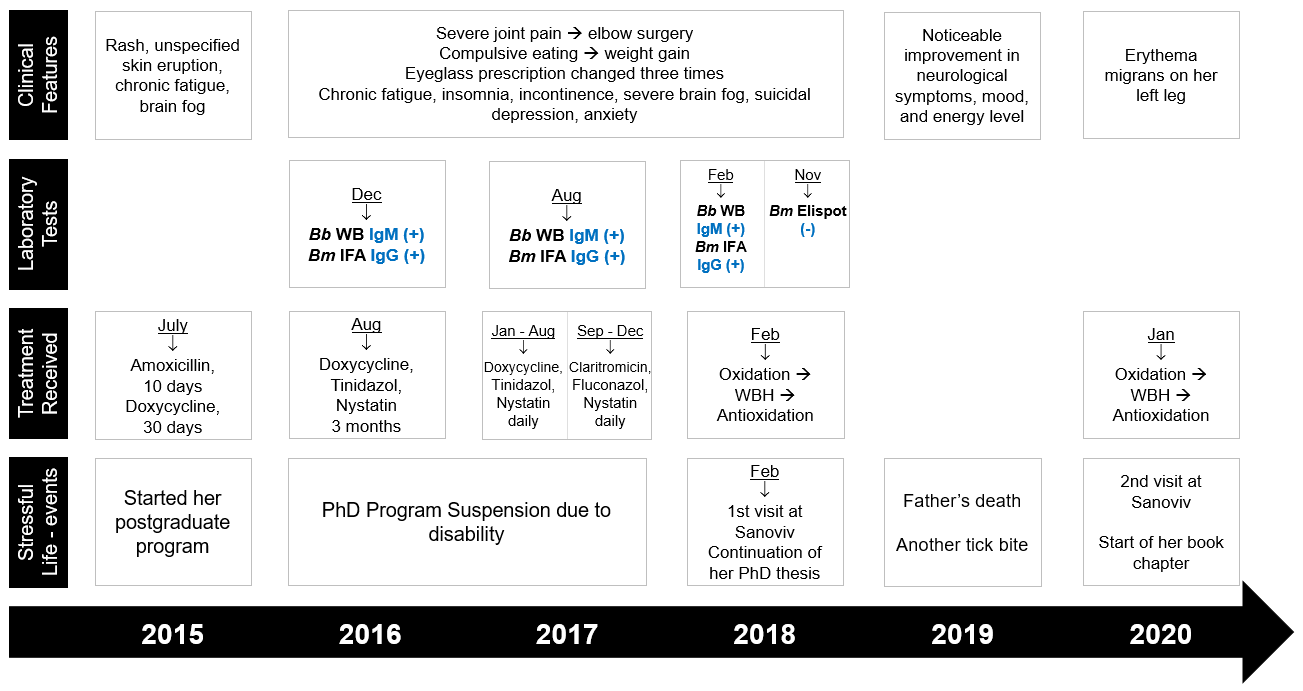
Figure 1. Patient Timeline.
In the Laboratory Tests section: the same results were obtained in December 2016, August 2017, and February 2018. Bb: Borrelia burgdorferi, Bm: Babesia microtii, WB: Western Blot, IFA: Immunofluorescence Assay.

Figure 2. Chronic Lyme Disease treatment essentials at Sanoviv.
WBH: Whole-body Hyperthermia; HDIVC: High Doses of Intravenous Vitamin C.
References
1. Steere AC, Strle F, Wormser GP, et al. Lyme borreliosis. Nat Rev Dis Primers. 2016;2(1):16090.
2. Cardenas-de la Garza JA, De la Cruz-Valadez E, Ocampo-Candiani J, Welsh O. Clinical spectrum of Lyme disease. Eur J Clin Microbiol Infect Dis. 2019;38(2):201-208.
3. Aucott JN, Rebman AW, Crowder LA, Kortte KB. Post-treatment Lyme disease syndrome symptomatology and the impact on life functioning: is there something here? Qual Life Res. 2013;22(1):75-84.
4. Mead PS. Epidemiology of Lyme Disease. Infectious Disease Clinics of North America. 2015;29(2):187-210.
5. Garg K, Meriläinen L, Franz O, et al. Evaluating polymicrobial immune responses in patients suffering from tick-borne diseases. Sci Rep. 2018;8(1):15932.
6. Johnson L, Wilcox S, Mankoff J, Stricker RB. Severity of chronic Lyme disease compared to other chronic conditions: a quality of life survey. PeerJ. 2014;2:e322.
7. Shor S, Green C, Szantyr B, et al. Chronic Lyme Disease: An Evidence-Based Definition by the ILADS Working Group. Antibiotics. 2019;8(4):269.
8. Peacock BN, Gherezghiher TB, Hilario JD, Kellermann GH. New insights into Lyme disease. Redox Biology. 2015;5:66-70.
9. Knapp KL, Rice NA. Human Coinfection with Borrelia burgdorferi and Babesia microti in the United States. Journal of Parasitology Research. 2015;2015:1-11.
10. Hartiala P, Hytonen J, Pelkonen J, et al. Transcriptional response of human dendritic cells to Borrelia garinii–defective CD38 and CCR7 expression detected. Journal of Leukocyte Biology. 2007;82(1):33-43.
11. Malavasi F, Deaglio S, Funaro A, et al. Evolution and Function of the ADP Ribosyl Cyclase/CD38 Gene Family in Physiology and Pathology. Physiological Reviews. 2008;88(3):841-886.
12. Lantos PM, Rumbaugh J, Bockenstedt LK, et al. Clinical Practice Guidelines by the Infectious Diseases Society of America (IDSA), American Academy of Neurology (AAN), and American College of Rheumatology (ACR): 2020 Guidelines for the Prevention, Diagnosis and Treatment of Lyme Disease. :48.
13. Lantos PM, Shapiro ED, Auwaerter PG, et al. Unorthodox Alternative Therapies Marketed to Treat Lyme Disease. Clinical Infectious Diseases. 2015;60(12):1776-1782.
14. Gill AL, Bell CNA. Hyperbaric oxygen: its uses, mechanisms of action and outcomes. QJM. 2004;97(7):385-395.
15. Huang C-Y, Chen Y-W, Kao T-H, et al. Hyperbaric oxygen therapy as an effective adjunctive treatment for chronic Lyme disease. Journal of the Chinese Medical Association. 2014;77(5):269-271.
16. Bocci VA. Scientific and Medical Aspects of Ozone Therapy. State of the Art. Archives of Medical Research. 2006;37(4):425-435.
17. Larsen R, Gozzelino R, Jeney V, et al. A Central Role for Free Heme in the Pathogenesis of Severe Sepsis. Science Translational Medicine. 2010;2(51):51ra71-51ra71.
18. Gozzelino R, Jeney V, Soares MP. Mechanisms of Cell Protection by Heme Oxygenase-1. Annu Rev Pharmacol Toxicol. 2010;50(1):323-354.
19. Bocci V, Larini A, Micheli V. Restoration of Normoxia by Ozone Therapy May Control Neoplastic Growth: A Review and a Working Hypothesis. The Journal of Alternative and Complementary Medicine. 2005;11(2):257-265.
20. Schwarzbach A, Herranen A, Gilbert L, Meriläinen L. Morphological and biochemical features of Borrelia burgdorferi pleomorphic forms. Microbiology. 2015;161(3):516-527.
21. Meriläinen L, Brander H, Herranen A, Schwarzbach A, Gilbert L. Pleomorphic forms of Borrelia burgdorferi induce distinct immune responses. Microbes and Infection. 2016;18(7-8):484-495.
22. Bialoszewski D, Pietruczuk-Padzik A, Kalicinska A, et al. Activity of ozonated water and ozone against Staphylococcus aureus and Pseudomonas aeruginosa biofilms. Medical science monitor: international medical journal of experimental and clinical research. 2011;17(11):BR339.
23. Rowen R. Ozone and oxidation therapies as a solution to the emerging crisis in infectious disease management: a review of current knowledge and experience. Med Gas Res. 2019;9(4):0.
24. Chen Q, Espey MG, Sun AY, et al. Ascorbate in pharmacologic concentrations selectively generates ascorbate radical and hydrogen peroxide in extracellular fluid in vivo. Proceedings of the National Academy of Sciences. 2007;104(21):8749-8754.
25. Duconge J, Gonzalez MJ, Warnock W, Riordan NH. Pharmacokinetics of Vitamin C: insights into the oral and intravenous administration of ascorbate. 2008;27(1):13.
26. Efferth T, Romero MR, Wolf DG, Stamminger T, Marin JJG, Marschall M. The Antiviral Activities of Artemisinin and Artesunate. CLIN INFECT DIS. 2008;47(6):804-811.
27. Li W, Mo W, Shen D, et al. Yeast Model Uncovers Dual Roles of Mitochondria in the Action of Artemisinin. Dutcher S, ed. PLoS Genet. 2005;1(3):e36.
28. Puri BK, Hakkarainen-Smith JS, Monro JA. The effect of artesunate on short-term memory in Lyme borreliosis. Medical Hypotheses. 2017;105:4-5.
29. LaRocca TJ, Crowley JT, Cusack BJ, et al. Cholesterol Lipids of Borrelia burgdorferi Form Lipid Rafts and Are Required for the Bactericidal Activity of a Complement-Independent Antibody. Cell Host & Microbe. 2010;8(4):331-342.
30. Hildebrandt B. The cellular and molecular basis of hyperthermia. Critical Reviews in Oncology/Hematology. 2002;43(1):33-56.
31. Hildebrandt B, Hegewisch-Becker S, Kerner T, et al. Current status of radiant whole-body hyperthermia at temperatures >41.5°C and practical guidelines for the treatment of adults. The German ‘Interdisciplinary Working Group on Hyperthermia.’ International Journal of Hyperthermia. 2005;21(2):169-183.
32. Jeziorski K. Hyperthermia in rheumatic diseases. A promising approach? r. 2018;56(5):316-320.
33. Lowry C, Lightman S, Nutt D. That warm fuzzy feeling: brain serotonergic neurons and the regulation of emotion. J Psychopharmacol. 2009;23(4):392-400.
34. Janssen CW, Lowry CA, Mehl MR, et al. Whole-Body Hyperthermia for the Treatment of Major Depressive Disorder: A Randomized Clinical Trial. JAMA Psychiatry. 2016;73(8):789.
35. Raison CL, Hale MW, Williams LE, Wager TD, Lowry CA. Somatic influences on subjective well-being and affective disorders: the convergence of thermosensory and central serotonergic systems. Front Psychol. 2015;5.
36. Xia X, Su C, Fu J, et al. Role of α-lipoic acid in LPS/d-GalN induced fulminant hepatic failure in mice: Studies on oxidative stress, inflammation and apoptosis. International Immunopharmacology. 2014;22(2):293-302.
37. Puri BK, Hakkarainen-Smith JS, Derham A, Monro JA. Co-administration of α-lipoic acid and glutathione is associated with no significant changes in serum bilirubin, alkaline phosphatase or γ-glutamyltranspeptidase levels during the treatment of neuroborreliosis with intravenous ceftriaxone. Journal of Complementary and Integrative Medicine. 2015;12(3):227-230.








0 Comments