

At the beginning of 2021, I broke my L3 vertebra during a motorcycle accident and underwent two surgeries in which surgeons replaced my shattered L3 with a metal “cage” (looks like a spring) and fused this cage to the L4 and L2 vertebrae with bars. I also broke both sides of my jaw and fractured my left shoulder. I felt so overwhelmed and totally discouraged by the ongoing pain. A year later, after doing the self-healing project as part of the university class assignment, I feel so much better all the time, stopped taking all prescription pain medications and eliminated the sharp pains in my back. This project has taught me that I have the skill set needed to be whole and healthy. –J.C., 28-year-old college student
Chronic pain is defined as a pain that persist or recurs for more than three months.1 It is exhausting and often associated with reduced quality of life and increased medical costs.2 Pain and depression co-exacerbate physical and psychological symptoms and can lead to hopelessness.3,4 To go to bed with pain and anticipate that pain is waiting for you as you wake up is often debilitating. One in five American adults experience chronic pain most frequently in back, hip, knee, or foot.2 Patients are often prescribed analgesic medications (“pain killers”) to reduce pain. Although, the analgesic medications can be effective in the short term to reduce pain, the efficacy is marginal for relieving chronic pain.5,6 Recent research by Parisien and colleagues (2022) reported that anti-inflammatory drugs were associated with increased risk of persistent pain.7 This suggest that anti-inflammatory treatments might have negative effects on pain duration. In addition, the long-term medication use is a major contributor to opioid epidemic and increased pain sensitivity.8-10 Pain can often be successfully treated with a multidisciplinary approach that incorporates non-pharmacologic approaches. These include exercise, acceptance and commitment therapy, as well as hypnosis.11 This paper reports how self-healing strategies, taught as part of an undergraduate university class, can be an effective approach to reduce the experience of chronic pain and improve health.
Each semester, about 100 to 150 junior and senior college students at San Francisco State University enroll in a holistic health class that focused on ‘whole-person’ Holistic Health curriculum. The class includes an assessment of complementary medicine and holistic health. It is based upon the premise that mind/emotions affect body and body affect mind/emotions that Green, Green & Walters (1970) called the psychophysiological principle12: “Every change in the physiological state is accompanied by an appropriate change in the mental emotional state, conscious or unconscious, and conversely, every change in the mental emotional state, conscious or unconscious, is accompanied by an appropriate change in the physiological state.”
The didactic components of the class include the psychobiology of stress, the role of posture, psychophysiology of respiration, lifestyle, and other health factors, reframing internal language, guided and self-healing imagery. Students in the class are assigned self-healing projects using techniques that focus on awareness of stress, dynamic regeneration, stress reduction imagery for healing, and other behavioral change techniques adapted from the book, Make Health Happen.13
The self-practices during the last six weeks of the class focus on identifying, developing, and implementing a self-healing project to optimize their personal health. The self-healing project can range from simple lifestyle changes to reducing chronic pain. Each student identifies their project such as increasing physical activity, eating a healthy diet and reducing sugar and junk food, stopping vaping/smoking, reducing anxiety or depression, stopping hair pulling, reducing headaches, decreasing eczema, or back pain, etc. At the end of the semester, 80% or more of the students report significant reduction in symptoms.14-17 During the last five semesters, 13 percent of the students focused on reducing pain (e.g., migraines, neck and shoulder pain, upper or lower back pain, knee pain, wrist pain, and abdominal pain). The students successfully improved their symptoms an average of 8.8 on a scale from 0 (No benefit) to 10 (total benefit/improvement). The success for improving their symptoms correlates 0.63 with their commitment and persistence to the project.18
The purpose of this paper is to describe a case example how a student with severe back pain reduced her symptoms and eliminated medication by implementing an integrated self-healing process as part of a class assignment and offer recommendations how this could be useful for others.
Participant: A 28-year-old female student (J.C.) who on January 28, 2021 broke her L3 vertebra in a motorcycle accident. She underwent two surgeries in which surgeons replaced her shattered L3 with a metal “cage” (which she describes as looking like a spring) and fused this cage to the L2 and L4 vertebrae with bars. She also broke both sides of her jaw and fractured her left shoulder. More than a year later, at the beginning of the self-healing project, she continued to take 5-10 mgs of Baclofen and 300 mgs of Gabapentin three times a day to reduce pain.
Goal of the self-healing project: To decrease the sharp pain/discomfort in her lower back that resulted from the motorcycle accident and, although not explicitly listed, to decrease the pain medications.
Self-healing process: During the last six weeks of the 2022 Spring semester, the student implemented her self-healing practices for her personal project which consisted of the following steps.
To create a self-healing plan that included exploring the advantage and disadvantage of her illness.
To create a step-by-step plan with specific goals to relief her tension and pain in her lower back. This practice allowed her to quantify her problem and the solutions. Like so many people with chronic pain, she focused on the problem and feelings (physical and emotional) associated with the pain. As a result, she often feels hopeless and worried that it would not change.
To observe and evaluate when her pain sensations changed. She recognized that she automatically anticipated and focused on the pain and anxiety whenever she needed to bend down into a squat. She realized that she had been anticipating pain even before she began to squat. This showed that she needed to focus on healing the movement of this area of her body.
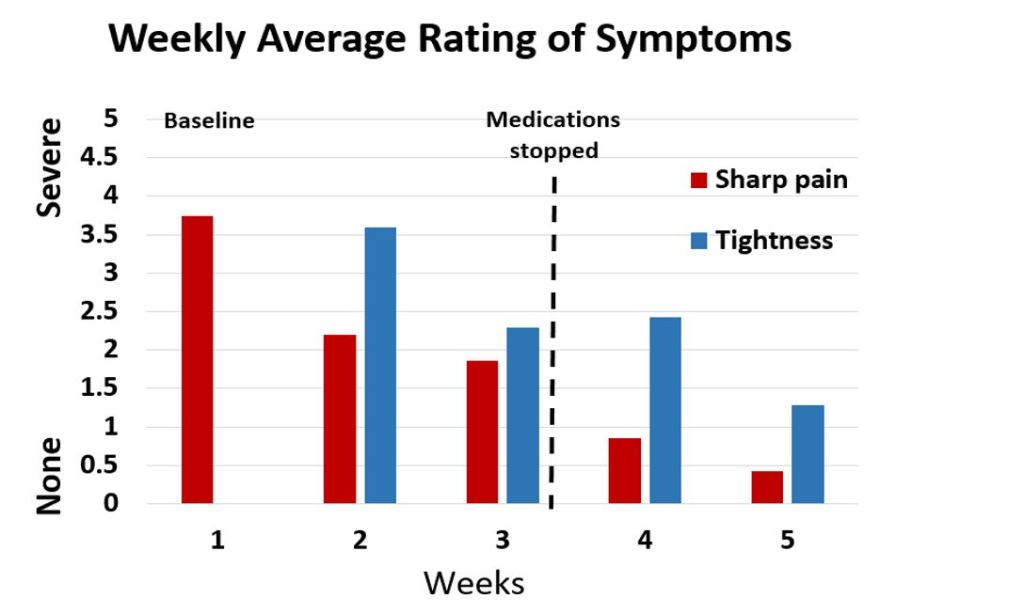
Through her detailed observations, she realized that her previous general rating of back pain could be separated into muscle tightness/stiffness and pain. With this realization, she changed the way she was recording her pain level. She changed it from “pain level” into two categories: tightness and sharp pains.
To ask questions of her unconscious through a guided practice of accessing an inner guide through imagery (For detailed instructions, see Peper, Gibney, & Holt, 2002, pages 197-206).13
In this self-guided imagery, the person relaxes and imagines being in a special healing place where you felt calm, safe, and secure. Then as you relaxed, you become aware of another being (wise one or guide) approaching you (the being can be a person, animal, light, spirit, etc.). The being is wise and knows you well. In your mind, you ask this being or guide questions such as, “What do I need to do to assist in my own healing?” Then you wait and listen for an answer. The answer may take many forms such as in words, a picture, a sense of knowing, or it may come later in dreams or in other forms. When students are assigned this practice for a week, almost all report experiencing some form of guide, and many find the answers meaningful for their self-healing project.
Through this imagery of the inner guide script, she connected with her higher self and the wise one told her to “Wait.” This connecting with the wise one was key in accepting that the project was not as daunting as she initially thought. She realized that pain was not going to be forever in her future. She also interpreted that as reminder to have patience with herself. Change takes practice, time and practice such as she previously experienced while correcting her posture to manage her emotions and edit her negative thoughts into positive ones.17 Whenever she would have pain or feel discouraged because of external circumstances, she would remind herself of three things:
- I need to have patience with myself.
- I have all the healing tools inside me, and I am learning to use them.
- If I do not make time for my wellness, I’ll be forced to make time for my illness.
To practice self-healing imagery as described by Peper, Gibney, & Holt (2002)13 and adapted from the work by Dr. Martin Rossman.19 Imagery can be the communication channel between the conscious/voluntary and the unconscious/autonomic/involuntary nervous system.20-22 It appears to act as the template and post-hypnotic suggestion to implement behavior change and may offer insight and ways to mobilize the self-healing potential.23 Imagery is dynamic and changeable.
The process of self-healing imagery consists of three parts.
- To inspect the problem and create a graphic illustration of the problem as it is experienced at that moment of time.
- To illustrate graphically how that area/problem would look when being completely well/whole or disappeared.
- To create a self-healing process by which the problem would become transformed into health.13 The process focuses on what the person can do for themselves; namely, each time they became aware of, anticipated, or felt the problem, they would focus on the self-healing process. It provides hope—since the person now focuses on the healing of the problem and becoming well.
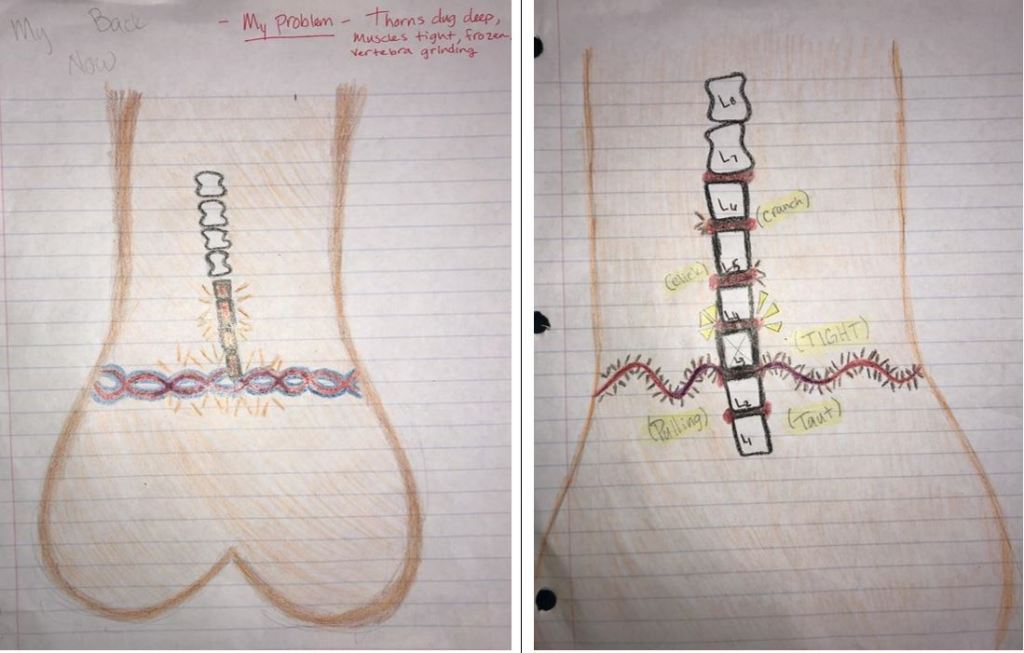
The drawings of inspection of the pain and problem she experienced at that moment of time are shown in Figure 1. The resolution of the problem and being well/whole are illustrated in Figure 2.
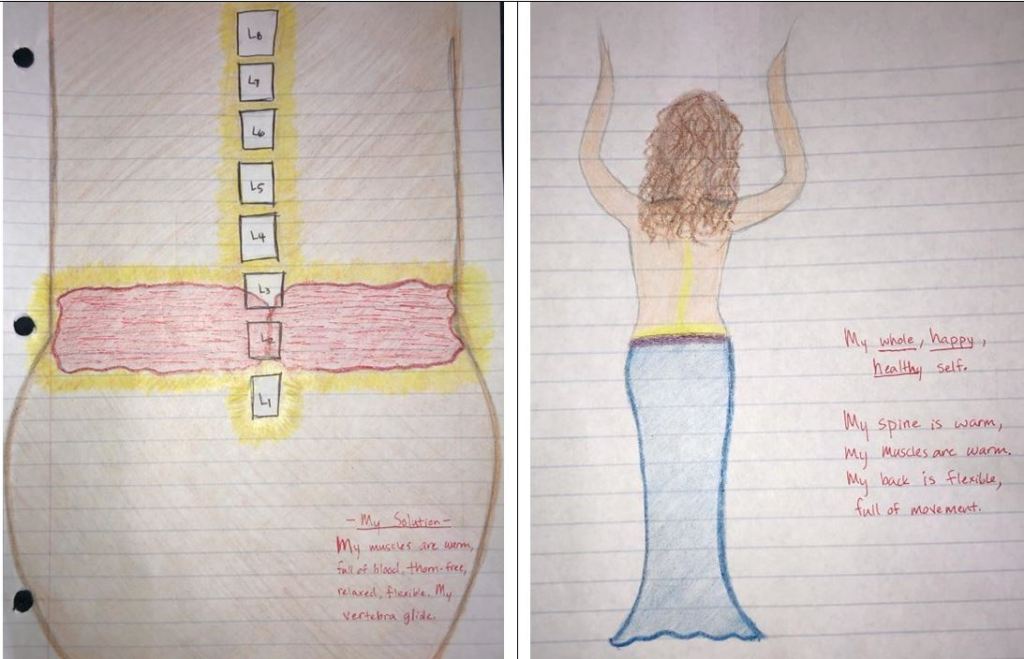
Although she utilized the first image of the muscles warm, full of blood, free of thorns and the muscles relaxed and flexible, her second image of her fully being healed was inspired through a religious statue of Yemaya that she had in her room (Yemaya is a major water spirit from the Yoruba religion Santeria and Orisha of the seas and protector of women). Each time she saw the statue, she thought of the image of herself fully healed and embodying the spirit Orisha. Therefore, this image remained important to her all the time.
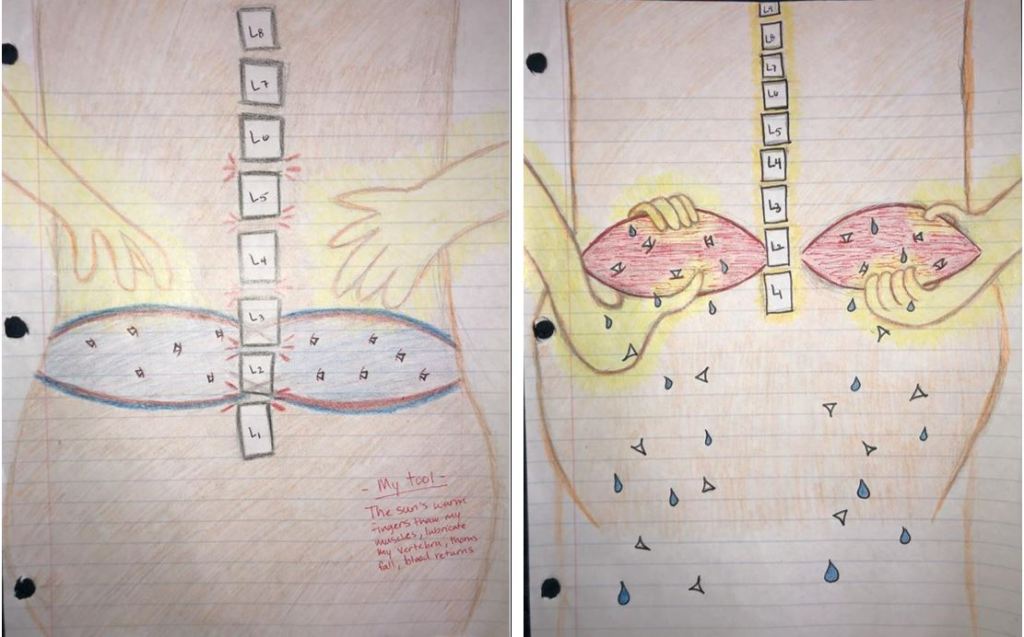
Her healing imagery process by which she transforms the image of inspecting of the problem to being totally well are illustrated in Figure 3.
For five weeks as she implemented her self-healing project by creating a self-healing plan, asking questions of her unconscious, drawing her self-healing imagery. She also incorporated previously learned skills from the first part of the semester such diaphragmatic breathing, hand warming, shifting slouching to upright posture, and changing language. Initially she paired hand warming with the self-healing imagery and she could feel an increase in body warmth each time she practiced the imagery. She practiced the self-healing imagery as an in-depth daily practice and throughout the day when she became aware of her back as described in one of her log entries.
I repeated the same steps as the day prior today. I did my practice in the early morning but focused on the details of the slowed down movements of the sun’s hands. I saw them as they stretched out to my back, passed through my skin, wrapped around my muscles, and began to warm them. I focused on this image and tried to see, in realistic detail, my muscles with a little ice still on them, feeling hard through and through, the sun’s glowing yellow-orange fingers wrapped around my muscles. I imaged the thorns still in my muscles, though far fewer than when I started, and then I imaged the yellow-orange glow start to seep out from the sun’s palms and fingers and spread over my muscles. I imaged the tendons developing as the muscle tissue thawed and relaxed, the red of the muscle brightened, the ice on and within my muscles started to melt, and the condensation formed as it ran down into collected droplets at the bottom of my muscles. I imaged the thorns lose their grip and fall out, one at a time, in tandem with the droplets falling. I continued this process and imaged my muscles expanding with warmth and relaxation as they stayed engulfed in the warmth of the sun.
At the end of my practice, I did a small stretch session. I felt extremely refreshed and ready for yet another extremely busy day between internship, graduation, and school. I would say I felt warm and relaxed all the way into the afternoon, about 6 hours after my practice. This was by far the most detailed and impactful imagery practice I have had.
The self-healing imagery practice provided me with the ability to conceptualize more than my problem as it showed me the tools to (and the importance of) conceptualizing my solution, both the tool and end result.
Results
Pain and tightness decreased, and she stopped her medication by the third week as shown in Figure 4.
At the 14-week follow-up, she has continued to improve, experiences minimal discomfort, and no longer takes medication. As she stated, “I was so incredibly shocked how early on [in the project] I was able to stop taking pain medications that I had already taken every day for over a year.”
Discussion
This individual case example provides hope that health can be improved when shifting the focus from pain and discomfort to focusing on actively participating in the self-healing process. As she wrote:
The lesson was self- empowerment in regard to my health. I brought comfort to my back. There is metal in my back for the rest of my life and this is something I have accepted. I used to look at that as a horrible thing to have to handle forever. I now look at it as a beautiful contraption that has allowed me to walk across a graduation stage despite having literally shattered a vertebra. I am reintegrating these traumatized parts of my body back into a whole health state of mind and body. Doctors did not do this, surgeries did not, PT didn’t and neither did pain medications. MY body and MY mind did it. I did this.
Besides the self-healing imagery and acting upon the information she received from the asking questions from the unconscious there were many other factors contributed to her healing. These included the semester-long self-practices and mastery of different stress management techniques, learning how stress impacts health and what can the person can do to self-regulate, as well as being introduced to the many case examples and research studies that suggested healing could be possible even in cases where it seemed impossible.
The other foundational components that was part of the class teachings included attending the weekly classes session and completing the assigned homework practices. These covered discussion about placebo/nocebo, possibilities and examples of self-healing with visualization, the role of nutrition, psychophysiology of stress and factors are associated with healthy aging across cultures. The asynchronous assignments investigated factors that promoted or inhibited health and the role of hope. The discussions pointed out that not everyone may return to health; however, they can always be whole. For example, if a person loses a limb, the limb will not regrow. The healing process includes acceptance and creating new goals to achieve and live a meaningful life.
The possibility that students could benefit by implementing the different skills and concepts taught in the class were illustrated by sharing previous students’ successes in reversing disorders such as hair pulling, anxiety, psoriasis, and pain. In addition, students were assigned to watch and comment on videos of people who had overcome serious illness. These included Janine Shepherd’s 2012 TED talk, “A broken body isn’t a broken person,”24 and Dr. Terry Wahl’s 2011 TEDxIowaCity talk, “Minding your mitochondria.”25 Janine Shepard shared how she recovered from a very serious accident in which she was paralyzed to becoming an acrobatic pilot instructor while Dr. Terry Wahl shares how she used diet to cure her MS and get out of her wheelchair. Other assignments included watching Madhu Anziani’s presentation, “Healing from paralysis-Music (toning) to activate health,” in which he discussed his recovery from being a quadriplegic to becoming an inspirational musician.26 The students read and commented on student case examples of reversing acid reflux, irritable bowel and chronic headaches.27-32
Although self-healing imagery appears to be the major component that facilitated the healing, it cannot be separated from the many other concepts and practices that may have contributed. For example, the previous practices of learning slow diaphragmatic breathing and hand warming may have allowed the imagery to become a real kinesthetic experience. In addition, by seeing how other students overcame chronic disorders, the class provided a framework to mobilize one’s health.
Lessons Extracted from This Case Example That Others May Use to Mobilize Health
- Take action to shifts from being hopeless and powerless to becoming empowered and active agent in the healing process.
- Change personal beliefs through experiential practices and storytelling that provides a framework that healing and improvement are possible.
- Teach the person self-regulation skills such as slower breathing, muscle relaxation, cognitive internal language changes, hand warming by which the person experiences changes.
- Provide believable role models who shared their struggle in overcoming traumatic injury, watch inspirational talks, and share previous clients or students’ self-reports who had previously improved.
- Transform the problem from global description into behavioral specific parts. For example, being depressed is a global statement and too big to work on. Breaking the global concept into specific behaviors such as, my energy is too low to do exercise or I have negative thoughts, would provide specific interventions to work on such as, increasing exercise or changing thoughts. In JC’s case, she changed the general rating of pain into ratings of muscle tightness and sharp pains. This provided the bases for strategies to relax and warm her muscles.
- Focus on what you can do at that moment versus focusing on the past, what happened, who caused it, or blaming yourself and others. Explore and ask what you now can do now to support your healing process and reframe the problem as a new opportunity for growth and development.
- Practice, practice, and practice with a childlike exploratory attitude. Focus on the small positive benefits that occur as a result of the practices. It is not mindless practice; it is practice while being present and being gentle with yourself. Do not discard very small changes. The benefits accrue as you practice more and more, just as many people have experienced when learning to play a musical instrument or mastering a sport. Even though many participants think that practicing 15 minutes a day is enough, it usually takes much more time. Reflect on how a baby learns to walk or climb. The toddler practices day-long and takes naps to regenerate and grow. When the toddler is not yet successful in walking or climbing, it does not give up or interpret it as failure or blaming himself that he cannot do it. It just means more practice.
- Have external reminders to evoke the self-healing practices. In JC’s case, the small statue of Yemaya in her room was the reminder. It reminded her to think of the image of herself fully healed each time she saw it.
- Guide yourself through the wise one imagery, ask yourself a question and listen and act on the intuitional answers.
- Develop a self-healing imagery process that transforms the dysfunction to health or wholeness. Often the person only perceives the limitations and focusses on describing the problem. Instead, acknowledge, accept what was and is, and focus on developing a process to promote healing. Many people do not realize that if they think/imagine how their injury/illness was caused, it may reactivate and recreate the initial trauma. This can be illustrated through imagery. When we think or imagine something, it changes our physiology. For example, when one imagines eating a lemon, many people will salivate. The image affects physiology. Thus, focus on processes that support healing.
- While practicing the imagery, experience it as if it is real and feel it happening inside yourself. Many people initially find this challenging as they see it outside themselves. One way to increase the “felt sense” is to incorporate more body involvement such as acting out the imagery with hand and body movements.
- When having a relapse, remind yourself to keep going. Every morning is the beginning of a new day, do each practices anew. In addition, reflect on something that was challenging in the past but that you successfully overcame. Focus on that success. As JC wrote, “I was also successful in that I gave myself slack and reminded myself that relapses will happen and what matters more is the steps I take to move forward.”
- Make your healing a priority that means doing it often during the day. Allow the self-healing imagery and process to run in the back of the head all the time just as a worry can be present in the background. So often people practice for a few minutes (which is great and better than not practicing at all); however, at other times during the day they are captured by their worry, negative thoughts or focus on the limitations of the disorder. When a person focuses on the limitations, it may interrupt the self-healing process. The analogy we often use is that the healing process is similar to healing from a small cut in the skin. Initially a scab forms and eventually the scab falls off and the skin is healed. On the other hand, if you keep moving the skin or pick on the scab, healing is much slower. By focusing on the limitations and past visualization of the injury, self-healing is reduced. This is similar to removing the scab before the skin has healed. As JC stated, “If you don’t make time for your wellness, you’ll be forced to make time for your illness” was 100% a motivating factor in my success.
- Explore resources for providers and people living with pain. See Dr. Rachel Zoffness’ website, which provides a trove of high-quality articles, books, videos, apps, and podcasts. https://www.zoffness.com/resources.
In summary, we do not know the limits of self-healing; however, this case example illustrates that by implementing self-healing strategies health and recovery occurred. As JC wrote:
To have broken a vertebra in my back and experience all the injuries that came with the accident when I already did not have the strongest mind-body connection was incredibly intense and really heartbreaking and discouraging in my life. And, that made things difficult because I was not able to 100% focus on my healing because I felt so overwhelmed by the feeling of discouragement that I felt. Experiencing this self-healing project, seeing the imagery that helped me not just feel so much better all the time but be able to stop taking all prescription pain medications and eliminate the sharp pains in my back has taught me that I have the skill set needed to be whole and healthy.
The interview with Jillian Cosby in which she describes her self-healing process is available at https://peperperspective.com/2022/07/31/healing-chronic-back-pain/.
References
- Treede R-D, et al. Chronic pain as a symptom or a disease: the IASP Classification of Chronic Pain for the International Classification of Diseases (ICD-11), Pain. 2019; 160(1): 19-27.
- Yong RJ, Mullins PM, Bhattacharyya N. Prevalence of chronic pain among adults in the United States. Pain. 2022; 163(2): e328-e332.
- IsHak WW, et al. Pain and Depression: A Systematic Review, Harvard Review of Psychiatry. Nov/Dec 2018; 26(6): 352-363.
- Von Korff M, Simon G. The relationship between pain and depression. British Journal of Psychiatry. 1996; 168(S30): 101-108.
- Eriksen J, et al. Critical issues on opioids in chronic non-cancer pain: An epidemiologic study. Pain. 2006; 125: 172–179.
- Tan G, Jensen MP. (2007). Integrating complementary and alternative medicine into multidisciplinary chronic pain treatment. In Chronic Pain Management (pp. 75-99). CRC Press. https://www.taylorfrancis.com/chapters/edit/10.3109/9781420045130-6/integrating-complementary-alternative-medicine-multidisciplinary-chronic-pain-treatment-gabriel-tan-mark-jensen
- Parisien M, et al. Acute inflammatory response via neutrophil activation protects against the development of chronic pain. Science Translational Medicine. 2022; 14(644).
- NIDA (2022). Opioid Overdose Crisis. Downloaded June 30, 2022. https://nida.nih.gov/research-topics/opioids/opioid-overdose-crisis
- Higgins C, Smith BH, Matthews K. Evidence of opioid-induced hyperalgesia in clinical populations after chronic opioid exposure: a systematic review and meta-analysis, British Journal of Anaesthesia. 2019; 122(6): e114-e126.
- Koob GF. Neurobiology of Opioid Addiction: Opponent Process, Hyperkatifeia, and Negative Reinforcement, Biological Psychiatry. 2020; 87(1): 44-53.
- Warraich H. Medicine has failed chronic pain patients. Here’s what they need. Pscyhe, Aeon. 2022. https://psyche.co/ideas/medicine-has-failed-chronic-pain-patients-heres-what-they-need
- Green EE, Green AM, Walters ED. Voluntary control of internal states: Psychological and physiological. The Journal of Transpersonal Psychology. 1970; 2(1): 1.
- Peper ., Gibney KH, Holt C. (2002). Make Health Happen: Training Yourself to Create Wellness. Dubuque, IA: Kendall-Hunt. ISBN: 978-0787293314
- Peper E, Sato-Perry K, Gibney KH. (2003). Achieving Health: A 14-Session Structured Stress Management Program—Eczema as a Case Illustration. 34rd Annual Meeting of the Association for Applied Psychophysiology and Biofeedback. Abstract in: Applied Psychophysiology and Biofeedback. 2003; 28(4): 308. https://biofeedbackhealth.files.wordpress.com/2013/12/2003-aapb-poster-peper-keiko-long1.pdf
- Peper E, Lin I-M, Harvey R, et al. (2014). Transforming Chained Behaviors: Case Studies of Overcoming Smoking, Eczema, and Hair Pulling (Trichotillomania), Biofeedback. 2014;42 (4): 154–160.
- Peper E, Miceli B, Harvey R. Educational Model for Self-healing: Eliminating a Chronic Migraine with Electromyography, Autogenic Training, Posture, and Mindfulness. Biofeedback. 2016; 44(3): 130–137.
- Peper E, Harvey R, Cuellar Y, Membrila C. (2022). Reduce anxiety. NeuroRegulation. 2022; 9(2): 91–97.
- Peper E, Almedras M, Heinz N, Harvey R. (in prep). How attending a Holistic Health class reduced symptoms.
- Rossman ML. Guided imagery for self-healing. New York: New World Library; 2000.
- Bresler D. Physiological Consequences of Guided Imagery. Pract Pain Manag. 2005;5(6).
- Hadjibalassi M, et al. The effect of guided imagery on physiological and psychological outcomes of adult ICU patients: A systematic literature review and methodological implications, Australian Critical Care. 2018;31(2): 73-86.
- Rossman, M. L. Imagine health! Imagery in medical self-care. In Sheikh, A.A. (ed). Imagination and healing. Routledge; 2019: pp 231-258.
- Battino R. Using Guided Imagery and Hypnosis in Brief Therapy and Palliative Care. New York: Routledge; 2020.
- Shepherd J. A broken body isn’t a broken person. TEDxKC. 2012.
- Wahl T. Minding your mitochondria. TEDzIowaCity. 2011.
- Anziani M, Peper E. (2021). Healing from paralysis-Music (toning) to activate health. https://peperperspective.com/2021/11/22/healing-from-paralysis-music-toning-to-activate-health/
- Peper E, Mason L, Huey C. (2017a). Healing irritable bowel syndrome with diaphragmatic breathing. https://peperperspective.com/2017/06/23/healing-irritable-bowel-syndrome-with-diaphragmatic-breathing/
- Peper E, Mason L, Huey C. (2017b). Healing irritable bowel syndrome with diaphragmatic breathing. Biofeedback. (45-4).
- Peper E. (2018). Breathing reduces acid reflux and dysmenorrhea discomfort. https://peperperspective.com/2018/10/04/breathing-reduces-acid-reflux-and-dysmenorrhea-discomfort/
- Peper E, Covell A, Matzembacker N. How a chronic headache condition became resolved with one session of breathing and posture coaching. NeuroRegulation. 2021; 8(4): 194–197.
- Peper E. (2022). Resolving a chronic headache with posture feedback and breathing. https://peperperspective.com/2022/01/04/resolving-a-chronic-headache-with-posture-feedback-and-breathing/
- Peper E, Mason L, Harvey R., et al. (2020). Can acid reflux be reduced by breathing? Townsend Letter. 2020; 445/446: 44-47.








0 Comments