
The US Cancer Program and Specific Types of Cancer, 1975–2007: A Failure
Part 1
b y Anthony D. Apostolides, PhD, and Ipatia K. Apostolides, BA
article@pattyapostolides.com
Introduction
In a recent article, we assessed the US cancer program by analyzing the overall incidence and mortality rates of all cancers combined.1 This study uses the same framework of analysis to assess the evolution, over 1975–2007, of 24 specific types of cancer. The analysis is presented in three parts: Part 1, in this issue, covers 10 cancers, from bladder cancer to kidney cancer; Parts 2 and 3, to be published in future issues, cover the remaining types of cancer in alphabetical order.
With regard to assessing the program of the National Cancer Institute (NCI) in preventing cancer, the criteria used were the incidence rate and the numbers of Americans afflicted by a cancer. A constant or increasing incidence rate over time (along with increased numbers of those afflicted) indicates a failure of the program of the NCI in the prevention of a cancer. A declining incidence rate, along with a declining number of those diagnosed with the cancer, indicates success in the prevention of a cancer. If the incidence rate declines, but the number of people afflicted increases, the program is deemed to be a failure.
With regard to assessing the treatment side of the NCI program, the criteria used were the mortality rate and the numbers of Americans who died from a cancer. A constant or increasing mortality rate of a cancer over time (along with increased number of deaths) indicates a failure of the NCI in the treatment of a cancer. If the mortality rate declines over time and the number of deaths decline, this indicates success in the treatment of a cancer. If the mortality rate declines over time but the number of deaths increases, then the program for the treatment side is shown to be a failure.
The incidence and mortality rates are also available for males and females, as well as for age groups within a gender. Also, the assessment is based on a long time period (1975–2007), which provides results that are more comprehensive and thus more reliable than those based on shorter time periods.
Data
The data were primarily obtained from the SEER-9 (Surveillance Epidemiology and End Results) database of NCI.2 The data on incidence and mortality rates are primarily for the invasive types of cancer; in some cases, data are available for in situ cancers.
Analysis
The 10 cancers analyzed in Part 1 are urinary bladder, brain, female breast cancer in situ, female breast cancer invasive, cervix, colon, corpus and uterus, esophagus, Hodgkin’s lymphoma, and kidney and renal pelvis.
The statistics are presented in chart form. Due to space limitations, the number of charts per cancer type presented in this article have also been reduced. (The complete set is provided in the long version of this article, available online at TownsendLetter.com.)
Cancer of the Urinary Bladder
(Invasive and In Situ)
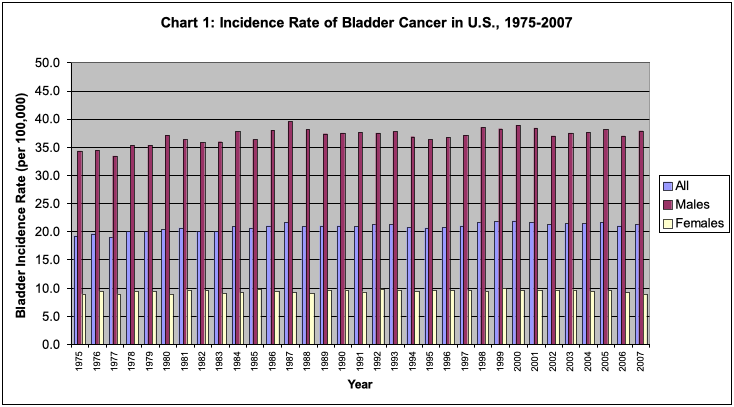
Over 1975–2007, the overall incidence rate of urinary bladder cancer grew from 19.3 in 1975 to 21.3 in 2007 (Chart 1). Also, the incidence rates of the males were much higher than those of the females.
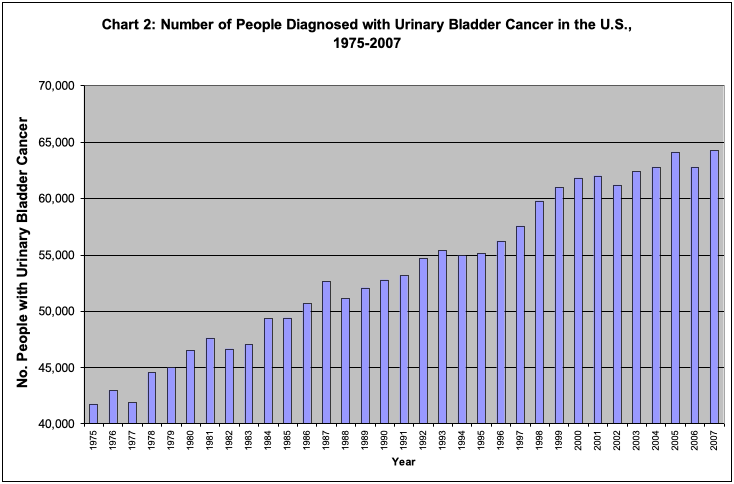
The number of Americans afflicted with this cancer increased markedly from 41,726 in 1975 to 64,205 in 2007 (Chart 2).3 The number of Americans diagnosed with this cancer, over 1975–2007, totaled an astounding 1.8 million.
The overall mortality rate of bladder cancer decreased from 5.5 in 1975 to 4.4 in 1987, then remained unchanged at 4.4 up to 2007. Thus, after 1987, there was not progress in the treatment of urinary bladder cancer. In addition, the males had a significantly higher mortality rate than the females.
The number of Americans who died annually from bladder cancer declined from 11,879 in 1975 to 10,708 in 1987. After 1987, however, the number rose to 13,155 in 2007. Therefore, from 1987 to 2007, the treatment side of bladder cancer was a failure. From 1975 to 2007, the total number of Americans who died from bladder cancer was 390,871.
Brain Cancer (Invasive)
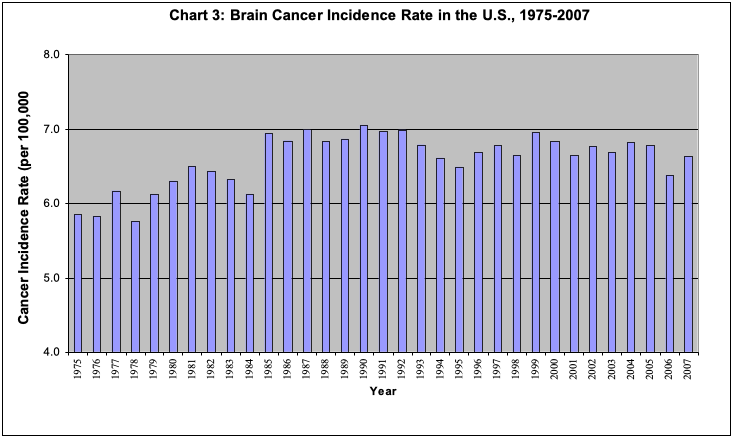
Chart 3 shows the overall incidence rate of brain cancer increasing from 5.9 in 1975 to 6.6 in 2007. That rate is 12 % higher than in 1975.
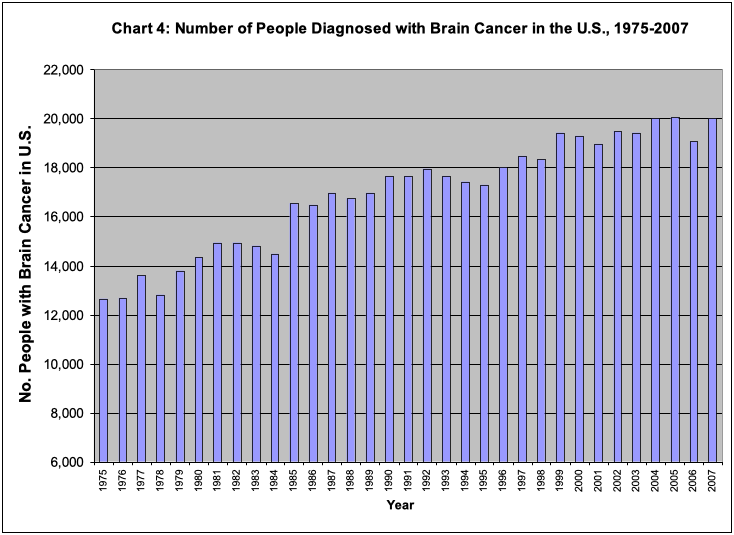
Also, the number of people afflicted by brain cancer surged from 12,634 in 1975 to 20,004 in 2007 (Chart 4). From 1975 to 2007, the number of Americans diagnosed with this cancer totaled a marked 558,716.
The mortality rate of brain cancer increased from 4.1 in 1975 to 4.95 in 1991. It then declined in 2007 to 4.2, which was still higher than in 1975.
The number of Americans who lost their lives to brain cancer was 8876 in 1975 and rose to 12,732 in 2007. The total number of Americans who died from this cancer was 383,569. The ratio between those who died to those who were diagnosed indicates that on average 60% of the people who get brain cancer will die from it. That is a grim statistic.
Cancer of the Female Breast (Invasive and In Situ)
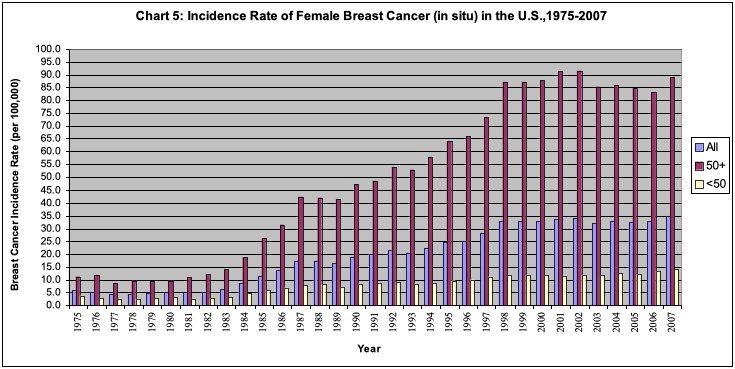
SEER provides statistics for two types of female breast cancer: in situ and invasive.4 The overall incidence rate of in situ breast cancer in 1975 was 5.8, and this rate soared 500% over time to reach 34.8 in 2007 (Chart 5). In addition, the incidence rate of the “50 plus” age group exceeded the rate of the “under 50” age group throughout 1975–2007. Moreover, both groups experienced higher rates in 2007 than in 1975, but more astounding was the 709% surge of the older group.
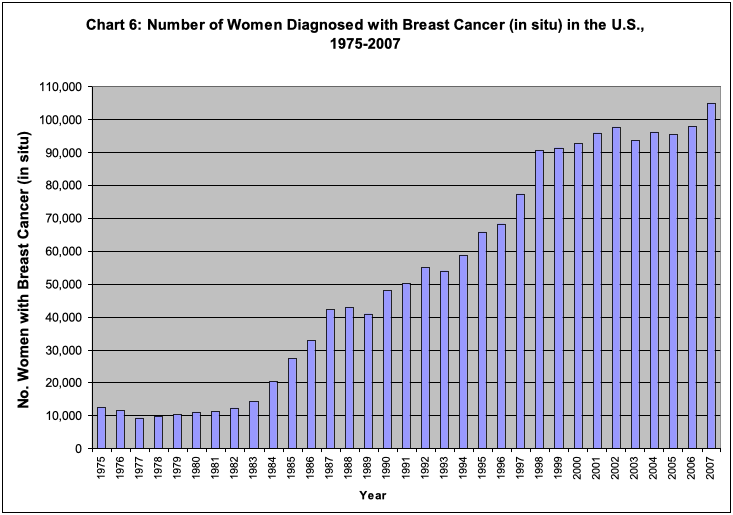
In 1975, 12,591 women were diagnosed with this cancer, while in 2007, an immensely higher number of women (105,057) received the diagnosis (Chart 6). During 1975–2007, the total number of women getting this cancer reached a stunning 1.7 million. Statistics for mortality rates for this disease are not available. Per private communication with SEER staff, we were informed that this cancer is rarely deadly.
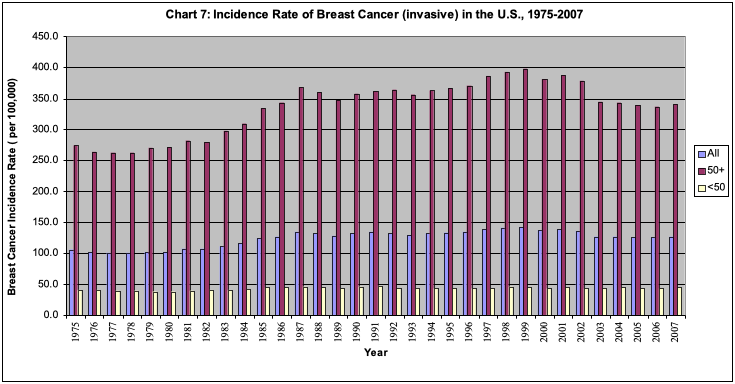
With regard to invasive breast cancer, the overall incidence rate of this cancer rose substantially from 105 in 1975 to 126 in 2007 (Chart 7). Also, the incidence rate for the 50-plus age group was shockingly higher than the under-50 age group from 1975 to 2007.
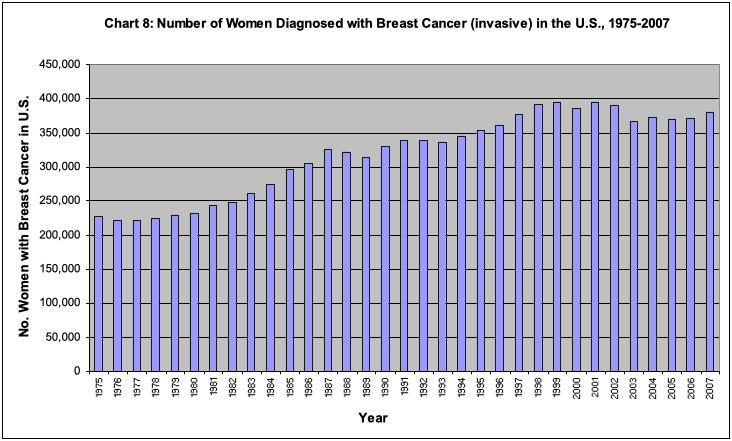
The number of women afflicted by invasive breast cancer also grew significantly from 226,923 in 1975 to 381,125 in 2007 (Chart 8). The total number of women diagnosed with the cancer between 1975 to 2007 was an astounding 10.6 million.
The overall mortality rate of invasive breast cancer increased from 31.5 in 1975 to 33.20 in 1990, then dropped to 22.8 in 2007. Also, the mortality rate of the older women was significantly higher than that of the younger women throughout 1975–2007.
In 1975, there were 67,924 deaths from this cancer, which reached 68,911 by 2007. The number of women who died from this insidious cancer from 1975 to 2007 was a shocking 2.5 million.
Cancer of the Cervix Uteri (Invasive)
The overall incidence rate of cervical cancer decreased over time, from 14.8 in 1975 to 6.6 in 2007 (Chart 9). The rate for the 50-plus age group was considerably higher than that of the under-50 age group throughout 1975–2007.
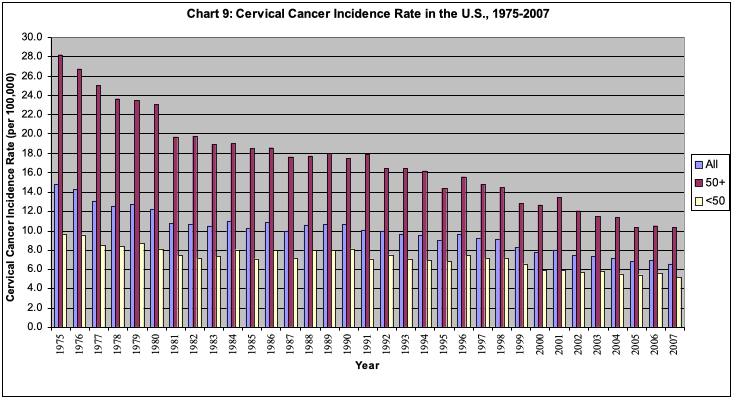
The annual number of women diagnosed with cervical cancer dropped from 31,942 in 1975, to 19,762 in 2007. The number of women diagnosed with the cancer during 1975–2007 totaled a marked 822,926.
The overall mortality rate of this cancer declined from 5.6 in 1975 to 2.7 in 2007 (Chart 10). With regard to age, the mortality rate of both age groups dropped, but the 50-plus age group had a much higher rate than the younger age group.
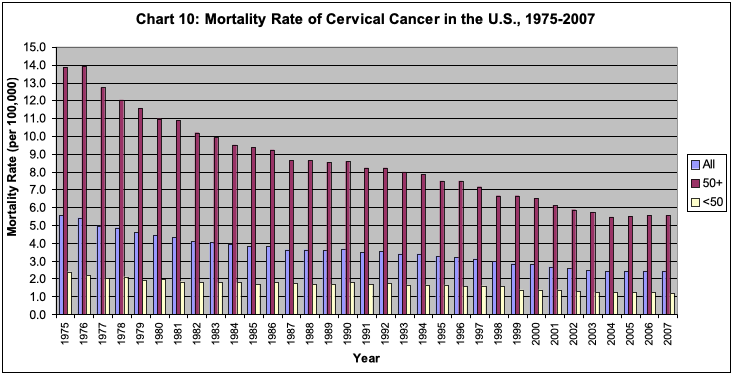
The number of deaths from cervical cancer declined from 11,987 in 1975 to 7301 deaths in 2007. The number of deaths from this cancer during 1975–2007 was 294,745.
Cancer of the Colon and Rectum (Invasive)
The overall incidence rate of colon cancer declined by 33% over 1975–2007 (Chart 11). With regard to gender, the incidence rate of men was much higher than that of women through the analysis period.
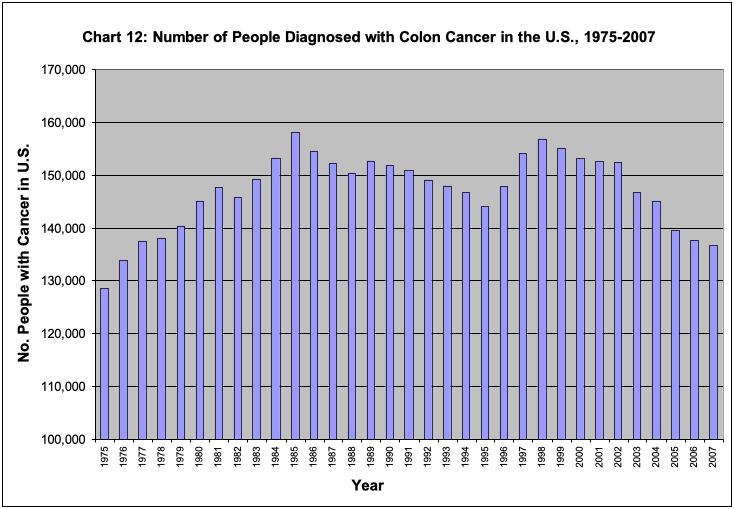
The number of people diagnosed with colon cancer during 1975–2007 rose from 128,547 to 136,616 (Chart 12). During 1975–2007, an extraordinary 4.8 million Americans had contracted colon cancer.
The overall mortality rate of colon cancer decreased by 39% over 1975–2007. Also, the mortality rate for the males was higher than the females throughout 1975–2007.
The annual number of deaths from colon cancer decreased from 60,667 in 1975 to 50,447 in 2007. The total number of deaths from this cancer during 1975–2007 was 1.9 million.
Cancer of the Corpus and Uterus (Invasive)
The overall incidence rate of corpus and uterus cancer declined by 30% over 1975–2007 (Chart 13). However, the rate of the older age group was incredibly higher than the rate of the younger age group.
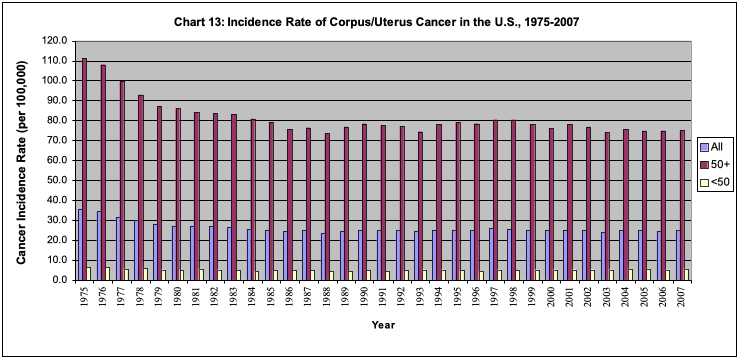
The number of women afflicted with this cancer declined from 1975 to 1988; after that year, it rose. The number of women diagnosed with the cancer during 1975–2007 totaled 2.2 million.
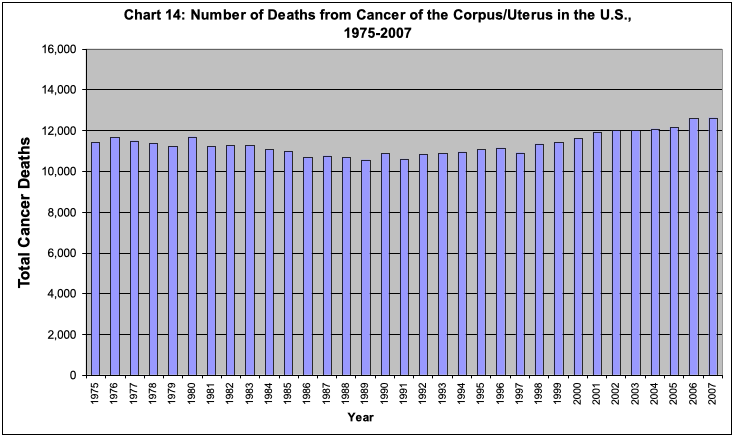
The overall mortality rate of this cancer declined by 21% over 1975–2007. The rate of the older age group was again significantly higher than that of the younger age group during 1975–2007. In 1975, the number of women who died from this cancer was 11,403, which grew to 12,612 in 2007 (Chart 14). The total number of deaths from this cancer during 1975–2007 was 373,943.
Cancer of the Esophagus (Invasive)
The overall incidence rate of esophageal cancer increased from 4.1 in 1975 to 4.6 in 2007. In addition, the incidence rates of males were much higher than those of the females over 1975–2007.
The number of Americans afflicted with esophageal cancer increased significantly from 8941 in 1975, to 13,969 in 2007. A total of 384,137 Americans were diagnosed with this cancer during 1975–2007.
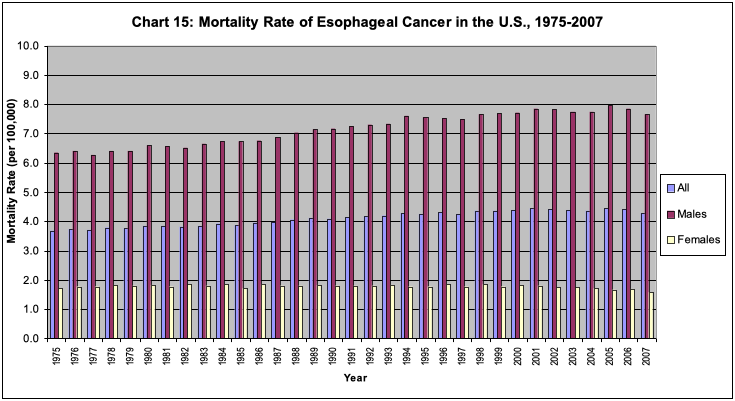
The overall mortality rate of esophageal cancer also rose from 3.7 in 1975 to 4.3 in 2007 (Chart 15). Also, the mortality rates of the males were significantly higher than those of the females over time.
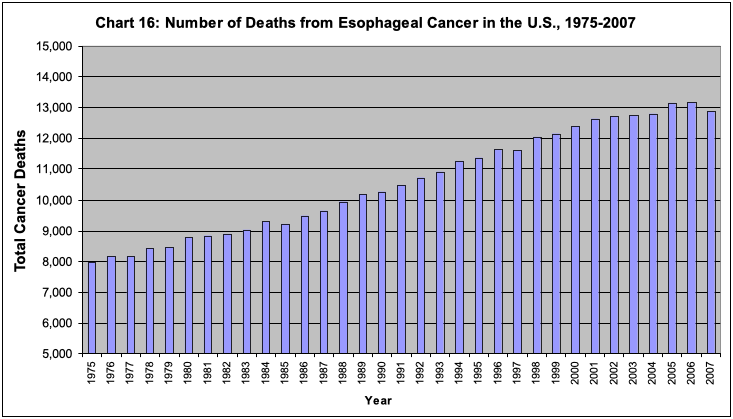 The number of Americans who lost their lives to esophageal cancer climbed annually from 7969 in 1975 to 12,883 in 2007 (Chart 16). Thus, 349,176 Americans died during 1975–2007 from this cancer. On average, 91% of Americans diagnosed with esophageal cancer died from it. That is indeed a terrifying outcome.
Hodgkin’s Lymphoma
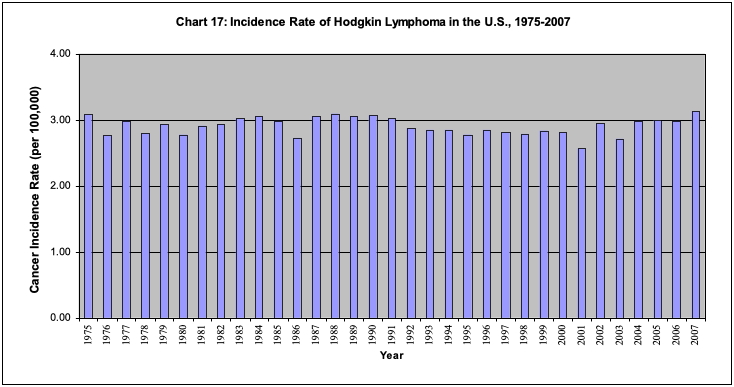
The overall incidence rate of Hodgkin’s lymphoma rose from 3.08 in 1975 to 3.13 in 2007 (Chart 17).
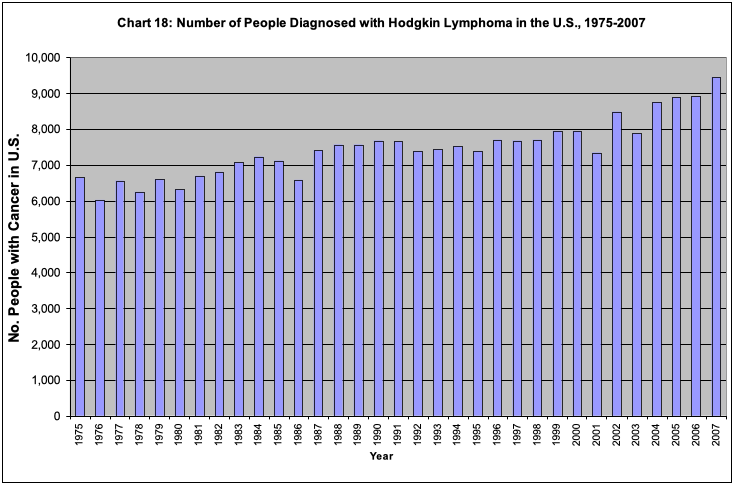
The number of Americans afflicted with this cancer climbed from 6652 in 1975 to 9444 in 2007 (Chart 18). The total number of people diagnosed with Hodgkin’s lymphoma during 1975–2007 was 245,975.
The overall mortality rate of Hodgkin’s lymphoma declined from 1.3 in 1975 to 0.4 in 2007. The number of annual deaths from Hodgkin’s lymphoma declined from 2829 deaths in 1975 to 1237 in 2007. The number of Americans who lost their lives to Hodgkin’s lymphoma during 1975–2007 was 57,260.
Cancer of the Kidney and Renal Pelvis (Invasive)
The overall incidence rate of kidney cancer increased significantly from 7 in 1975 to 15 in 2007 (Chart 19). Both genders experienced increases in their incidence rates over 1975–2007, but the males had a significantly higher incidence rate overall.
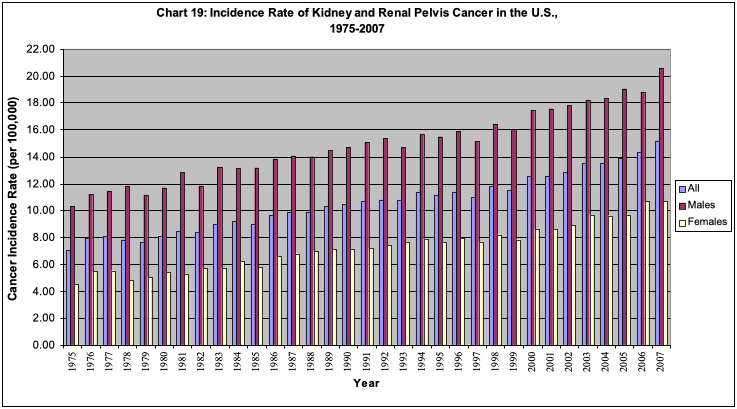
The number of Americans diagnosed with kidney cancer tripled from 15,291 in 1975 to 45,800 in 2007. The total number of Americans diagnosed with this cancer during 1975–2007 was a remarkable 914,172.
Chart 20 shows a rise in the overall mortality rate of kidney cancer from 3.6 in 1975 to 4 in 2007. Also, the mortality rate of the males was substantially higher than that of the females.
The number of Americans who lost their lives to kidney cancer rose significantly from 7797 in 1975 to 12,069 in 2007. The number of Americans who died from this cancer during 1975–2007 totaled 342,597. This indicates that, on average, 38% of those diagnosed with kidney cancer will die from it.
Conclusions
Our study found a failing US/NCI program in the prevention of 7 out of 10 cancers (bladder, brain, female breast in situ, female breast invasive, esophagus, Hodgkin’s lymphoma, and kidney) – as indicated by increasing or constant incidence rates, and increasing numbers of people diagnosed with a specific cancer. Moreover, 2 of the 10 cancers (colon and corpus/uterus) showed decreasing incidence rates but increasing numbers of those afflicted, also indicating a failing program in the prevention of these cancers. Only 1 of the 10 cancers (cervical) had declining incidence rates and declining numbers of those afflicted, showing success in the prevention side.
The incidence rates of males were substantially higher than for females – and increased faster over time for several cancers. Also, for the female cancers, significantly higher incidence rates were noted for older women as compared with younger women.
Our study also revealed a failing US/NCI program in the treatment of 6 out of 9 cancers (bladder, brain, female breast invasive, corpus/uterus, esophagus, and kidney) – as indicated by rising or constant mortality rates and rising numbers of deaths, or declining mortality rates and rising number of deaths. There were 3 out of 9 cancers (cervical, colon, Hodgkin’s lymphoma) that showed decreased mortality rates and declining number of deaths, suggesting that the cancer program in the treatment side of these cancers had success.
With respect to the differences observed in the age groups, the compounding effect of environmental carcinogens (chemicals, air pollution, pesticides, radiation, etc.) attacking older women over a longer time span contributes to that group’s having higher rates of cancer as compared with the younger group. Of particular concern are the nuclear power plants and other facilities spewing out radioactive releases both routinely and through accidents that are not disclosed to the public. The link between low-dose radiation and cancer has been described by a recent study by the National Research Council (2006) and by Dr. J. Gofman (1981). In addition, the mortality rates were higher for the older women than for the younger women.
With respect to the differences observed in the genders, the incidence and mortality rates of men were much higher than for women. It is likely that the exposure of men to occupational carcinogens (mining, construction, chemical industry, etc.) contributes to these higher rates. Also, lifestyle habits such as smoking can play a role.
This study showed increasing incidence rates and increasing mortality rates in the majority of the 10 cancers studied from 1975 to 2007. This resulted in a shocking 24 million Americans diagnosed with cancer during this period, and 6.6 million Americans prematurely losing their lives to these cancers.
The US government failed those millions of Americans in the prevention and treatment of cancer; these results have been influenced by the relationship between economics and politics. First, the prevention program has intense points of friction. The attempt to remove a carcinogenic product by a government agency from the market is typically fought by lobbies of the industries whose sales and profits will be affected negatively; they typically win the battle. Also, the treatment side of cancer greatly benefits the conventional health-care industry, as pharmaceutical companies pump out increasing number of drugs to treat the ever-growing number of Americans afflicted by these cancers. These conventional treatments, as seen by the cancer mortality data, have been a failure overall.
The toxic relationship between the government and corporations has been described in the literature, including the books Toxic Deception – How the Chemical Industry Manipulates Science, Bends the Law and Endangers Your Health (Fagin and Lavelle 1999) and Deceit and Denial (Markowitz and Rosner 2003). Other studies, such as The Menace of Atomic Energy (Nader and Abbotts 1977), have examined a similar relationship for the atomic power industry and the government. Thus, regulations are not implemented to remove carcinogens from the environment – or in other words, to ensure the health and safety of the American people – because they are fought by corporations and other interests to ensure their profits. The end result is that increasing numbers of Americans are becoming victims to cancer.
These failures call for a basic restructuring of the NCI and reorientation of the US program to prevent and cure cancer.
Notes
1. Apostolides AD, Apostolides IK. The US Cancer Program, 1975–2006: A Failure. Townsend Lett. Aug/Sept 2010; Part 1; October 2010;Part 2.
2. SEER-9 provides data from nine geographic areas: Connecticut, Hawaii, Iowa, Utah, New Mexico, Detroit, Atlanta, Seattle, and San Francisco. This geographic group constitutes approximately 10% of the US population. The US cancer mortality data are obtained by NCI from the Centers for Disease Control and Prevention (CDC) and are incorporated into the SEER database. SEER provides both incidence and mortality rates of cancers in age-adjusted form and expressed in terms of 100,000 population. The incidence rates are also adjusted by SEER for delays in the reporting of cancer cases. These adjustments were described and discussed in our previous article in the Townsend Letter (Aug/Sept 2010; October 2010).
3. This number is calculated by multiplying the incidence rate by the population of the country (per 100,000).
4. Invasive cancer is defined as cancer that has spread beyond the layer of tissue in which it developed and is growing into surrounding, healthy tissues. In situ cancer is early cancer that is present only in the layer of cells in which it began. Some cancers like mesothelioma, leukemia, and lymphoma are not specified as “invasive” because they are by nature invasive (per communication with SEER staff).
References
Begley S. We fought cancer … and cancer won. Newsweek. September 6, 2008.
Epstein SS. The politics of cancer revisited. Freemont Center, NY: East Ridge Press; 1998.
Fagin D, Lavelle M, Center for Public Integrity. Toxic Deception – How the Chemical Industry Manipulates Science, Bends the Law and Endangers Your Health. Monroe, ME: Common Courage Press; 1999.
Faquet GB. The War on Cancer: An Anatomy of Failure, A Blueprint for the Future. Dordrecht, Netherlands: Springer; 2005.
Gofman, J.W. Radiation and Human Health: A Comprehensive Investigation of the Evidence Relating Low-Level Radiation to Cancer and Other Diseases. San Francisco: Sierra Club Books; 1981.
Markowitz G, Rosner D. Deceit and Denial – The Deadly Politics of Industrial Pollution. Berkeley, CA: University of California Press; 2003.
Nader R, Abbotts J. The Menace of Atomic Energy. New York: W. W. Norton and Co.; 1977.
National Research Council, Board of Radiation Effects Research. Health Risks from Exposure to Low Levels of Ionizing Radiation – BEIR VII PHASE 2. Washington, D.C.: National Academies Press; 2006.
SEER-9 (Surveillance Epidemiology and End Results). Cancer statistics review 1975–2007 [online document]. Available at: www.seer.cancer.gov/statistics.
United States Bureau of the Census. Population. In: Statistical Abstract of the United States.
Anthony D. Apostolides, PhD, received a doctoral degree in economics from the University of Oxford, UK, and an MA degree from the University of Pittsburgh. He has taught on health-care economics and related fields at the university level; and carried out research in health care delivery and finance. He was engaged in research at the UN, Economic Commission for Europe and The Conference Board. He also worked for the State of Maryland, Department of Health; and for the federal government. His publications include articles in peer-reviewed journals.
Ipatia K. Apostolides, BA, has a bachelor’s degree in biology from Case Western Reserve University and several years’ graduate coursework. She has worked in the cancer field for over 15 years – as a laboratory manager and data manager at the Cleveland Clinic, and as data manager at the Children’s Hospital Bone Marrow Transplant Center in Cincinnati. She was also supervisor in the PLCO study at Georgetown University. She has coauthored several medical articles related to cancer.








0 Comments