
KEYWORDS: Breast reconstruction; Regenerative medicine, Cell-assisted lipotransfer; Stem ccells/adipose-derived; LifeWave nanotechnology, Suzanne Somers; breast implant alternative
The Role of Regenerative Medicine in Breast Reconstruction
By Karina Gordin, MSc
Breast augmentation is among the most common cosmetic surgical procedure in the US, with approximately 106,000 reconstructive plastic surgeries performed in breast cancer patients post-mastectomy.1 Silicone and saline implants are routine options, despite mixed outcomes and reports of complications, most notably capsular contracture, numbness, leaking and breaking, as well as reoperations involving implant replacement and removal.2 Regarding the latter, approximately 42,000 implant removals were performed in 2015, 17,892 of which comprised reconstructive cases.3 Considering these statistics, it is unsurprising that in spite of the increased number of breast augmentations, debates persist about the safety of implants. Trusted health advocate, renowned actress, and New York Times bestselling author Suzanne Somers has been at the forefront of the breast reconstruction debate, advocating for alternative treatment options that harness the body’s own capacity to heal and recover. One such option is cell-assisted lipotransfer (CAL) – a groundbreaking regenerative medical procedure that regrows the breast, rather than reconstructs it. Namely, CAL is based on the premise of autologous fat grafting, which utilize the patient’s own subcutaneous fat tissue (from regions like abdomen and lower legs) as implant for the breast. However, unlike conventional fat grafting, which demonstrates relatively poor long-term viability,4 cell-assisted lipotransfer enhances fat graft survival rate via autologous adipose-derived stem cells (ADSC). In fact, studies5 have demonstrated that ADSC can survive the period of hypoxia post-surgery, which is thought to result in the necrosis of conventional fat. Adipose-derived stem cells enhance both angiogenesis and adipogenesis,6 which translates well in the clinical setting, with long-term graft retention and lower post-operative complications.7,8
The abundance and easy accessibility of adipose tissue enables relatively simple harvesting, precluding the need for in-vitro expansion.9 Using the novel cell-assisted lipotransfer technology, aspirated fatty tissue is divided into two aliquots; half the volume of aspirated fat is processed to isolate stromal vascular fraction-containing stem cells, while the remaining half is prepared for grafting. Freshly isolated stromal vascular fraction stem cells are attached to the aspirated fat, and reinjected into the breast, ultimately restoring volume, sensation, comfort, motion, and over all appearance of the original healthy breast- a result that Suzanne Somers may personally attest to.
KG
:
You spearheaded the first US-based clinical trial examining cell-assisted lipotransfer (CAL) in breast reconstruction. Can you please set the scene for your interest in regenerative medicine, and the path that led to your becoming the first patient in the United States to undergo the experimental procedure?
SS
: I had read about a doctor at the University of Tokyo- Dr. Kotaro Yoshimura- a wonderful man who had successfully regrown the breasts of over 400 Japanese women using stem cells and fat transfer. I took a chance and called him and to my great surprise and good luck, he knew who I was. We talked often on the phone and eventually he agreed to come to Los Angeles and meet with Dr. Joel Aronowitz at Cedars-Sinai Plastic and Reconstructive Surgery Center in Los Angeles. Dr. Aronowitz was very interested in working with stem cell therapy, and Dr. Yoshimura taught him the procedure. But it wasn’t that simple. I needed to apply for an Institutional Review Board to qualify me for a clinical trial; that took three years! The day it was granted, July 2011, we went to work to begin the procedure, and my surgery was performed in August.
I prepped my body with the help of the great Dr. Jonathan Wright through supplementation and immune strengthening so that after the procedure I would not have to rely on medications and painkillers. As expected, aside from the anesthetic, I only needed to take White Willow supplements for a day to relieve pain. The day of the surgery was incredibly emotional and exciting for me. It had been a long journey that was finally coming to fruition.
KG: Can you expound upon your “long journey,” including the course of your treatment?
SS
: When I had a lumpectomy to remove a 2.4 cm tumor, I lost half my right breast. I had no chemo, but the 35 days of radiation treatments destroyed tissues in my right breast, leaving it small and flat, but with the nipple intact. During the 11 years missing half of the breast was something I just accepted. It didn’t affect me negatively but reminded me how lucky I was to have found cancer early enough, and that I had the courage to walk away from conventional medicine. It wasn’t a reckless decision. I had researched it, and the idea of pumping my body with chemical poison just did not sit well. Instead I chose to change my diet and lifestyle, and I also injected Iscador, a mistletoe extract that I was able to get from Europe which builds the immune system. I am forever grateful I made these decisions for myself.
KG: In so many words, you were a “guinea pig” back in 2008, when the adipose-derived stem cell injection was first performed. What were your initial expectations and short-term clinical benefits, and have they reliably predicted the long-term effects?
SS
: I was so emotionally prepped and ready and felt so good about my doctors, all of whom are men I admire greatly, that being the first woman in the United States to be granted permission felt to me a privilege and honor. I knew in my gut it was going to work.
I had gone 11 years missing one half of a breast. My good fortune was that when my tumor had originally been removed, it was below the nipple so I had nipple and skin to work with. That is vital for women to understand; once a complete mastectomy is performed or a radical lumpectomy (where they remove both the nipple and skin), the woman will never be able to have the beautiful outcome that I have enjoyed. So leaving the nipple and skin (if possible) intact is very important for the desired outcome.
Here is how it worked for me: they removed some fat from my stomach (boo-hoo), spun the stem cells out of that fat, discarded the weak ones, kept the strong stem cells and put them back into the amount of fat we needed to regrow my breast so that fat was now rich with healthy strong stem cells. In “lay-person speak,” they took what appeared to me to be akin to a turkey baster filled with the fat and stem cells and injected that mixture into my once-cancerous breast until it was the same size as my other healthy breast. I was able to leave the hospital as a whole person. Can you imagine what an incredible feeling that was for me?
For a year afterwards I felt what I can only describe as “electrical zippers” in this newly grown breast which were my blood vessels forming. There was no pain involved, just a sensation. Today that “electrical” feeling has gone away as the breast is now healed, full and real with a blood supply. To me it’s nothing short of a miracle. It’s impossible to reject yourself. My body recognized the ingredients.
The breast is beautiful. I have full feeling and it is natural. In other words, it’s “me.” Every time I can catch a glimpse of myself in the mirror, I am surprised and delighted to see that I am whole again. As an aside, the first two weeks after I had this procedure I was so excited that I was showing them to anyone, until finally my husband said that I had to cool it. Ha ha.
KG: How long did the procedure take?
SS:
Only a couple of hours for the entire procedure of removing some of my fat through liposuction, whipping it in a mechanism akin to a centrifuge to separate it into three layers: fat, blood, and stem cells. The stem cells were harvested and filtered; weak stem cells were discarded. Then my stem cell-enriched autologous fat was injected under and over the tissue of my right breast, lifting the breast to match the dimension and position of my left breast in a process that took 10 to 15 minutes.
KG: Regarding long-term effects, clinical data about the inherent safety and viability of CAL are limited. Accordingly, questions concerning risks like neoplasia and calcification remain. Can you please describe your experience with CAL in terms of safety, side effects, pain and recovery? And have you received follow-up procedures?
SS
: I have had no side-effects other than there was a bit of loss of volume. Luckily, years earlier I had banked my stem cells with the NeoStem Company where they removed 10 bags of my stem cells and cryogenically froze them for a future need.
To add back the small amount of volume loss, Dr. Aronowitz (in an outpatient procedure with light anesthetic) removed a small amount of fat once again, but used my “banked” stem cells instead. The result is perfect!
KG: Looking back on the clinical trial, from a more complete and informed vantage point, what new insights have you gained about CAL over the last decade, and what has perhaps surprised (or dismayed) you about the procedure and results?
SS
: I’m not sure how many of these procedures Dr. Aronowitz has been able to perform. I know it was in the hundreds, until the FDA closed down the clinical trial. When you say dismay, I believe some lobbyist got involved (most likely a breast implant lobbyist) and tried to squash this miraculous procedure.
I’m dismayed because we all know that women who have received implants usually have one or more subsequent surgeries for problems associated with inserting a foreign object in their bodies: leaking, rupturing, pain, damage to small blood vessels, etc.
KG
:
Do you foresee cell-assisted lipotransfer becoming more mainstream, and gain approval for more research studies? Likewise, do you foresee breast stem-cell reconstruction becoming a regular post-treatment option, covered by insurance? Are there obstacles currently in the way of this mission, including FDA regulations?
SS
: Not to be cynical, but follow the money. There is a lot more money in selling implants than in using a woman’s own fat and stem cells, which are impossible to reject. You can’t reject yourself. Implants come with risk and problems, often needing subsequent surgeries due to leaking and other conditions created by having a foreign substance free to roam around, confusing the body. Each one of those surgeries cost a lot of money. Do the math. Also, the implant industry is in place, and few are willing to disrupt it. I am hoping that CAL will become mainstream. It makes so much sense. Why, when you can put yourself back together again using parts from your own “self” would anyone ever think of putting a foreign object in the body as a better idea? It’s healthier and doesn’t confuse the body.
KG: Can you briefly discuss other applications of cell-assisted lipotransfer, and the implications of CAL in plastic surgery? Have you experimented with CAL for “cosmetic” purposes?
SS
: I have not used this procedure for any other parts in my body. But I would imagine it is safer and better than injecting substances from unknown sources. Using your “self” has to be the better choice.
KG
:
Beyond the improvement in physical health and appearance, how has your psychological and emotional satisfaction evolved over the last decade? And what are your expectations for the decade to come?
SS
: Maybe it sounds strange, but I think all women can relate; our breasts are where we nurture our children and our partners in life. They are part of who we are; they are a large part of our softness. Having gone without a breast for so long has given me such a deep appreciation for being intact again. I have no foreign object in my body, I have nothing to reject, and everything about my body experience at this time in my life is better; my clothes fit and look better, and I feel good about myself when nude.
Cancer (for me) has turned out to be a gift. I had to learn to accept myself in a way I never thought I would be forced to do. Having come to fame years ago in “Three’s Company” as a sex symbol, (a term I was never very comfortable with), losing my breast was a wake-up to what is truly important in life. You learn you are not invincible, that who you love and who loves you are all that matters.
Cancer reshaped my life. A true wake-up call: I changed the way I ate; I switched to all-organic and real food only; I eliminated chemicals from my life as best I could; I worked on my thoughts being positive; I didn’t feel any self-pity, rather I felt lucky that through this negative I was able to learn so many things about myself and have this opportunity to embrace true health. The gift kept on giving because then I was able to use my celebrity to get to the best and brightest in the field of nondrug cancer protocols and write one of my most successful books, Knockout, which continues to be a worldwide seller. I’m a big believer in negatives as opportunities; the pain and agitation is what teaches us and gives us strength to overcome and turn negatives to positives much like judo, using forward energy to win.
KG: What projects are you currently working on, and what can we look forward to?
SS
: Ever productive, I am just finishing my 26th book and have already begun on book number 27. The next book to come out is a celebration of my marriage and relationship, which upon publication will have totaled 50 years. We are partners in love, life, family, and health. We have both embraced a healthy lifestyle, feeling it is respectful to one another to keep ourselves as healthy as possible. Neither of us takes any over-the-counter or pharmaceutical drugs unless absolutely necessary and in that case they are a godsend. I don’t rush to take an Advil because I have a headache; rather, I use LifeWave non-drug nanotechnology pain patches called IceWave (from a company in which I am involved, for full disclosure). These are pain patches with organic amino acids that activate the infrared light in the body through nanotechnology and move the chi (or energy) around, thus eliminating pain. There are other patches for inflammation; I tore my meniscus while performing my one-woman Broadway show and rather than surgery or any kind of painkiller I used the LifeWave nanotechnology glutathione patches on the inside of my right knee and I put an Aeon patch (an inflammation patch) on the outside. Within two weeks my pain had subsided. I believe we rush too quickly to our medicine cabinets without thinking of the consequences of putting a foreign substance into our body be it Tylenol or ibuprofen. As we are all under the greatest chemical and environmental assault in the history of humanity, we don’t want to add more foreign substances and further we confuse the body.
Both my husband and I have been on bioidentical hormone replacement for over two decades, we embrace designer supplementation, including breakthrough supplements like TA-65, and we eat our own homegrown organic food. When we travel, we bring food with us and if that’s not convenient, we seek out restaurants that have at least one organic offering. It has all paid off, as I will relay in my next book, #27, about aging a new way. There is nothing so far about aging that I do not like. I like the way I look, I like the way I sleep, I like the way I feel, I have boundless energy, I have a great libido, I have shiny, healthy hair and strong nails, and I have wisdom and perspective. It’s all fantastic. That is my message to my constituency moving forward. If the present paradigm of aging horrifies you and decrepit, frail, or with one of the big three (heart disease, cancer, Alzheimer’s) all culminating in a nursing home is not how you want your endpoint to be, then you’ve got to make the right choices starting this moment. Every choice matters, and every choice has consequences, good or bad; choose well.
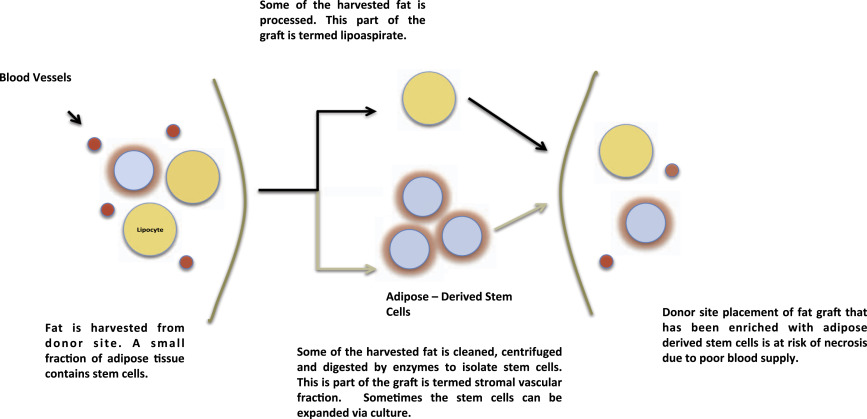
Figure 1.
The cell-assisted lipotransfer procedure. Harvested fat is separated with approximately one half being used to harvest adipose derived stem cells and the other being processed for use as a fat graft. The two constituents are then combined and placed within the recipient site. Note that the black arrows indicate the procedure for a conventional autologous fat transfer procedure
(permission pending)
Bio: Katrina Gordin is a medical journalist and currently writes for a variety of commercial and peer-reviewed health publications. She would like to thank her father, Dr. Leonid Gordin, for advocating the importance of meditation and mindfulness, which has informed her writing and research. Karina can be reached at Write@HealthWright.org.
Picture in 2/13 email.
-
. ASPS National Clearinghouse of Plastic Surgery Procedural Statistics, American Society of Plastic Surgeons. 2015: p. 9. https://www.plasticsurgery.org/news/plastic-surgery-statistics.↩︎
-
. Dancey A, et al. Capsular contracture – what are the risk factors? A 14 year series of 1400 consecutive augmentations. J Plast Reconstr Aesthet Surg, 1 (65) (2012), pp. 213–218.↩︎
-
. ASPS National Clearinghouse of Plastic Surgery Procedural Statistics, American Society of Plastic Surgeons. 2015: p. 9. https://www.plasticsurgery.org/news/plastic-surgery-statistics.↩︎
-
. Kaufman MR, et al. Autologous fat transfer for facial recontouring: is there science behind the art? Plast Reconstr Surg. June 2007;119(7):2287-96.↩︎
-
. Khouri RK, et al. Diffusion and perfusion: the keys to fat grafting. Plast Reconstr Surg Glob Open, 2014; 2:p. e220.↩︎
-
. Zeeshaan A, et al. Cell assisted lipotransfer in breast augmentation and reconstruction: A systematic review of safety, efficacy, use of patient reported outcomes and study quality. JPRAS Open. December 2016; 10:5–20.↩︎
-
. Moseley TA, et al. Adipose-derived stem and progenitor cells as fillers in plastic and reconstructive surgery. Plast Reconstr Surg, 2006;118.↩︎
-
. Aronowitz JA, et al. A novel and effective strategy for the isolation of adipose-derived stem cells: minimally manipulated adipose-derived stem cells for more rapid and safe stem cell therapy. Plast Reconstr Surg, 2015;135: p. 454e.↩︎
-
. Fraser JK, et al. Fat tissue: an underappreciated source of stem cells for biotechnology. Trends Biotechnol, April 2006; 24(4): 150–154.↩︎







0 Comments