
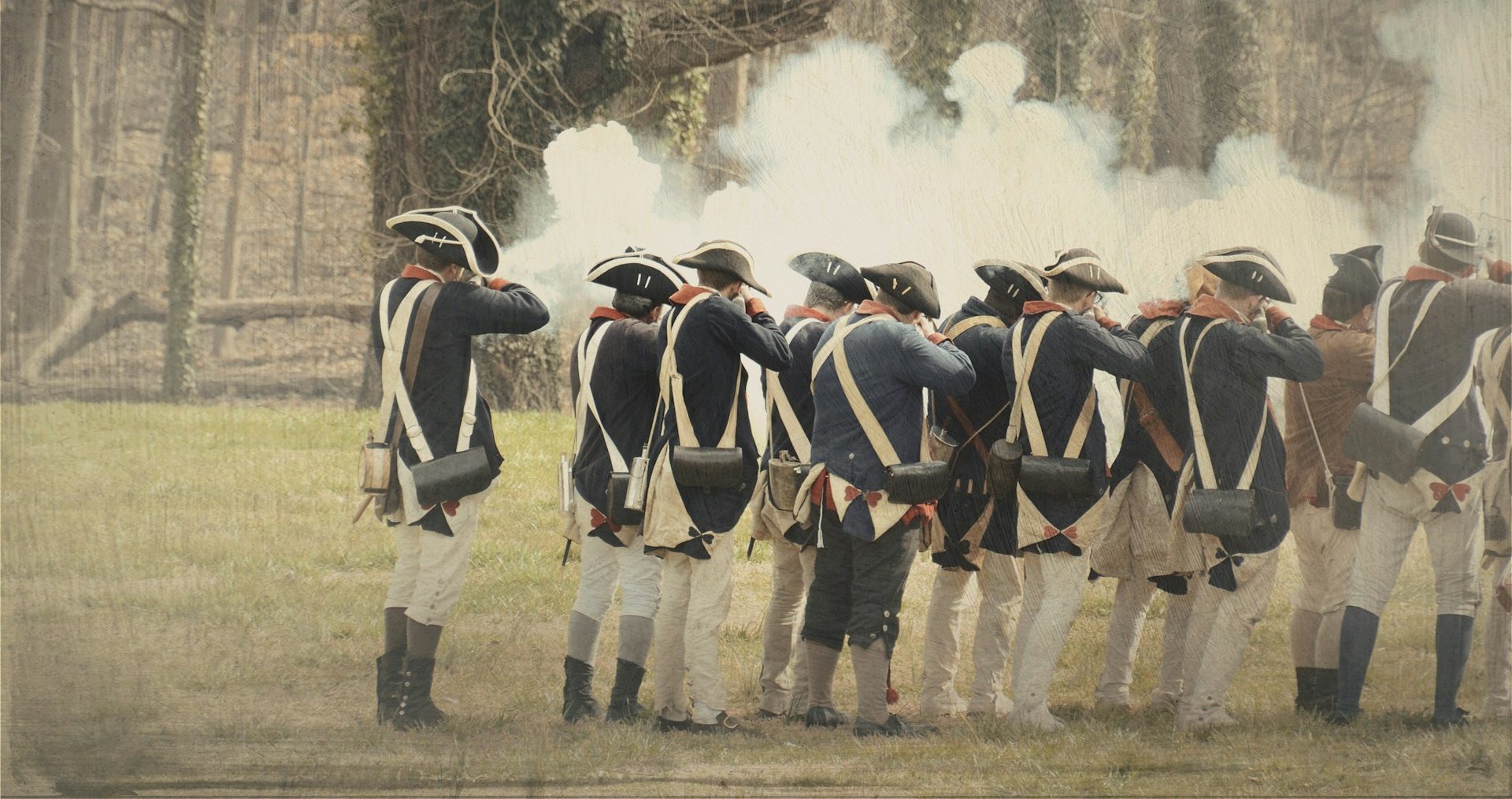
Coming up on February 5, 2022, will be an anniversary that few people are aware of. It was on February 5, 1777, that George Washington made a strategic decision that many historians credit with allowing the American military forces to win the War of Independence against Britain. This coming year will mark the 245th anniversary of George Washington’s order that those who bore arms for our fledgling democracy either had to show proof of immunity or undergo vaccination.
At the time, far more American troops were dying of smallpox than enemy gunfire…. British troops arrived on the continent possessing a herd immunity to smallpox that Americans did not have. American troops were vulnerable to this disease in a way the British were not. Smallpox was endemic in England and most of the British troops had the disease when children. Less than a quarter of the American troops were immune.
Washington had considered ordering vaccination in 1775, during the battle of Boston but had not gone through with the plan.
Obviously, the terms “vaccine” or “vaccinate” were still years off in the future. Technically, these terms should be used to describe the inoculation technique Edward Jenner developed in 1796 using cowpox pus. Earlier doctors had noticed that milkmaids who became infected with cowpox did not get smallpox. During his apprenticeship at age 13, Jenner heard a milkmaid say, “I shall never have smallpox for I have had cowpox. I shall never have an ugly pockmarked face.” In May of 1796, he inoculated an eight-year-old boy, James Phipps, with the fluid from a fresh cowpox lesion taken from milkmaid Sarah Nelmes. Phipps suffered mild symptoms that healed in a few weeks. When exposed to infectious smallpox, Phipps was protected from the disease. “Vacca” is Latin for cow, so the term vaccine applies to immunization using pus from an individual infected with cow pox. The anti-vaxers of Jenner’s era argued that the vaccine would turn they and their offspring into cows. The term vaccination was unheard until 1800 when Jenner’s friend Richard Dunning started to use it.1
For those of us who tend toward diligence in our choice of words, we might want to reserve the terms “vaccine” and “vaccinate” specifically for the use of cowpox to produce immunity to smallpox. It is not just the source of the pox in cows that the term distinguishes. Cowpox was a ‘lesser disease,’ an idea reminiscent of weaker versus stronger diseases that Samuel Hahnemann touches on in his writings. Technically, a stickler might say that the term “vaccine” should only apply to immunizations using smallpox derivatives and that in the case of other diseases for which immunizations are prophylaxis, the term “vaccin”e is inappropriate. Popular convention appears to have overruled such distinctions.
The World Health Organization makes a different distinction between the two terms. According to the WHO a vaccine is the stuff while immunity is the goal, “you can be exposed to it without becoming infected.”
Vaccine: A preparation that is used to stimulate the body’s immune response against diseases. Vaccines are usually administered through needle injections, but some can be administered by mouth or sprayed into the nose.
Immunity: Protection from an infectious disease. If you are immune to a disease, you can be exposed to it without becoming infected.2
The command George Washington actually delivered to his troops was that new recruits had to show proof of immunity, (the disease leaves obvious recognizable scars on those who survive it) or undergo a process called variolation.
Variolation was far more serious than vaccination would eventually prove to be. “Variolation used a lancet or needle to introduce pulverized dried smallpox scabs or pustule fluid into the skin of an individual.” The term “variolation” is from Latin, “variola,” for smallpox. Some medical historians trace the origin of the practice of variolation to tenth century China,3 or perhaps 16th century China.4 Still others date the origin much earlier, back to 1000 BC in India.5 The practice arrived relatively late to Europe and by extension the American Colonies.
Credit for introducing variolation to England is unarguably given to Lady Mary Wortley Montague in 1721. In 1717, Lady Mary Wortley Montagu, the wife of the then British ambassador to the Turkish Empire, learned about variolation in the bath houses of Constantinople. She herself had suffered from the disease as a young woman so the value of prevention was obvious. On her return to England, she encouraged experiments that subjected several prisoners and orphans to variolation. When later deliberately exposed to the disease, these subjects were immune.
When acute smallpox infection is acquired through a small localized wound, a healthy person was more likely to survive the infection than if they had acquired the disease naturally through aerosolized viral particles.
When none of these people contracted the disease, variolation was deemed safe and members of the royal family were inoculated. The procedure became fashionable among the well-to-do of Europe. It was only safe in comparison to the full-fledged disease. Patients became quite ill, and mortality rates are estimated to have been from 2-3%. Still, the disease itself was much more lethal. In the 1721 American epidemic that started in Boston April 22, the fatality rate was high. Of the city’s population of 10,600 people, 844 died in less than a year, nearly 8% of the total population.6
Variolation reached the American colonies about the same time as it did England. In Massachusetts, Cotton Mather promoted variolation as a way to prevent smallpox during the 1721 epidemic in Boston. You may recognize Mather’s name for his role in the Salem Witch Trials. Mather first learned about inoculation from a West African slave named Onesimus, writing, “he told me that he had undergone the operation which had given something of the smallpox and would forever preserve him from it, adding that was often used in West Africa.’’ After confirming this account with other West African slaves and reading of similar methods being performed in Turkey, Mather became an avid proponent of inoculation.7
Mather collaborated with Boston physician Zabdiel Boylston, inoculating patients while keeping records of outcomes. They reported that only 2% of the inoculated died as a result while 14.8% of those with naturally occurring disease succumbed.8 Not everyone supported variolation. The greatest opposition was based on religious arguments, that preventing the contagion blocked God’s will. Other’s opposed variolation based on what we might consider sensible grounds, that the procedure was not adequately tested, mechanism was unknown, and that it posed risk to healthy people. Keep in mind that this argument occurred in 1721. Acceptance of the germ theory of disease was still a century and a half in the future.
There have been at least two major variants in smallpox, Variola Major and Variola Minor. The Major variant was dominant in the 1700s and persisted until about 1927 after which the minor strain was responsible for most infections. The minor version was relatively mild with a case-fatality rate of less than 1%.
Back to George Washington. Among the Continental regulars that were under Washington’s command, 90% of deaths were caused by disease, and smallpox was the leading cause. Washington wrote to Congress on the 5th of January 1777 informing them of his decision to inoculate the troops. On the 6th he wrote to Dr. William Shippen Jr, explaining that: “Necessity not only authorizes but seems to require the measure, for should the disorder infect the Army . . . we should have more to dread from it, than from the Sword of the Enemy.”
Most British troops were already immune to smallpox, a clear military advantage against the colonists. Americans remained fearful of the immunization process. The Continental Congress had actually issued a proclamation in 1776 prohibiting Surgeons of the Army to inoculate.
Washington knew that a mass inoculation put the entire army in a dangerous position should the British discover what was going on. Variolation still had a fatality rate of 5-10% and even when things went well it took a month to recover one’s health. This could not have been an easy choice for Washington.
Less than a quarter of the Continental Army had had the virus. Inoculating the remaining three quarters and every new recruit would have been a daunting task. Washington well knew that variolation would sicken his troops, leaving them invalids for a month. Keeping the plan secret must have only added to the complexity.
There was no precedent to Washington’s plan. He secretly gave orders to his commanding officers to oversee the inoculation of their troops. At least eleven hospitals were built where invalided soldiers could recuperate.
“…Washington conducted the first mass inoculation of an army at the height of a war that immeasurably transformed the international system. Defeating the British was impressive, but simultaneously taking on Variola was a risky stroke of genius.”9
Looking back on these events, one must wonder about the mindset of both Washington and the troops he led. Knowingly committing themselves to variolation, a process that had known risks of being fatal, speaks of a commitment to both their cause and their fellow troops that is now difficult to fathom. Even at the time the concept of herd immunity was understood and the soldiers accepted the risks knowing that they were protecting others from harm.
Vaccination did not end smallpox quickly. The disease continued to be endemic in the world for two centuries. It is estimated that smallpox killed over 300 million people during the 20th century.10
The World Health Organization (WHO) initiated a plan to eradicate smallpox originally in 1959. This campaign failed to reach its goal. The WHO launched a second attempt in 1967 conducting immunization and disease surveillance around the world. This time they were successful. The last person to have naturally acquired variola major was a three-year-old in Bangladesh in 1975. The last naturally acquired case from variola minor occurred in October 1977 in Somalia.
The WHO declared smallpox eradicated in1980, making it the first and only infectious disease that has been eradicated, well almost. The virus now officially exists in two places in the world, the Centers for Disease Control and Prevention in Atlanta, Georgia, and the VECTOR Institute in Koltsovo, Russia. One hopes they are forever secure there.
References
1. Baxby D. Edward Jenner’s inquiry after 200 years. BMJ. 1999;318(7180):390. doi:10.1136/bmj.318.7180.390.↩︎
2. https://www.cdc.gov/vaccines/vac-gen/imz-basics.htm↩︎
3. S.R. Eagle, S.C. Gad, in Encyclopedia of Toxicology (Third Edition), 2014↩︎
4. Jennifer Louten, 15.4.1 Origin of Smallpox Vaccination in Essential Human Virology, 2016↩︎
5. Stephen N.J. Korsman and Wolfgang Preiser. Virology, 2012↩︎
6. Hasselgren PO. The Smallpox Epidemics in America in the 1700s and the Role of the Surgeons: Lessons to be Learned During the Global Outbreak of COVID-19. World J Surg. 2020;44(9):2837-2841. doi:10.1007/s00268-020-05670-4↩︎
7. Buhr, S. To Inoculate or Not to Inoculate?: The Debate and the Smallpox Epidemic of 1721. Constructing the Past 2000. 1:61-67.↩︎
8. Best, M. Neuhauser, D. and Slavin, L. “Cotton Mather, you dog, dam you! I’ll inoculate you with this; with a pox to you”: smallpox inoculation, Boston, 1721. Quality and Safety in Health Care 2004.13:82-83.↩︎
9. https://www.loc.gov/rr/scitech/GW&smallpoxinoculation.html↩︎








0 Comments