
Environmental Medicine Update
by Marianne Marchese, ND
Lead in the Drinking Water: An American Crisis – Again!
Introduction
Lead poisoning is a phrase that Americans have not heard in the news in over two decades. Many assumed, since lead has been removed from household paint and gasoline, that the sources of exposure have been removed. Then came the 2016 news reports of lead in the drinking water in several US cities. The first report was from Flint, Michigan – that thousands were exposed to lead in the drinking water. Next came the USA Today report showing lead in the drinking water of several schools and day-care facilities across the US. Both cases have brought public awareness to the fact that lead is indeed not gone from our lives. It’s time to revisit the heavy metal lead, its source of exposure in today’s environment, and its health effects on adults and children.
Lead
Lead is a well-known heavy metal that is ubiquitous in the environment. Its adverse health effects have created public health crises throughout the world. Lead is commonly found in pipes, batteries, weights, ammunition, cable covers, and sheets used to shield us from radiation. The largest use for lead is in batteries in cars and other vehicles. Lead compounds are used as pigment in paints, dyes, and ceramic glazes and in caulk. Lead was once used in the US as a gasoline additive to increase octane rating. It is no longer used in gas, paints, dyes and pigments in the US, but it’s still in the environment.1
Lead enters the environment from mining and from factories that make or use lead or compounds. Lead is released into the air during the burning of coal, oil, or waste. Once it’s in the air it travels and can enter our water supplies and land the soil.1 Most of the lead in the soil comes from old houses that had lead paint and from previous car exhaust emitted when gasoline contained lead. Other sources of lead include lead that falls to the ground from the air and chipping of lead-based paint from buildings, bridges, and other structures. Lead from pipes may be released into the water when the water is acidic or “soft.” Lead enters the drinking water primarily as a result of the corrosion of piping materials. It may remain in the environment for many years.
Exposure
In addition to air, water, and soil, we are exposed to lead through various products, herbal medicines, food sources, and jewelry. Lead has been found in children’s jewelry sold in vending machines and stores. Some costume jewelry designed for adults has also been found to contain lead. Common Ayuvedic herbal products have been found to contain lead.2 The metal may be in foods or liquids that have been stored in ceramics, pottery, china, or crystal. Lead can be found in candy, wrappers, pottery containers, and certain ethnic foods. Some nonglossy, vinyl miniblinds from foreign countries contain lead.2 The Agency for Toxic Substances and Disease Registry (ATSDR) provides a nice summary below of the sources of lead exposure and how contamination occurs.
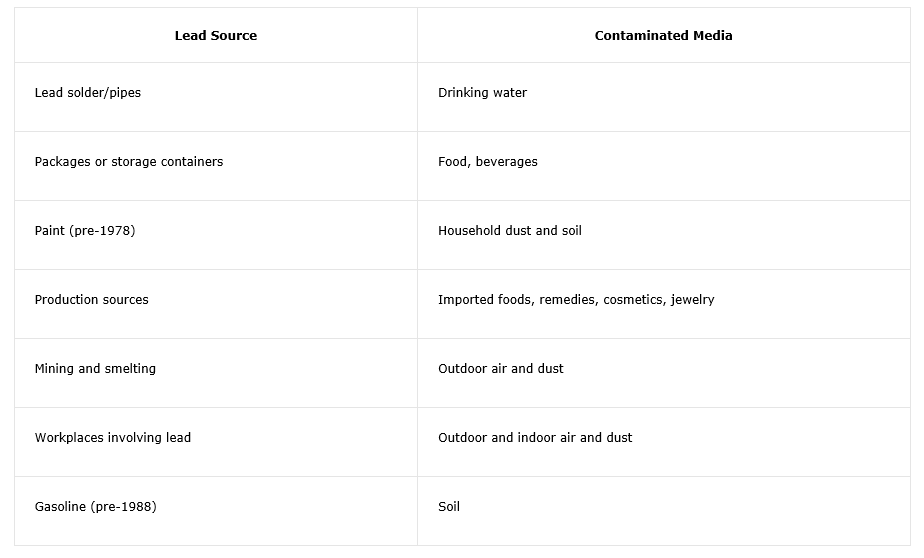
Source: Lead toxicity: where is lead found? [Web page]. Agency for Toxic Substances and Disease Registry. http://www.atsdr.cdc.gov/csem/csem.asp?csem=7&po=5.
Health Effects
The adverse health effects of lead exposure are well documented. Lead can affect the immune system and cause chronic infections as well as autoimmune conditions.3 These effects can occur whether exposure takes place in adulthood, childhood, or in utero. Unborn children are at the greatest risk of adverse health effects, including low birth weight and premature birth. In children, lead exposure has been associated with decreased intelligence, slowed growth, and hearing problems. Exposure to high levels of lead can result in kidney and brain damage as well.3
Acute exposure, considered lead poisoning, can cause loss of appetite, headache, hypertension, abdominal pain, kidney damage, fatigue, arthritis, hallucinations and vertigo. Acute exposure is typically a high dose of lead in a short amount of time. Chronic exposure to lead can result in serious issues for children, including mental retardation, birth defects, psychosis, autism, allergies, dyslexia, weight loss, hyperactivity, paralysis, muscular weakness, and brain and kidney damage. 4 Chronic exposure can be low doses of lead over a short or long duration. Early symptoms of lead exposure prompting a doctor to test for lead may include muscle weakness, fatigue, ADD, muscle pain, joint pain, decreased appetite, changes in taste, headache, insomnia, irritability, and weight loss.
Once exposed, lead is mostly stored in our bones, and early life exposure can create health problems during aging. Bone turnover that occurs with normal aging or due to early osteopenia can release lead into the blood and soft tissues. This can also occur during pregnancy, when there is an increase in bone mobilization, accounting for lead in the umbilical cord blood or newborns. This phenomenon was highlighted years ago in an article by M. Hernandez-Avila published in October 1996 in Environmental Health Perspectives.
Lead in
Drinking Water
Schools and Day-Care Facilities
. The March 20, 2016, issue of USA Today highlighted an investigation that found lead in the drinking water of schools and day-care facilities across the US. An analysis by the Environmental Protection Agency (EPA) showed that about 350 US schools and day-care centers failed lead tests a total of about 470 times from 2012 through 2015. Children at an elementary school in Ithaca, New York, were found to have elevated blood lead levels. The source was the schools drinking water. The EPA states that any amount of lead in the water over 15 parts per billion (ppb) warrants immediate action. One water sample at a Maine elementary school was 41 times above the EPA limit. A preschool in Pennsylvania was 14 times higher than the EPA limit, and a sink in a music-room bathroom at the Ithaca elementary school tested this year at 5000 ppb of lead.5
Schools typically do not test their own water for lead and other hazardous substances. They depend on their water sources such as municipal utilities to do the testing. Among schools and day cares required to test, the USA Today analysis found problematic lead levels in 42 states.5 The lead contaminated water at these schools isn’t used just for drinking, but also for cooking, and washing hands. Schools often sit empty for long stretches over the summer, allowing unused water to stay in contact with old lead pipes; and if the water is particularly corrosive, it can dissolve lead from the pipes. If schools are not testing for it, this problem can go undetected for months or years. Sometime the parents are not immediately told about the problem even once the school is aware. The lack of transparency is also at the heart of the Flint water crisis.
Flint, Michigan
. By now most people are aware of the crisis in Flint, where thousands of people were exposed to lead in the drinking water. City and state officials knew about the exposure long before making the public aware and offering guidance on how to avoid exposure, get tested for lead in the body, and correct the problem that caused the exposure. It is estimated that over 8000 children were exposed to lead in Flint.6 The public outcry and media attention is what drove USA Today to investigate if there is lead in the water of other US cities. So what happened in Flint?
Flint happened due to economics. The city was bankrupt and looking to save money, so officials decided to stop buying drinking water from Detroit, which charged Flint $21 million in 2011. The original plan was to join a new water treatment system that, like Detroit, drew water from Lake Huron, but that system wasn’t ready.6 So in 2014, the city began using treated water from the Flint River. The river water was corrosive, which, as stated above, can wear away pipes, leaching lead into the water. The city of Flint didn’t properly treat the water from the river to make it less corrosive, and the state didn’t properly test the water for lead levels. Both the city and state downplayed concerns from residents, pediatricians, and even General Motors, which stopped using the water because it was too corrosive. The state finally admitted that something was wrong after scientists from Virginia Tech went to Flint to test the water and found elevated lead levels in 40% of homes.6 Residents were exposed to lead in the water for a longer period of time than they should have been, almost 2 years, due to the inaction of state and city officials.
Testing
Doctors are responsible for screening patients for lead exposure and linking various symptoms and disease to the effects of lead. Symptoms may not appear immediately after exposure, thus making lead toxicity hard to diagnose. The Centers for Disease Control and Prevention (CDC) states that lead is best tested in the blood (whole blood), but in some instances urine is necessary. The problem with most labs’ offering lead tests is that the reference range is set too high, and interpreting the result is not always done correctly. Pediatric blood levels come with various reference ranges based on the child’s age. The CDC states: “No safe blood lead level in children has been identified.” There is no toxic threshold for lead, meaning that there is no measurable level of lead in the body below which no harm occurs. So having reference ranges really doesn’t make any sense. Either it’s there or it’s not.
In 2016 the CDC updated the level of blood lead considered elevated in a child and set it at 5ug/dl.7 For people exposed to lead chronically, the levels found in the body are significantly elevated. Blood lead levels of 30 to 80 μg/dL have been found in children living in old houses painted with lead-based paint, levels of 77 to 104 μg/dL in pottery-glaze workers, 90 to 137 μg/dL in those who consumed contaminated herbal medicines, 109 to 139 μg/dL in indoor firing range instructors, and up to 330 μg/dL in individuals who had drunk juice from glazed pottery.8 Studies show that the amount of lead present in the body can determine if that person is at risk for disease. The blood lead level linked to adverse effects can be below the CDC’s elevated range of 5ug/dl. This is especially true for children, as outlined in this table from the CDC.

Source: Centers for Disease Control and Prevention. Educational Interventions for Children Affected by Lead. Atlanta: U.S. Department of Health and Human Services; 2015. Available at http://www.cdc.gov/nceh/lead/publications/Educational_Interventions_Children_Affected_by_Lead.pdf.
Lead is mostly stored in two parts of the bone and in soft tissues such as the liver. The lead in the bone’s surface can easily pass into the blood, whereas lead stored in cortical bone is immobilized. Studies have reported that 40% to 70 % of lead in the blood of adults originates from bones.8 Since lead is stored in the bone, a blood lead test may not accurately reflect body burden of lead in someone with chronic exposure or with high-dose exposure wherein it’s out of circulation and stored in the bone. Bone lead will only show up in the blood if it is currently being mobilized by bone turnover or chelation therapy.9
This is where both blood and urine testing are appropriate to catch circulating levels and stored levels of lead. Urine lead testing would consist of both random urine and provoked urine testing using a chelating agent to mobilize lead stored in bone.9 The January 2011 Environmental Medicine Update column of the Townsend Letter discussed provocative urine metal testing; that is, proper testing method and which chelator is best to use depending on exposure history and symptoms.10 Lead concentration in cortical bone can also be measured through X-ray fluoroscopy (XRF). Provocative urine testing with a chelating agent and bone XRF are known to be the most sensitive techniques for determining the degree of lead accumulation in the body.
Treatment
Once it is established that lead is present in the body, the treatment to remove lead consists of chelation therapy. The ATSDR states: “Chelation therapy is necessary when blood lead levels are higher than 45µg/dL.” This of course makes no sense when the CDC states that health effects are seen in children with levels in the blood as low as 3ug/dl. A chelating agent is a substance that can form several bonds to a single metal ion.11 The most common chelating agents are ethylenediaminetetraacetic acid (EDTA), dimercaptosuccinic acid (DMSA) or 2,3-dimercapto-1-propane sulfonic acid (DMPS), dimercaprol (British anti-Lewisite [BAL]), and penicillamine.
Calcium disodium EDTA (CaNa2EDTA; often listed simply as CaEDTA) and DMSA have a greater affinity for lead than the other chelating agents.10 Only CaNa2EDTA can be used for treating lead poisoning, not Na2EDTA (disodium edetate). Na2EDTA should never be used, because it will induce tetany and possibly fatal hypocalcaemia. CaNa2EDTA is FDA approved for treating lead poisoning. It is administered intravenously and can increase urinary lead excretion 20-fold to 50-fold. CaNa2EDTA removes lead from the extracellular compartment only, because it does not enter cells.
Chelation therapy can result in a decrease in essential minerals from the body, thus causing some side effects. DMSA has been found to not cause a decrease in minerals such as zinc, iron, calcium, and magnesium and is the most efficient and safe chelating agent for lead exposure.11 The drawbacks of CaNa2EDTA are that it contributes to a greater loss in minerals compared with DMSA.11 The FDA approved DMSA in January 1991 for treating children with blood lead levels > 45 µg/dL. DMSA is an effective oral chelating agent.
New strategies in heavy metal chelation therapy include the use of combination therapy such as DMSA and CaNa2EDTA and the coadministration of antioxidants and nutrients. Taurine, vitamin B6, quercetin, vitamin E, vitamin C, garlic, curcumin, and lipoic acid have all been shown to decrease the effects of lead exposure or help remove lead from the body.11 These nutrients are often used along with chelation therapy. The replacement of essential minerals is necessary with chelation because minerals are pulled out along with metals.
Summary
The water crisis in Flint, Michigan and the USA Today report on schools and day-care facilities, have brought to light the fact that people are still at risk for lead toxicity from water. Lead exposure through the drinking water has significant health effects on adults and children. Doctors need to know how to screen patients for signs, symptoms, and health conditions linked to lead. Proper interpretation of blood and urine tests help diagnose exposure and determine if chelation therapy is indicated. The recent media reports have increased public awareness of lead poisoning which will hopeful prevent further exposure by remediating the source and clear lead from the drinking water.
Notes
-
Public health statement for lead [Web page]. August 2007. Agency for Toxic Substances and Disease Registry. http://www.atsdr.cdc.gov/PHS/PHS.asp?id=92&tid=22. Accessed March 15, 2016
-
Sources of lead [Web page]. New York State Department of Health. April 2010. https://www.health.ny.gov/environmental/lead/sources.htm. Accessed March 15, 2016.
-
Krueger WS, Wade TJ. Elevated blood lead and cadmium levels associated with chronic infections among non-smokers in a cross-sectional analysis of NHANES data. Environ Health. 2016 Feb 11;15(1):16.
-
Jaishankar M et al. Toxicity, mechanism and health effects of some heavy metals. Interdiscip Toxicol. 2014 Jun;7(2):60–72.
-
Unger L. Lead taints drinking water in hundreds of schools and day care facilities. USA Today. March 20, 2016. http://www.usatoday.com/story/news/nation/2016/03/17/drinking-water-lead-schools-day-cares/81220916.
-
Nelson L. EPA email: “I’m not so sure Flint is the community we want to go out on a limb for” [online article]. Vox. March 15, 2016. http://www.vox.com/2016/3/15/11239438/flint-epa/in/10563335. Accessed March 23, 2016.
-
Centers for Disease Control and Prevention. Lead elevated blood levels: 2016 case definition [Web page]. https://wwwn.cdc.gov/nndss/conditions/lead-elevated-blood-levels/case-definition/2016. Accessed March 23, 2016.
-
Kim HC et al. Evaluation and management of lead exposure. Ann Occup Environ Med. 2015;27:30.
-
Lowry JA. Oral chelation therapy for patients with lead poisoning [online document]. World Health Organization committees’ expert. December 2010. http://www.who.int/selection_medicines/committees/expert/18/applications/4_2_LeadOralChelators.pdf. accessed 3/23/2016
-
Marchese M. Provocative heavy metal testing; which chelator is best? Townsend Letter 2011;Jan:89–91.
-
Shakhashiri BZ. Chemical of the week: chelates and chelating agents [Web page]. Science is Fun. http://scifun.chem.wisc.edu/chemweek/chelates/chelates.html. Accessed March 25, 2016.







0 Comments