
Introduction
Arsenic is a metal that is present in our food, air, and water. It is an element and a naturally occurring mineral found in the environment. Arsenic persists in the environment because it does not break down easily. Arsenic exists in two main forms: inorganic and organic. Organic arsenic is the main form found in foods while inorganic arsenic is present in soil and groundwater. Inorganic arsenic is more hazardous to human health than organic arsenic. Of course, toxicity is dependent on the dose of the exposure, absorption, and elimination from the body.1 Inorganic arsenic used to be produced in the US by being heated in smelters, which produced a fine dust in the air. This form of arsenic was made as a preservative for wood and although no longer made in the US, it is still imported from other countries. In the past, arsenic used to be in pesticides used in agriculture, and it still permeates the soil and groundwater. Some organic arsenic compounds are used as additives in animal feed.1 Arsenic has been used as alloy additives; in electronic devices, such as smartphones; in veterinary medicines; pigment production; in glass manufacturing; as bronzing or decolorizing agents; in textile printing; in tanning; and many other uses.2 Inorganic arsenic is naturally occurring and is released into the air by volcanoes, the weathering of arsenic-containing minerals and ores, and commercial and industrial processes. Arsenic cannot be destroyed in the environment; it persists forever accumulating in water and food. This is how people are exposed to arsenic, which can have adverse health effects.
Food
Grains, produce, fish, especially shellfish, are the main sources of organic arsenic exposure via food. Arsenic found in fish and shellfish exists primarily as two forms of organic arsenic that are essentially nontoxic.2 Rice is a significant source of organic arsenic exposure, and it is estimated that a half cup of rice equals drinking a litter of water containing 10 ug/L of arsenic.3 Rice simply absorbs arsenic from the groundwater in which it is grown. The form of arsenic in rice is also organic arsenic and is rapidly cleared from the body and considered harmless. Shrimp and tuna are significant sources of dietary exposure as well. It does not matter if the tuna is wild caught, packed in water verses oil, or deemed low in mercury. It still may contain organic arsenic. Organic arsenic from food has a very short half-life, is metabolized, and eliminated quickly from the body, and determined to be harmless to human health.
Water
Groundwater is the most common source of exposure of inorganic arsenic in the US. Inorganic arsenic can get into rivers, lakes, or an underground water by dissolving in rain or snow. It also gets into the water through the discharge of industrial wastes and agriculture run-off. Inorganic arsenic in groundwater is generally about 1 ug/L but may exceed 1,000 ug/L in contaminated areas or where arsenic levels in soil are high. Groundwater is more likely to contain high levels of arsenic than surface water.2
The Environmental Protection Agency (EPA) regulates public drinking water under the Safe Drinking Water Act, which was enacted in 1974. It requires the EPA to set standards for contaminants through the National Primary Drinking Water Regulations, which minimizes risk for contaminants. Standards fall into two categories: the maximum contaminant level (MCL), which is enforceable by law and is less stringent, and the maximum contaminant level goal (MCLG), which is only a guideline. These two numbers can vary significantly. The federally mandated MCLG for arsenic is 0 ug/L; however, the MCL is 10 ug/L.
It was only in 2006 that the EPA set the limit for municipal water supply to the current level of 10 ug/L. The level used to be set at 50 ug/L. Suddenly dropping the level from 50 ug/L to 10 ug/L put the burden on cities to figure out how to remove arsenic from the drinking water. Many areas of the US still exceed the 10 ug/L level.3 Some areas of the US contain high natural levels of arsenic in rock, and this can lead to high levels of arsenic in the water. Due to geographical variations, people will not know if the water they are drinking contains high levels of arsenic unless they test their home water.
In 2011 the United States Geological Survey published results of a study on arsenic in the drinking water. They sampled wells in parts of aquifers used for drinking water in the US and found that 7 percent of the wells sampled contained arsenic at a concentration that exceeded the MCL of 10 ug/L. The greatest concern was in the Southwest, where concentrations of arsenic exceeded the MCL in about 16 percent of drinking-water wells sampled.4 In the Southwest basin-fill aquifers, arsenic concentrations in drinking-water wells exceeded the MCL more than twice as frequently as in drinking-water wells nationwide.
But at what level in the water does arsenic start to pose a risk to health. Is the EPA maximum contaminant level at 10 ug/L low enough to keep us safe? Some environmental organizations and recent published studies say the level needs to be lowered and arsenic basically removed from the drinking water to prevent adverse health effects. Other studies conclude that the level set at 10 ug/L is adequate. Currently the EPA is considering lowering the MCL from 10 ug/L to 5ug/L to reduce cancer risk, specifically bladder and lung cancer.5
Health
Both the Environmental Protection Agency and the Agency for Toxic Substances and Disease Registry list arsenic as a cancer-causing compound. Human studies suggests that exposure to inorganic arsenic by inhalation may result in lung cancer, and exposure by ingestion may result in nonmelanoma skin cancer, bladder, kidney, liver, and lung cancers. Arsenic is absorbed in the GI tract, distributed throughout the body, and reduced to arsenite to be methylated. Methylation is the main way in which arsenic is metabolized by the body. Inorganic arsenic (including arsenate and arsenite) is methylated into monomethylated and dimethylated compounds (MMA, DMA) in the liver. These metabolites are then excreted through the kidney together with unmethylated inorganic arsenic.6 It appears that an individual’s ability to methylate and eliminate arsenic plays a role in disease development.
A 2017 study tried to examine the differences in arsenic methylated metabolites and risk of disease. It found that inorganic arsenic exposure was associated to cancer risk in persons with higher percentage of MMA metabolites and lower percent of DMA metabolites. The same was true for cardiovascular diseases and carotid atherosclerosis. For diabetes, however, lower MMA% and higher DMA% was associated with higher risk of diabetes and metabolic syndrome.6 Methylation of arsenic occurs primarily in the liver and individual genetic differences in metabolism called single nucleotide polymorphisms, SNPs, affect arsenic break down.3 There are several labs that can test for methylation SNPs in the body to help determine one’s ability to break down arsenic.
Most studies linking arsenic to adverse health effects show exposure from groundwater, not food, is the main culprit. Cancer, COPD, cardiovascular disease, diabetes, pre-diabetes, and decreased cognitive function are linked to inorganic arsenic in the water.3 A study published in 2017 found that arsenic levels in the drinking water below the 10 ppb standard is linked to prostate cancer.7 Other studies did not come to the same conclusion. Perhaps the determining factor of the health effects at levels in the water below 10 ug/L is genetic variations in arsenic metabolism and length of low-dose, chronic exposure. Regardless, since many people are unknowingly exposed to arsenic in their drinking water, it is important to test not only home drinking water for arsenic but to test patients for elevated arsenic in the urine.
Arsenic Levels in the Body
The Center for Disease Controls’ National Health and Nutrition Examination Survey (NHANES) samples a large segment of the US population monitoring for various chemicals through blood and urine testing. Arsenic is best tested for via urine sample (either a 24-hour collection or a random sample). Most samples do not differentiate organic arsenic from inorganic arsenic. However, some commercial labs can specify arsenic in the urine upon request. To eliminate organic arsenic from a urine sample leaving mostly inorganic arsenic, it is important to have patients avoid all seafood, chicken, and rice three to four days before urine collection. Reference ranges vary from lab to lab. NHANES lists a urine arsenic above 55 ug/L as in the 95th percentile. Any level above 55 ug/L would be considered elevated.
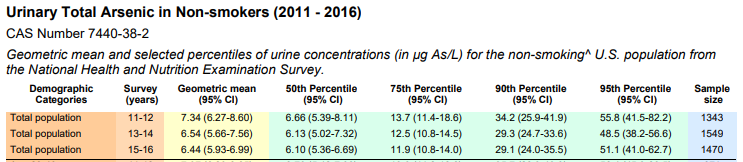
The World Health Organization states a 24-hour urine level <50 ug/L is acceptable. Mayo Clinic has a tighter reference range of <35 ug/L for a either a 24-hour urine or random urine collection. Lab Corp reference range for either a random or 24-hour collection states <50 ug/L is normal. Lab Corp can differentiate inorganic arsenic in the sample from organic arsenic and states inorganic arsenic <19 is acceptable. Quest Diagnostic reference range for a random urine arsenic test is <35 ug/L and a 24-hour urine range of <80 ug/L.
Different labs have different reference ranges for what is an acceptable level of arsenic in the body. In general, a random level above 35 ug/L and 24-hour level above 50 ug/L would be a cause for concern. If a patient’s urine arsenic is elevated and they avoided food sources of arsenic three to four days before the urine collection, then the home water should be tested. Drinking water is the most common source of exposure. Unless they have reverse osmosis water filtration for both cooking and drinking water there is a chance that their water is the source of exposure.
Case Example
Early 2020 a 36-year-old female presented with joint pain in her hands, hair shedding in the shower, body pain all over that comes and goes, and fatigue. March 2019: her primary care provider ran blood work showing negative ANA and normal CBC, CMP, lipid, ESR, CRP, Lyme disease, EBV, CMV, and TSH. Later her vitamin D, B12 and iron were tested and normal. She was referred to a rheumatologist who repeated labs May 2019 and did an x-ray of her hands. The x-ray was normal, rheumatoid factor negative and again the ANA was negative. The rheumatologist said the joint and muscle pain was from overuse and prescribed ibuprofen. She changed her mattress, pillow, started stretching, and got a sit-stand desk. She came to see me because she had been taking ibuprofen for six months and felt like her symptoms still flared up every now and then. She specifically wanted heavy metal testing.
At the initial appointment she complained of hair shedding, muscle and joint pain that comes and goes with no pattern, and she had fatigue. She was on no medications as she had stopped the ibuprofen. She took vitamin-D3 (4,000 IU a day), a fish oil (1,500 mg a day) and B-complex. She had no other health concerns or issues. Repeat TSH, CBC, CMP and thyroid antibodies were all negative.
An environmental exposure history revealed no exposure at work to metals, solvents, or pesticides. Her hobbies are exercising and piano. She does not any eat fish and tries to eat organic fruits and vegetables and mostly eats a plant-based diet. She is gluten free and eats very little cow milk products. Her protein sources are organic soy products, eggs, some cow milk products, and occasional wild game that her husband hunts. She has a very healthy and balanced organic diet. She does not use any personal care products with parabens, phthalates or BPA and minimizes chemical exposure in general. She grew up in Tucson Arizona, on city water, and was not near agriculture or a golf course. She drinks refrigerator filtered water at home for the past 10 years, which eliminates lead according to the label. She has lived in Phoenix Arizona, in the same house for the past eight years with no water leaks or remodel done. She wanted heavy metal testing. We did a random first morning urine metal test and blood lead and mercury. The blood lead was <2 and blood mercury <3, which are normal. The results of the urine metal test show the arsenic level in a random sample was 93 ug/g, which was above the reference range.
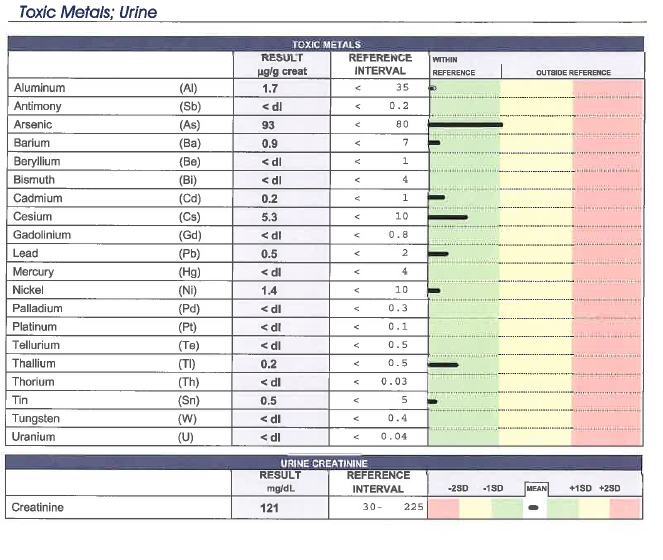
Identifying the source of exposure was the top priority. As already mentioned, she did not eat any fish and very minimal rice and chicken. She drank and cooked with water from the refrigerator filter, which is not reverse osmosis. Reverse osmosis filtration removes arsenic from water. So she tested her home water for arsenic. She used an Arizona Department of Health certified commercial drinking water laboratory. The level came back at 10.9 ppb only 0.9 ppb above the EPA maximum contaminant level. Although this is not a significantly elevated level, we do not know how long this level of arsenic has been in her water nor do we know if she has any SNPs of methylation metabolism pathways. She was not interested in SNP testing.
The treatment plan consisted of installing a reverse osmosis water filtration system for both drinking and cooking water. For four months she took N-acetylcysteine (600 mg twice a day) and a liver phase one and phase two supplement providing co-factors for metabolism and methyl donors. The cofactor support product contained vitamin A, vitamin D3, vitamin K1, vitamin B-1, vitamin B-2, vitamin B-3, vitamin B-5, vitamin B-6, vitamin B-12 (as methylcobalamine), vitamin C, vitamin E, biotin, folate (5-methyl-tetrahydrofolate), calcium, chromium, copper, iodine, magnesium, manganese, molybdenum, potassium, selenium, zinc, choline, inositol, boron, vanadium, green tea extract, and turmeric.
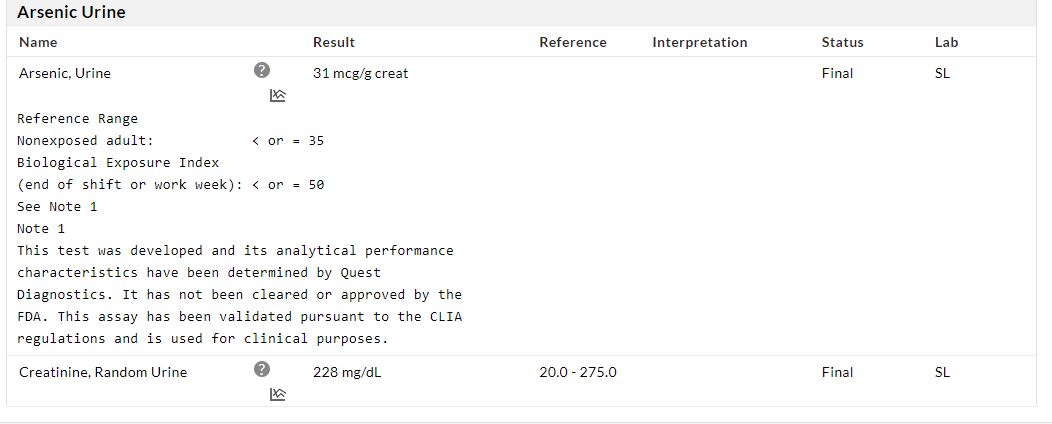
Six months after starting treatment, she felt remarkedly better. She had energy, her hair stopped shedding and joint pain resolved. We retested her random urine arsenic level six months after starting treatment and using reverse osmosis water with a commercial lab to utilize her insurance. The level dropped from 93 ug/g to 31 mcg/g. (note that mcg and ug are the same).
Summary
Arsenic is a metal that is present in our food, air, and water. Organic arsenic is the main form found in foods while inorganic arsenic is present in soil and groundwater. Inorganic arsenic is more hazardous to human health than organic arsenic. Arsenic can have adverse health effects on humans with cancer being the number one consequence of high-dose, acute exposure or low-dose, chronic exposure. Other milder and more subtle health effects occur over time as well. The case example demonstrates a need for health care providers to think outside the box. Consider blood and urine metal testing as a screening tool when other labs are normal and the patient’s symptoms cannot be explained. Since water is a common source of exposure, testing the home drinking water can help identify if arsenic is present. Arsenic is cleared from the body through methylation processes, which is why methyl support and antioxidants along with avoiding the source of exposure is helpful for eliminating arsenic from the body.
References
- Agency for Toxic Substances and Disease Registry (ATSDR). 2007. Toxicological profile for Arsenic. Atlanta, GA: U.S. Department of Health and Human Services, Public Health Service. Accessed online 6/4/2021 Arsenic | Toxicological Profile | ATSDR (cdc.gov)
- Environmental Protection Agency. 2021. Arsenic Compounds. Accessed online 6/4/2021 Arsenic April 2021 (epa.gov)
- Crinion WJ, Pizzorno JE. Clinical Environmental Medicine. 1st edition. St Louis MO, 2019.
- DeSimone, L.A., McMahon, P.B., and Rosen, M.R., 2014, The quality of our Nation’s waters—Water quality in Principal Aquifers of the United States, 1991–2010: U.S. Geological Survey Circular 1360, 151 p., https://dx.doi.org/10.3133/cir1360.
- Environmental Protection Agency. 6/22/2020. National Primary Drinking Water Regulations; Arsenic and Clarifications to Compliance and New Source Contaminants Monitoring. Accessed online 6/9/2021. https://www.federalregister.gov/d/00-13546
- Kuo CC, et al. The Association of Arsenic Metabolism with Cancer, Cardiovascular Disease, and Diabetes: A Systematic Review of the Epidemiological Evidence. Environ Health Perspect. 2017;125(8):087001.
- Roh T, Lynch CF, Weyer P, Wang K, Kelly KM, Ludewig G. Low-level arsenic exposure from drinking water is associated with prostate cancer in Iowa. Environ Res. 2017;159:338-343.








0 Comments