
Monthly Miracles
by Michael Gerber, MD, HMD
Integrative Ophthalmology
‘I Was Going Blind and Now I Can See.’
At age 14, H. M. looked into her mirror to apply eye makeup and realized that she couldn’t see. She went to an optometrist, and when he examined her eyes he turned pale and told her to get to the hospital immediately. It was then she had her first Kenalog (triamcinalone) shots into her eyes. That began a nine-year saga of many conventional ophthalmologic interventions to treat her retinal tears, uveitis, pars planitis, retinal scarring, macular edema, synechia, glaucoma, and cataracts. Six weeks ago while still on 4 ophthalmic eyedrops plus Voltaren, H. M. was told that she would need to take methotrexate for the rest of her life to suppress her immune system or she would soon be completely blind. I will detail her conventional and integrative treatment later in the article.
Pars Planitis
I have had a number of happy resolutions of eye diseases over the years, most through serendipitous therapeutic trials. In 1998, L. T., a then 45-year-old female, had suffered since the mid 1980s from pars planitis, which accompanied her sarcoidosis.1 Pars planitis (also called intermediate uveitis) is an inflammation of the uvea, part of the choroid lining in the eye which contains the blood vessels, that causes white blood cells and other inflammatory exudate to enter the vitreous humor (see Figure 1) and make white blobs (snowballs) build up, which impairs the vision and can lead to cataract, severe inflammatory glaucoma, swelling of the macula, retinal atrophy, and hemorrhage into the vitreous. It is of idiopathic (autoimmune) origin about 70% of the time, with sarcoidosis association 22%, multiple sclerosis 8%, and other infectious diseases such as Lyme and Epstein-Barr virus in less than 1% of patients.
Figure 1
: Anatomy of the Human Eye

L. T. had several eye surgeries, many Kenalog shots into the eyes. Still her left eye couldn’t read the big E on the eye chart, and the right eye was only slightly better. Her eye docs prescribed cyclosporine as a long-term treatment for her disease, which she declined. At that point I began seeing her. She also had quarter-sized granulomas on her legs from the sarcoidosis. After giving my usual lifestyle work-up, I suggested nutrients, especially vitamin A, lutein, vitamin C and trace minerals, vitamin E complex, and magnesium and gave bioidentical hormone replacement therapy with thyroid, adrenal, and progesterone. Since the pars planitis is an inflammatory process, it seemed important to use all the anti-inflammatory oils, omega-3s, omega-5s (cetyl myristoleate), and omega-6s (primrose oil). Her stools were always floating and foul-smelling, so I suggested that she begin pancreatic and plant enzymes, 5 three times per day, away from meals and after meals. In addition, we started Pleo Muc eye drops 5X, Mucor racemosis Fresen, the famous endobiont (pleomorphic fungus that lives within all of us) that improves circulation and has many wonderful uses all over the body.3 Her challenged mercury test was 13 times higher than the reference range limit. She had her mercury amalgam fillings removed and began chlorella and DMSA.
Within one month, she had no more white cells visible in her eyes and her granulomas were fading. Her vision improved rapidly, and her ophthalmologists said that she had no more need for cyclosporine or methotrexate. Within two months, she could count fingers with her left eye, the right eye had improved to the point of one year prior, and the leg granulomas were almost gone. She particularly noted that the enzymes had helped the edema in the right eye. Within 18 months, her eyes had stabilized, although her cataracts still remained secondary to the multiple steroid treatments.
Fourteen years later her vision is still stable, though the WBCs start to return after three or four days off her pancreatic and plant enzymes. She regards the enzymes as the most important part of her therapy and changes her enzymes every few months, usually using Wobenzym or one of the other similar formulas.
Retinitis Pigmentosa
Retinitis pigmentosa (RP) is an inherited, degenerative eye disease that causes severe vision impairment and blindness.2 RP is a form of retinal dystrophy and is caused by abnormalities of the photoreceptors (rods and cones) of the retinal pigment epithelium, leading to progressive sight loss. Its most common symptoms are night blindness as a result of the degeneration of peripheral visual fields and increasingly impaired peripheral vision and sometimes central vision.
C. H., a 57-year-old female with a 20-year history of RP symptoms and a plethora of other conditions, including chronic fatigue, which is also related to RP, consulted us over three years ago. She was on Diamox, a diuretic, to treat edema in the retina. After instituting our treatments as above and treating her very hypothyroid condition along with severe hypercholesterolemia and hypertriglyceridemia, we started Pleo Muc eye drops 5X. Of all our treatments, she thinks that Pleo Muc is the most important and has stabilized her RP for the past three years so that she no longer requires Diamox. When she ran out of Pleo Muc for one month, her symptoms returned.
‘The Lawn’
When speaking in Tempe, Arizona, in February, I had the pleasure of hearing two lectures from Thomas Rau, MD, the medical director of his Paracelsus Klinic in Lustmuhle, Switzerland. He is an outstanding biological physician and a well-known lecturer and author in the integrative medical world, highly regarded for his expertise in Enderlein isopathic therapies.4 He began one lecture asserting the absolute importance of the health of the intestinal tract, which he called the “lawn,” since the bowel contains roughly 10,000 square feet of surface area similar to a football field in size. Since 70% of our immune system emanates from the bowel and Peyer’s patches (Figure 2) make 90% of our T lymphocytes, it is important to prepare the soil with care.
Figure 2: Peyer’s Patches
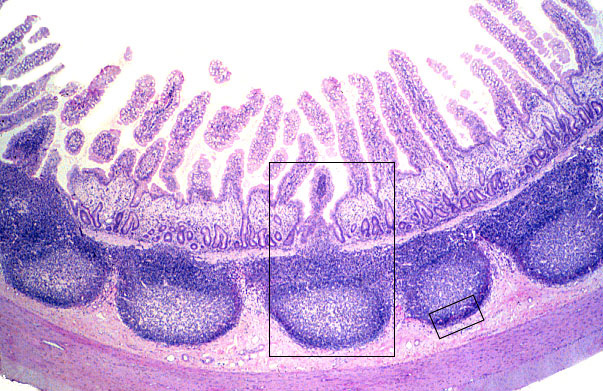
Peyer’s patches, the lymphoid bodies that surround the lumen of the small and large intestines, can be damaged by antibiotics and environmental toxins over a lifetime and may not produce enough T cells. If the numbers of T cells are too low, they may become hyperreactive and attack human tissue, promoting autoimmunity, allergy, and arthritis. By using Rebas 4X (homeopathic Peyer’s patches) and Pleo Fort 4X (Penicillium roqueforti), the soil can be rebuilt and allow the immune system to function normally. I was astounded! We have had these remedies in our pharmacy for over 20 years and I didn’t understand this concept. Pleo Fort is always great for intestinal distress, GI flu’s, food poisoning, and failure to thrive in infants. We had used Rebas for autism and sinus conditions but without thought of these two remedies’ being important for autoimmunity. This combination has been very helpful for one case of pericarditis, autoimmune hepatitis, and now our 23-year-old H. M., who was going blind.
H. M.
H. M. was diagnosed with pars planitis at age 14. She has three ophthalmologists and a retinal specialist. Also at age 14 she had her first vitrectomy, a procedure that removes the vitreous humor loaded with white cells and inflammatory exudate and replaces it with saline. She has had multiple Kenalog shots in the eyes with subsequent cataract formation and laser surgery last summer for retinal detachment. In addition, her intraocular pressure (IOP) was very high, 56 mm of Hg (couldn’t see; normal value is from 10 to 21 with an average of 16 mm of Hg) while on a combination of drops for glaucoma. She had been treated with prednisone up to 50 mg per day on numerous occasions with severe psychiatric side effects (psychosis) and body numbing. It also promoted approximately two urinary tract infections per month treated with antibiotics. When she came into our clinic on April 10, 2012, she also had Hashimoto’s thyroiditis, TPO of 309, icterus with elevated bilirubin and AST with a speckled pattern ANA of 1:160. Medications at that time included Xibron drops, a NSAID to reduce swelling, Durezol drops, a topical corticosteroid, Combigan drops, and oral Voltaren.
One week before coming to our clinic, she decided to become vegan and renounced junk food, fast food (used to live off McDonald’s), sugar, gluten, and dairy and began juicing. She was only on vitamin D supplementation. I began with our usual therapy as above with Pleo Muc eye drops; Wobenzym; magnesium glycinate; and thyroid, adrenal, and progesterone support. Two weeks later she said that her vision was normal and she had made many health improvements and lost 10 pounds. At that time I added Rebas suppositories 3X three times per week and Pleo Fort caps 4X daily. At one month, her IOP was 18 and her eye doctors stopped the glaucoma meds and said that she wouldn’t need the methotrexate now. Her pars planitis was gone and uveitis was completely under control, and she was off steroid drops and Voltaren. The Xibron drops were being titrated down gradually. She thought that the most resolution of the pars planitis came with the Rebas and Pleo Fort therapy within two weeks. At six weeks her IOP is 15 and she is 20/20 left eye and 20/30 right eye and believes her vision to be totally normal; even though she still has cataracts, they don’t seem to cause cloudy vision. She is no longer icteric and is off all medications except a very low dose of Xibron drops. Her ophthalmologists don’t want to see her for another three months.
These cases make one think that integrative physicians should work more closely with ophthalmologists. It is certainly exciting to have such nice responses. Thanks, Dr. Rau, for a new perspective in dealing with autoimmunity.
Notes
1. Retinal Consultants. Pars planitis [Web page]. www.retinalmd.com/en/resources/conditions-and-diseases/pars-planitis.
2. Retinitis pigmentosa [online article]. Wikipedia. http://en.wikipedia.org/wiki/Retinitis_pigmentosa.
3. Pleo Muc (Mucokehl in Europe) is one of the fungi that live in us and has many forms. It is the fungus that grows on corpses when we die and it can be brought back to life from 5000-year-old mummies. The little forms of the fungus mate with the big forms, which block circulation and return them to the small forms, which are beneficial. It is the “make love, not war” antibiotic with no side effects unless you kill off the bad forms too quickly. You can find the Pleo-Muc eyedrops and 70 or so other pleomorphic preparations from TerraMedica.com. See Enderlein G. Bacteria Cyclogeny. Prescott. AZ: Enderlein Enterprises; 1916, 1991.
4. Rau T. Biological Medicine the Future of Natural Healing.1st ed. Semmelweis-Institut Verlag fur Naturheilkunde Gmbh; 2011.








0 Comments