

SARS-CoV-2 is transmitted primarily via respiratory droplets produced while talking, coughing, and sneezing. Indirect routes, such as airborne and surface-mediated transmission, are also possible, especially considering SARS-CoV-2 can stay viable in aerosols and on surfaces for up to 72 hours. UV-C (ultraviolet C) light has been suggested to be an effective tool to reduce the spread of respiratory born viruses and protect public health in commercial, public, transportation, and health care settings.1 One limitation of conventional UVC devices is that they are not safe for human exposure due to adverse effects on human skin and eyes.
Effective disinfection technology to combat severe acute respiratory syndrome coronavirus 2 (SARS-CoV-2) can help reduce viral transmission during the ongoing COVID-19 global pandemic and in the future. UV devices emitting UVC irradiation (200 to 280 nm) have proven to be effective for virus disinfection, but limited information is available for SARS-CoV-2 due to the safety requirements of testing, which is limited to biosafety level 3 (BSL3) laboratories.1-3
UV devices emitting UVC irradiation (200 to 280 nm), such as the low-pressure (LP) UV lamp and UV light-emitting diodes (LEDs), have been widely used for virus disinfection of water, air, and surfaces since the early 20th century.2-6 No statistically significant difference in UV inactivation performance was observed between the LP UV lamp and the UV LED 270nm (i.e., LED with a peak emission wavelength of 270 nm). Viral genome damage is likely to be the primary inactivation mechanism for these UVC devices, and SARS-CoV-2 should have similar sensitivities to UV irradiation from these devices due to similar levels of nucleic acid absorbance at their peak emission wavelengths (i.e., 254 and 270 nm, respectively).
UVC radiation has been shown to destroy the outer protein coating of the SARS-coronavirus, which is a different virus from the current SARS-CoV-2 virus. The destruction ultimately leads to inactivation of the virus. The effectiveness of the pulsed xenon-based ultraviolet light systems in reducing aerobic bacteria, also in the absence of manual disinfection, was demonstrated by Jinadatha et al.7 UVC light prevents MRSA infection of superficial wounds in vivo.8 The evidence suggests the effectiveness of UV-C technology in reducing manual cleaning failures, enhancing the logarithmic reduction of surface pathogen colonies. However, the safety and success of these devices will depend on several physical and biological factors.9
Oral or nasal pathways are airborne entry routes from both animate and inanimate sources; pathway-bound fluids’ role in initial primary carriers result in microbic transitory infection, exaggerating severity onset of a pandemic.
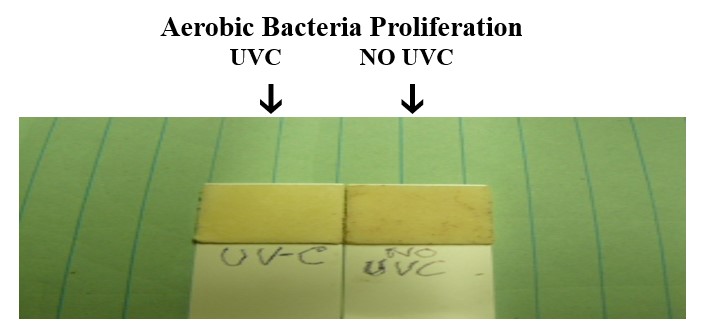
Conventional UVC devices should never be applied or used on human skin surfaces at any range; therefore, to determine the efficacy of UV devices emitting UVC irradiation (wavelengths between 270 to 275 nm), oral samples of 1-part (10%) human saliva to 9-parts distilled water were swab sampled prior to incubation at 25-30° C to determine UVC efficacy on aerobic bacteria, yeast, and mold proliferation.
A “Portable Deep UVC Sterilizer” that produces a wavelength of 270-275 nm was randomly selected to test its efficacy inhibiting common aerobic bacteria, yeast, and mold proliferation. The aerobic bacteria (AB) swab sample counts were determined following 24-hours incubation at 25-30° C while yeast-mold (YM) counts required 72-hours incubation at 25-30° C. The Biosan Laboratories Sani-Check AB and YM Test Swab Samples consisting of 1-part saliva to 9-parts pure water were utilized for counting aerobic bacteria, yeast, and mold samples. A male subject submitted swab samples to measure AB and YM counts per square inch.
| Microbial Count Post-Incubation Biosan Laboratories Sani-Check Aerobic Bacteria, Yeast, Mold Swab Samples 10% Saliva:90% Solution | ||
| AEROBIC BACTERIA 24-hours Incubation 25-30° C | YEAST 72-hours Incubation 25-30° C | MOLD 72-hours Incubation 25-30° C |
| NO UVC 10,000 in2 | NO UVC 0 in2 | NO UVC 0 in2 |
| UVC 0 in2 | UVC 0 in2 | UVC 0 in2 |
UVC applications to inanimate surfaces producing wavelengths ranging from 270-275 nm are shown to completely inhibit aerobic bacteria proliferation in human saliva:H2O swab samples (1:9) following incubation. It has also been confirmed:
“Exposure of cells to UVC triggers a global response, which can either counteract the deleterious effects by enabling DNA repair or lead to apoptosis. If the number of hits at viral, bacterial or cellular DNA or RNA exceeds the repair capacity, cells will die or host cells will be unable to allow replication of the respective virus. UVC radiation has been shown to destroy the outer protein coating of the SARS-Coronavirus, which is a different virus from the current SARS-CoV-2 virus.”10,11
No yeast-mold was produced in human saliva:H2O solute swab samples.
“UV light disinfection works by using a device that can either be handheld, mobile, or standalone. The UV-C disinfection device emits UV-C light, which targets the microorganisms, destroying their DNA. That’s because, when exposed to electromagnetic radiation within a particular wavelength, the genetic material of the microorganisms is modified. This limits the ability of the microorganisms to reproduce, preventing their spread on surfaces within a space. A UV-C disinfection device targets DNA to cause thymine or cytosine dimer formation. It also goes after RNA to trigger uracil dimer formation. Thymine, cytosine, and uracil inactivate the microbes, causing mutation, failure to reproduce, and eventual death. A study funded by the Centers for Disease Control and Prevention (CDC)shows that UV-C disinfection devices can enhance hospital disinfection by effectively eradicating MRSA, VRE, Acinetobacter, and C. difficile under experimental conditions. Their data confirm that automated UV-C-emitting devices can decrease the bioburden of important pathogens in real-world settings such as hospital rooms.”12
Declaration: Bill Misner financed the cost of this project to determine the efficacy of a Chinese-made “Portable Deep UVC Sterilizer” that produces a wavelength of 270-275 nm to completely inhibit commensal aerobic bacteria proliferation. No competing interests herein are proclaimed.
References
- Ma B, et al. UV Inactivation of SARS-CoV-2 across the UVC Spectrum: KrCl* Excimer, Mercury-Vapor, and Light-Emitting-Diode (LED) Sources.
- Beck SE, et al. 2014. Wavelength dependent UV inactivation and DNA damage of adenovirus as measured by cell culture infectivity and long range quantitative PCR. Environ Sci Technol 48:591–598.
- Hull NM, Linden KG. 2018. Synergy of MS2 disinfection by sequential exposure to tailored UV wavelengths. Water Res 143:292–300.
- Linden KG, Hull N, Speight V. 2019. Thinking outside the treatment plant: UV for water distribution system disinfection. Acc Chem Res 52:1226–1233.
- Kowalski W, Bahnfleth W, Hernandez M. 2009. A genomic model for predicting the ultraviolet susceptibility of viruses. IUVA News 11:15–28.
- Beck SE, et al. 2017. Evaluating UV-C LED disinfection performance and investigating potential dual-wavelength synergy. Water Res 109:207–216.
- Jinadatha C, et al. Evaluation of a pulsed-xenon ultraviolet room disinfection device for impact on contamination levels of methicillin-resistant Staphylococcus aureus. BMC Infect. Dis. 2014;14:187. doi: 10.1186/1471-2334-14-187.
- Ponnaiya B, et al. Far-UVC light prevents MRSA infection of superficial wounds in vivo. PLoS One. 2018;13(2):e0192053. Epub 2018/02/22. pmid:29466457; PubMed Central PMCID: PMC5821446.
- Paz MO, et al. COVID-19 outbreak: Should dental and medical practices consider uv-c technology to enhance disinfection on surfaces? – A systematic review. J Photochem. 2022 Mar; 9: 100096.
- Cadet J, Sage E, Douki T. Ultraviolet radiation-mediated damage to cellular DNA. Mutat Res. 2005;571:3–17.
- Sinha RP, Hader DP. UV-induced DNA damage and repair: a review. Photochem Photobiol Sci. 2002;1:225–236
- Anderson DJ, et al. Decontamination of Targeted Pathogens from Patient Rooms Using an Automated Ultraviolet-C-Emitting Device. Infect Control Hosp Epidemiol. 2013 May; 34(5): 466–471.
Published May 6, 2023








0 Comments