
The
U.
S. Cancer Program and Specific Types of Cancers, 1975–2007: A Failure – Part 2
by Anthony D. Apostolides, PhD, and Ipatia K. Apostolides, BA
article@pattyapostolides.com
Introduction
In a recent article, we assessed the US cancer program by analyzing the overall incidence and mortality rates of all cancers combined.1 This study uses the same framework of analysis to assess the US program on the prevention and treatment of 24 specific types of cancer – in three parts and in alphabetical order. Part 1, published in the Aug./Sept. issue of the Townsend Letter, assessed cancers from bladder to kidney. Part 2 assesses seven cancers: Leukemia, liver, lung, melanoma, mesothelioma, myeloma, and non-Hodgkin’s lymphoma. 2
Data
The data were primarily obtained from the SEER-9 (Surveillance Epidemiology and End Results) database of NCI.
Analysis
The statistics used for the analysis are presented in chart form. During the period 1975–2007, we calculated the following charts: (1) The incidence rate – to include overall rates, and rates for males and females; (2) The number of Americans afflicted with the cancer; (3) The mortality rate – to include overall rates, and rates for males and females; and (4) The number of Americans who died from that cancer. Due to space limitations, only a few of the charts are presented in this article. The complete set is provided in the long version of the article, available online at TownsendLetter.com.
Two criteria were used to assess the program of the National Cancer Institute (NCI) in preventing cancer: the incidence rate and the number of Americans afflicted by a cancer. A constant or increasing incidence rate over time, along with increased numbers of those afflicted, indicates a failure of the NCI program in the prevention of a cancer. Also, if the incidence rate declines but the number of people afflicted increases, the prevention program is deemed to be a failure. A declining incidence rate, along with a declining number of those diagnosed with the cancer, however, indicates success in the prevention of a cancer.
The criteria used to assess the treatment side of the NCI program were the mortality rate and the numbers of Americans who died from a cancer. A constant or increasing mortality rate of a cancer over time, along with increased numbers of deaths, indicates a failure of the NCI program in the treatment of a cancer. Also, if the mortality rate declines over time but the number of deaths increase, the program for the treatment of that cancer is shown to be a failure. If the mortality rate declines over time and the number of deaths decline, this indicates success in the treatment of a cancer.
Leukemia
The overall incidence rate of leukemia increased from 12.8 per 100,000 population in 1975 to 14 in 2007. Moreover, males had significantly higher incidence rates than the females. In 1975, the incidence rate of males was 16.9, while that of the females was 10, and by 2007, the rate of males had risen to 18.3, while that of the females had increased to 10.8.
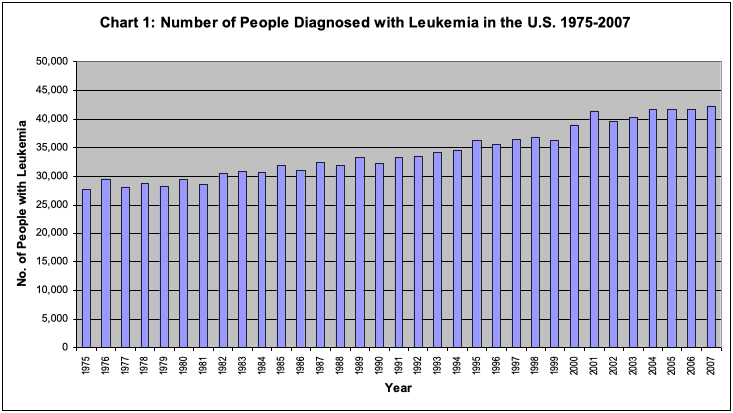
The number of Americans afflicted with leukemia increased significantly from 27,601 in 1975 to 42,270 in 2007 (Chart 1). The total number of people diagnosed with leukemia during the analysis period totaled 1.1 million.
The overall mortality rate of leukemia decreased from 8.1 in 1975 to 7.0 in 2007. This represents a decline of −0.45% (or 0.0045) per annum – a very small magnitude.
In addition, the mortality rate of the males was 11 in 1975, while that of the females was 6, and by 2007, the rate of the males declined to 9.4 while that of the females was 5.3.
The number of deaths from leukemia increased from 17,472 in 1975 to 21,120 in 2007. The total number of deaths from leukemia during 1975–2007 reached 659,574. The ratio of those who died from leukemia to those who were stricken with that cancer indicates that, on average, 58% of Americans diagnosed with leukemia will die from it. That is a grim statistic.
Cancer of the Liver and Intrahepatic Bile Duct (Invasive)
The overall incidence rate of liver cancer surged from 2.6 in 1975 to 7.2 in 2007. In 1975, the incidence rate of males was 3.9, while that of the females was 1.6. By 2007, the incidence rate of males had surged to 11.2, while that of the females had increased to 3.8.
The number of Americans struck with liver cancer rose rapidly from 5,702 in 1975 to 21,844 in 2007 – representing an amazing 283% increase. The total number of Americans afflicted with liver cancer during 1975–2007 was 378,311.
The overall mortality rate of liver cancer increased significantly, from 2.8 per 100,000 population in 1975 to 5.4 in 2007 (Chart 2).
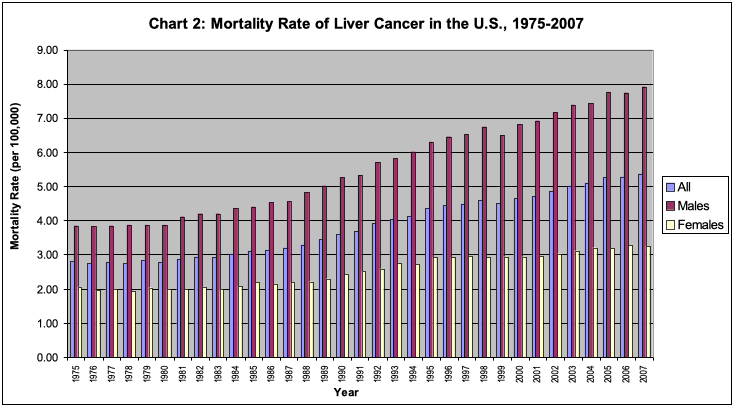
The mortality rate of the males was 3.8 in 1975, while that of the females was 2. By 2007, the rate of the males had climbed to 7.9, as compared with 3.2 for the females. The faster increase in the mortality rate of the males than of the females over time resulted in a widening gap between the two genders.
The numbers of Americans who lost their lives to liver cancer jumped from 6069 in 1975 to 16,202 in 2007. The total number of deaths from liver cancer during this period reached 332,421. This indicates that, on average, 88% of Americans afflicted with liver cancer will die from the disease.
Cancer of the Lung and Bronchus (Invasive)
Lung cancer had the highest incidence rate of any other cancer studied. The overall incidence rate rose from 52 per 100,000 population in 1975, to 61 in 2007.
In 1975, the incidence rate of males was a remarkable 90, much higher than that of the females, which was 25. By 2007, the incidence rate of males had declined to 72, while that of the females had risen to 53. Consequently, the gap between the two genders narrowed over time.
In 1975, the number of Americans diagnosed with lung cancer was 112,867 (Chart 3). That high number escalated to 186,543 in 1998, and by 2007 had reached 180,000. The total number of Americans diagnosed with lung cancer during 1975–2007 totaled a shocking 5.4 million.
The overall mortality rate of lung cancer was 42.6 in 1975 and peaked in 1989, at 58. Subsequently, it began a gradual descent, reaching 50.7 in 2007. However, that rate was still noticeably higher than in 1975.
The mortality rate of males in 1975 was 74.5, much higher than that of the females, at 17.6. After 1991, the rate for the males declined – reaching 65.2 in 2007 – while that of the females continued to rise to 40 in 2007.
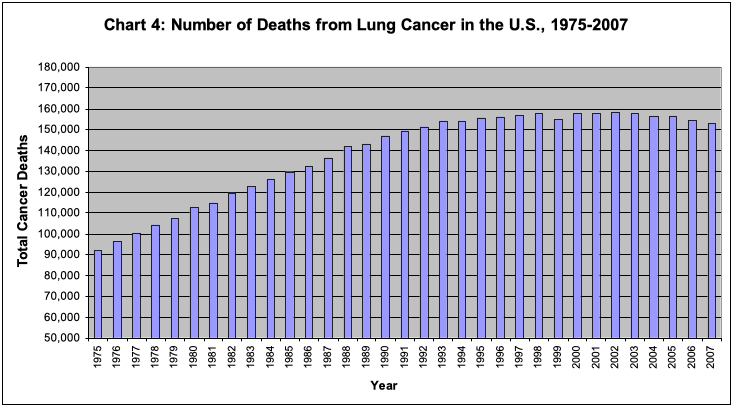
In 1975, 91,918 Americans died from lung cancer, and by 2007 that number jumped to 152,539
(
Chart 4). The total number of deaths from this cancer during this period was a shocking 4.6 million. That number indicates that, on average, 85% of Americans diagnosed with lung cancer will die from it – a horrible statistic.
Melanoma of the Skin (Invasive)
The incidence rate of the males tripled from 8.5 in 1975 to 26.9 in 2007, while the rate of the females more than doubled, from 7.4 to 17.8. Again, the incidence rate of the males far exceeded the rate of the females.
The number of Americans who contracted this cancer climbed significantly from 17,040 in 1975 to 64,808 in 2007. That represents a remarkable 280% increase over the analysis period, or an 8.8% annual growth rate. The total number of Americans afflicted with this cancer during the analysis period totaled a remarkable 1.3 million.
In 1975, the overall mortality rate was 2.1, and by 2007 it had increased to 2.7. Both genders experienced increased mortality rates. The rate of the males rose from 2.6 in 1975 to 4.0 in 2007, while the rate of the females increased from 1.6 to 1.7. Moreover, the males experienced more of a worsening in their mortality rate over time than the females.
The number of deaths doubled from 4471 in 1975 to 8,056 in 2007. The total number of deaths from melanoma during the analysis period was 219,602.
Mesothelioma
In 1975, the overall incidence rate of mesothelioma was 0.6, and in 2007 it had reached 0.96. With regard to gender, the incidence rate of males in 1975 was 1.0, while that of females was 0.3; and by 2007 the rate of the males had risen to 1.7, while it was 0.4 for the females.
The number of Americans diagnosed with mesothelioma rose from 1361 in 1975 to 2896 in 2007. The total number of Americans diagnosed with mesothelioma during the analysis period was 83,902.3
Myeloma
The overall incidence rate of myeloma increased by 20% over 1975–2007, rising from 4.91 in 1975 to 5.97 in 2007. The incidence rate of males in 1975 was 6.4, while the rate of females was 3.9. Over time, the situation for both genders worsened so that by 2007, the incidence rate of males had risen to 7.8, while the rate of females had reached 4.6.
The number of Americans afflicted by myeloma also increased substantially over time – from 10,604 in 1975 to 18,012 in 2007; a notable 70% increase. The total number of Americans afflicted with myeloma during the analysis period reached 474,101.
The overall mortality rate of this cancer rose from 2.9 in 1975 to 3.5 in 2007. With regard to gender, in 1975 the males once again had a higher mortality rate (3.7) than the females (2.4). Moreover, the mortality rate of males rose faster than that of the females, to reach 4.4 by 2007, while the rate of females increased to 2.8.
The number of Americans who lost their lives to this cancer also increased substantially over time – from 6,350 in 1975 to 10,469 in 2007. The total number of deaths from myeloma during the analysis period was 305,693. This indicates that on average, 64% of Americans afflicted by this cancer will die from it – a grim statistic.
Non-Hodgkin’s Lymphoma
In 1975, the overall incidence rate of non-Hodgkin’s lymphoma was 11, and by 2007, it had climbed to 21. That is, it grew by 91% over time. The incidence rate of both genders increased significantly over the analysis period. Men once more had a higher incidence rate than women (13 versus 10 in 1975), and that difference increased over the analysis period (26 for men versus 17 for women, in 2007).
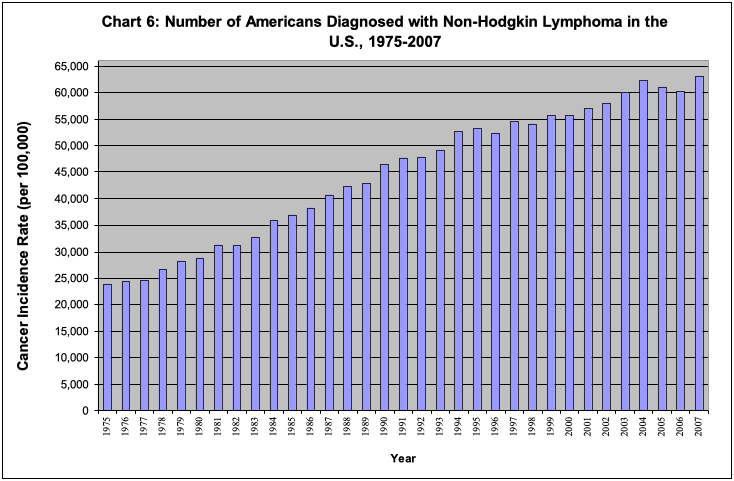
Moreover, the rapidly increasing incidence rate resulted in an ever-increasing numbers of Americans being afflicted by this cancer over the analysis period (Chart 6). That number was 23,887 in 1975 and climbed significantly to 63,028 by 2007.
The total number of Americans afflicted with non-Hodgkin’s lymphoma during the period of analysis totaled a significant 1.5 million.
Data on the mortality rate of non-Hodgkin’s lymphoma also indicate a failing US cancer program in treating this cancer. The overall mortality rate increased from 5.6 in 1975 to 6.5 in 2007. The mortality rate of both men and women also increased over the period of analysis. In 1975, the mortality rate of the males was 7, while that for the females was 4.7; and by 2007, the rate had reached 8.3 for the males and 5.2 for the females.
In 1975, 12,000 Americans died from non-Hodgkin’s lymphoma and this number grew by over 100% to reach 24,235 in 1997; it then decreased to 19,672 in 2007. That number, however, was still much higher than in 1975. The total number of Americans who lost their lives to non-Hodgkin’s lymphoma during the period of analysis totaled 622,451. This indicates that on average, 42% of Americans diagnosed with non-Hodgkin’s lymphoma will die from it.
Conclusions
The analysis over 1975–2007 showed increasing incidence rates and rising numbers of those afflicted for 7 out of 7 cancers: (1) leukemia; (2) liver cancer; (3) lung cancer; (4) melanoma; (5) mesothelioma; (6) myeloma; and (7) non-Hodgkin’s lymphoma. This indicates a failing US/NCI cancer program in the prevention side of these cancers.
In all seven cancers, the incidence rates of males were significantly higher than those of the females, and increased faster over time.
Our study also found a failing US/NCI program in the treatment of 6 out of 6 cancers (mortality data are not available for mesothelioma), as indicated by rising or constant mortality rates and rising numbers of deaths; or declining mortality rates but rising numbers of deaths. These cancers are: liver, lung, melanoma, myeloma, non-Hodgkin’s lymphoma, and leukemia.
In addition, mortality rates of males were greater than those of females for all cancers assessed, and they increased faster over time.
An effective national program in the prevention of cancer requires two necessary components: (1) discovery of the carcinogenic substances through research; and (2) regulatory authority to ban, or regulate, those carcinogens. The NCI program failed dismally in cancer prevention for these seven cancers because the second component is missing. The NCI essentially does not have the power to regulate carcinogens. Without that power, it cannot enforce the prevention of cancer. The results of our analysis can attest to that lack of cancer prevention.
The NCI’s announcements of its involvement in “cancer prevention” are misleading and deceptive, since they give the public the perception that it actually does work to prevent cancer. In reality, it only carries out research on those issues, without the implementation work. And nothing else of a regulatory nature follows those studies. It would seem that the cancer prevention system of the US was designed to fail.
Increasing mortality rates over 1975–2007 of the six cancers also indicate a failing US/NCI program of cancer treatment. Currently, there are three basic conventional approaches to treating cancer, approved by NCI and the Food and Drug Administration: surgery, radiation, and chemotherapy. It is obvious that the use of those modalities has been a failure at cancer treatment for these six cancers. There are other treatments available, the “alternative” treatments. However, NCI has not encouraged research on those treatments. The alternative treatments have faced many obstacles from the federal or state governments, including the regulatory section of the Food and Drug Administration and state medical societies. These obstacles are revealed in Politics in Healing – the Suppression and Manipulation of American Medicine, by D. Haley (2005). As we mentioned before, “It seems unthinkable that the US, which professes to champion freedom around the world, does not offer the same freedom to its people in their choice of cancer treatment.” 4
The failures on both the prevention and treatment sides call for a basic restructuring of the National Cancer Institute and the US cancer program. On the prevention side, these changes should include the creation of an agency that has both research capabilities and regulatory authority to regulate/ban carcinogens. On the treatment side, and given the limitations of conventional cancer treatments, there should be a strong emphasis on encouraging the funding, by the government, and testing of a substantial number of alternative cancer treatments. This will require thoughtful planning and direct involvement by the federal government; that is, the president and Congress.
Notes
1. Apostolides AD, Apostolides IK. The US Cancer Program, 1975–2006: A Failure. Townsend Lett. Aug/Sept 2010; Part 1; October 2010; Part 2.
2. Part 3, to be published in a future issue of this journal, will cover the remaining types of cancer in alphabetical order.
3. Data on mortality of mesothelioma are not available for 1975–2007. That cancer cannot be identified as the cause of death in versions of ICD (International Classification of Diseases) prior to version 10. So SEER can only identify deaths from mesothelioma for 1999 and beyond, according to information from SEER staff.
4. Apostolides AD, Apostolides IK. The US Cancer Program, 1975–2006: A Failure. Townsend Lett. Oct 2010; Part 2.
References
Fagin D, Lavelle M., Center for Public Integrity. Toxic Deception – How the Chemical Industry Manipulates Science, Bends the Law and Endangers Your Health. Monroe, ME: Common Courage Press; 1999.
Faquet GB. The War on Cancer: An Anatomy of Failure, A Blueprint for the Future. Dordrecht, Netherlands: Springer; 2005.
Gofman, JW. Radiation and Human Health: A Comprehensive Investigation of the Evidence Relating Low-Level Radiation to Cancer and Other Diseases. San Francisco: Sierra Club Books; 1981.
Gould JM et al. The Enemy Within – The High Cost of Living Near Nuclear Reactors. New York: Four Walls Eight Windows; 1996.
Hailey D. Politics in Healing – The Suppression and Manipulation of American Medicine. Washington, D.C.: Potomac Valley Press; 2005.
Markowitz G, Rosner D. Deceit and Denial – The Deadly Politics of Industrial Pollution. Berkeley, CA: University of California Press; 2003.
Nader R, Abbotts J. The Menace of Atomic Energy. New York: W. W. Norton and Co.; 1977
National Research Council, Board of Radiation Effects Research. Health Risks from Exposure to Low Levels of Ionizing Radiation – BEIR VII PHASE 2. Washington, D.C.: National Academies Press; 2006.
SEER-9 (Surveillance Epidemiology and End Results). Cancer statistics review 1975–2007 [online document]. Available at: www.seer.cancer.gov/statistics.
Sherman JD. Life’s Delicate Balance – Causes and Prevention of Breast Cancer. New York: Taylor & Francis; 2000.
United States Bureau of the Census. Population. In: Statistical Abstract of the United States.
Yablokov AV, Nesterenko VB, Nesterenko AV, Sherman JD consulting editor. Chernobyl – Consequences of the Catastrophe for People and the Environment. Reprint of volume originally published by the New York Academy of Science in 2009.
.
Anthony D. Apostolides, PhD, received a doctoral degree in economics from the University of Oxford, UK, and an MA degree from the University of Pittsburgh. He has taught on health-care economics and related fields at the university level; and carried out research in health care economics and delivery. He was engaged in research at the UN, Economic Commission for Europe and The Conference Board. He also worked for the State of Maryland, Department of Health; and for the federal government. His publications include articles in peer-reviewed journals.
Ipatia K. Apostolides, BA, has a bachelor’s degree in biology from Case Western Reserve University and several years’ graduate coursework. She has worked in the cancer field for over 15 years – as a laboratory manager and data manager at the Cleveland Clinic, and as data manager at the Children’s Hospital Bone Marrow Transplant Center in Cincinnati. She was also supervisor in the PLCO study at Georgetown University. She has coauthored several medical articles related to cancer.








0 Comments