
SPONSORED ARTICLE
Extracts of Pao Pereira and Rauwolfia Vomitoria
Show Promise to Enhance Prostate Health
by Morton Walker, DPM
As an 82-year-old male, I have long been interested in ways to enhance prostate health. As a medical journalist, I have written many articles on men’s health and the importance of alternative methods for treating urogenital ailments.1
My most recent publication, Cancer’s Cause Cancer’s Cure: Finally the Truth About Cancer, Its Causes, Cures, and Prevention (Hugo House Publishers Ltd.; 2012) leads a medical consumer through the journey of the noteworthy discoveries of microbiologist Mirko Beljanski, PhD. Readers of the Townsend Letter will be familiar with Beljanski’s research on the effect that environmental carcinogens have on the secondary structure of DNA as well as the powerful botanical extracts that Beljanski discovered: Pao pereira (geissospermum) and Rauwolfia vomitoria, which have shown great promise in suppressing tumors, including prostate tumors, without damaging healthy cells.
This article, however, is not about prostate cancer per se. Rather, I want to explore the possibilities of using Pao pereira and Rauwolfia vomitoria to enhance as well as restore prostate health. Enhancing or restoring prostate health has two very specific indicators: (1) lowering elevated prostate specific antigens (PSA) to acceptable levels and then maintaining those levels; and (2) keeping men from experiencing the debilitating effects of benign prostatic hyperplasia (BPH).
Prostate health, prostate cancer, and BPH are closely related. Ronald E. Wheeler, MD, who specializes in overcoming prostate illness, confirms, “BPH is the most commonly diagnosis made by urologists for men between the ages of 45 and 74.”2 According to the American Cancer Society, while 1 in 6 men will be diagnosed, only about 1 in 36 will die from prostate cancer. In other words, most men diagnosed with prostate cancer do not die from it.3
Natural Botanicals as Preventive Agents
Given that both prostate cancer and BPH occur with such relatively high frequency in men, prevention rather than treatment offers the best line of defense.
Aaron Katz, MD, was the director of the Center for Integrative Urology and Holistic Medicine in the Department of Urology at Columbia University Medical Center. Melissa Burchill, RD, CDN, notes that Katz’s group “focused on complementary treatment modalities for men experiencing both benign and malignant prostate problems. Their goal is to identify [plant] extracts and natural [botanicals] that would benefit prostate and bladder cancers.”4
Since 2006, Katz’s team has confirmed that Beljanski’s Pao pereira and Rauwolfia vomitoria are two natural botanical extracts that show promise in prostate and bladder cancers.5 In an in vivo study with mice, both extracts reduced overall tumor volume.
In 2006, Debra L. Bemis, PhD, and her colleagues reported that a β-carboline alkaloid enriched extract from Rauwolfia vomitoria “is an effective inhibitor of cell growth in the human prostate cancer cell line, LNCaP, in both cell culture and in vivo tumor xenograft experimental systems.” The data suggest that the Rauwolfia vomitoria extract affects overall tumor volume by reducing tumor cell proliferation.6
The Columbia team then studied a β-carboline-rich extract of Pao pereira bark. The researchers found that, in a dose-dependent manner, and like the Rauwolfia vomitoria extract, the Pao pereira extract suppressed the growth of LNCaP and induced apoptosis (cell death).7
The results of these preclinical studies prompted the Center for Holistic Urology to embark on a phase 1 clinical trial using a combination of the Pao pereira and Rauwolfia vomitoria extracts for men with high risk of developing prostate cancer The test group consisted of men with elevated levels of prostate specific antigen (>2.5 ng/dL) but showed no clinical signs of prostate cancer (based on a negative biopsy report).8
Commenting on the initial results of the study, Katz said that a combination of Pao pereira and Rauwolfia vomitoria “can produce favorable health benefits and give men the opportunity to do something positive to reduce their risk for more serious outcomes. Yet, [the plan extracts have] no side effects, [are] not a drug, and [are] well tolerated.”9
Katz went on to report that the preliminary data are showing that the two extracts combined “significantly lowered PSAs in a 12-month period. Also we have had very few patients convert to prostate cancer and have found a number of patients who have had a dramatic improvement in their urinary symptoms. Men are clearly having less frequency, better streams, and better flow rates.”9
If enhancing prostate health is the goal, then from the results of the in vitro, in vivo, and clinical studies, one may infer that Beljanski’s botanical extracts could keep the prostate gland healthier causatively instead of reactively.
In other words, if the study shows that a number of patients show dramatic improvement, perhaps the two natural extracts could work preventively. Why wait for elevated PSA counts to benefit from Pao pereira and Rauwolfia vomitoria?
Beljanski, DNA Destabilization, and Prostate Health
To answer that question, it is necessary to quickly review the original research of Mirko Beljanski into the environmental causes of cancerous DNA.
He spent 40 years at his laboratory bench studying RNA and DNA, which led to the development of what he called DNA destabilization, a theory about a mechanism for the development of cancer.
Beljanski’s new idea was that rather than just changes in the primary structure of DNA – the basis of the predominant theory for the development of cancer, cancer as mutagenic – changes in the secondary structure of DNA might contribute to the development of cancer. The secondary structure of DNA relates to the hydrogen bonding that takes place between the two strands of DNA. He observed that carcinogenic substances always interfere with some of the hydrogen bonds that maintain the two strands of the double helix together, causing the formation of openings or loops between the strands. When this occurs, the DNA becomes destabilized, increasing the risk of a cell becoming cancerous.10
Figure 1: Illustration of the destabilization of DNA caused by binding of carcinogens. Binding of carcinogens disrupts the hydrogen bonds that maintain the DNA duplex and the strands of the duplex are separated. Enzymes for DNA replication have increased access to the initiation sites on the exposed strands and DNA duplication may be abnormally accelerated.
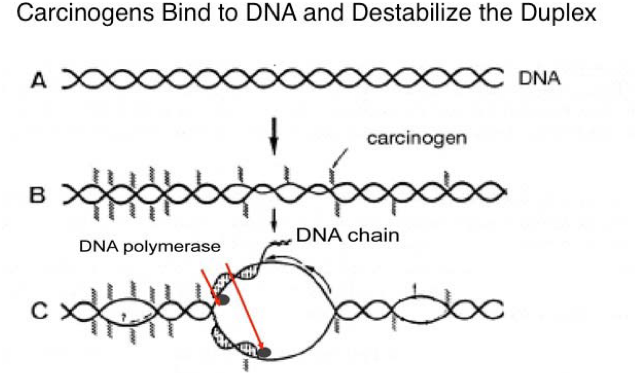
Beljanski also found that destabilized DNA is not immediately permanent. The binding of carcinogens that happens in DNA destabilization is dynamic and reversible in the early stages. It is a cumulative process and only becomes permanent when many strands of DNA have been destabilized. At a certain point, the DNA does not close any longer, which explains the accelerated proliferation of cancer cells. 11
Given that men are constantly bombarded with carcinogenic substances, prostate DNA is constantly under attack. That is what makes the extracts of Pao pereira and Rauwolfia vomitoria so promising when looking to enhance prostate health causatively. As the extracts of the two botanicals can cause apoptosis in cells with destabilized DNA, ingesting the two extracts to counteract the destabilized DNA while it is still in its dynamic and reversible early stages is a highly effective strategy. In case there are cancerous cells, the plant extracts induce the apoptosis of these cells.
Real Men with Real Results
As most studies are concerned with the science behind a potential natural solution to prostate problems, rarely do we have the chance to enjoy actual anecdotal evidence that a natural product is working. Such anecdotal evidence abounds with the Pao pereira and Rauwolfia vomitoria extracts. For example, urogenital illness patient Rod W., of Denver, Colorado, writes:
I feared the worst when my doctor told me that I had a PSA count of 19. My doctor told me it was almost certainly prostate cancer, and it had probably metastasized. I found out about [the Beljanski remedies]. I was skeptical, but I took them. Six weeks later my PSA count was down to seven. Then it slipped to five and has stayed there for over a year.
This is not an uncommon occurrence. Many men have experienced equally dramatic results with the plant extracts. Henri Boiteux, PhD, a resident of southern France and retired as professor of physics at the University of Paris, had been administrator of the Department of Scientific Research at his country’s prestigious National Scientific Research Center (the CNRS). In 1994 he was diagnosed with prostate cancer. He knew of Beljanski’s botanicals and, at the suggestion of an alternative health-care physician, began taking them.
Professor Boiteux, who was sometimes unable to bring on a urine stream, ingested the plant extracts faithfully; and within a very short time the frequency of his urinary urgency reduced from up to six times per night to just three. But while the urgency to urinate began to diminish, he found that his urine contained some blood. Men with prostate disease are likely to identify with these same prostatic difficulties. But within a month to six weeks of taking the plant extracts, all of Boiteux’s prostatic disease signs and symptoms improved.
By May 1995 the prostate pathology had completely disappeared and his PSA was down from 9.6 ng/ml to essentially normal at 4.0 ng/ml. Boiteux remains cancer free to this day because he takes a preventive round of the Beljanski botanicals. Not only that, his arthritic knee also does not give him problems as long as he takes Pao pereira routinely, not surprising given that Pao pereira is now showing anti-inflammatory properties.12
Pao pereira Anti-Inflammatory Properties
The anticancer effects of the Pao pereira and Rauwolfia vomitoria plant extracts are well documented, but their anti-inflammatory effects are just beginning to be appreciated. Beljanski published one study showing that the Pao pereira extract suppresses the activity of the cytokine, interleukin (IL)-6, a major inflammatory pathway.13
As noted above, in the phase 1 trial at Columbia University Medical Center, Katz found that men with BPH reported significant improvement in their urinary symptoms. Experiments are now under way to discover the full extent of the anti-inflammatory effects of the Pao pereira and Rauwolfia vomitoria extracts. It will be interesting to see the effects of the extracts on the specific inflammatory pathways that are activated in men with BPH. 12
Conclusion
Cancer prevention studies are notoriously difficult to conduct. However, the data that urological medicine has available to us, from in vitro, in vivo, and phase 1 trials concerning the extracts of Pao pereira and Rauwolfia vomitoria, are highly suggestive that the extracts of these two botanicals discovered by Mirko Beljanski, PhD, could enhance prostate health prior to the occurrence of malignant or nonmalignant problems. Men in Europe have used the extracts for many years to safely maintain their prostate health. Men in America deserve the same.
Notes
1. Walker M. The urologist with zero tolerance for prostate problems. Townsend Lett . April 2001;201:78–82; . You can restore prostate health. Explore. 1998;8(5) :28–35; Sereenoa repens extract (saw palmetto) relief for benign prostatic hypertrophy (BPH). Townsend Lett. February/March 1991:107–110 ; Astounding herbaceutical corrects prostatitis and benign prostatic hyperplasia. Explore. 1997;7(6):36–42 ; Prostate troubles, hemorrhoids & heat therapy. Healthy Nat J. 76–77.
2. Interview with Ronald Wheeler. April 5, 2012.
3. American Cancer Society. Prostate cancer [online article]. http://www.cancer.org/Cancer/ProstateCancer/DetailedGuide/prostate-cancer-key-statistics. Last revised February 27, 2012. April 3, 2012.
4. Burchill M. Two herbal extracts for protecting prostate cell DNA. Integr Med. Apr/May 2010;9(2).
5. Steinman D. Dr. Beljanski’s innovative approach to cancer. Doctors Prescript Health Living. 2008;11(12):18–20. See also Bemis DL et al. Anti-prostate cancer activity of a B-carbline alkaloid enriched extract from Rauwolfia vomitoria. Int J Oncol. 2006;29:1065–1073.
6. Bemis DL, Capodice JL, Gorroochurn P, Katz AE, Buttyan R. Anti-prostate cancer activity of a B-carboline alkaloid enriched extract from Rauwolfia vomitoria. Int J Oncol. 2006;29:1065–1073.
7. Bemis DL, Capodice JL, Desai M, Katz AE, Buttyan R. B-carbline alkaloid-enriched extract from the Amazonian rain forest tree Pao pereira suppresses prostate cancer cells. J Soc Integr Oncol. Spring 2009;7:59–65.
8. Steinman D. Dr. Beljanski’s innovative approach to cancer. Doctors Prescription Health Living. 2007;11(8):30–32.
9. Interview reported in Burchill, op cit. Original interview appeared in Steinman D, ibid.
10. Schachter MB. Integrative oncology for clinicians and cancer patients: part 4. Townsend Lett. Dec. 2011:92–97. See also Beljanski M. Oncotest: a DNA assay system for the screening of carcinogenic substances. IRCS Med Sci. 1979;47 :218–225.
11. Hall JL. DNA destabilization, cancer, and inflammation. First published as Chapter 6. Anti-Aging Therapeutics Vol. 13:53–64.
12. Walker M. Cancer’s Cause, Cancer’s Cure: The Truth About Cancer, Its Causes, Cures, and Prevention. Denver: Hugo House Publishers; 2012.
13. Beljanski M, Crochet S. The selective anticancer agent PB-100 inhibits interleukin-6 induced enhancement of glioblastoma cell proliferation in vitro. Int J Oncol. 1994;5:873–879.







0 Comments